
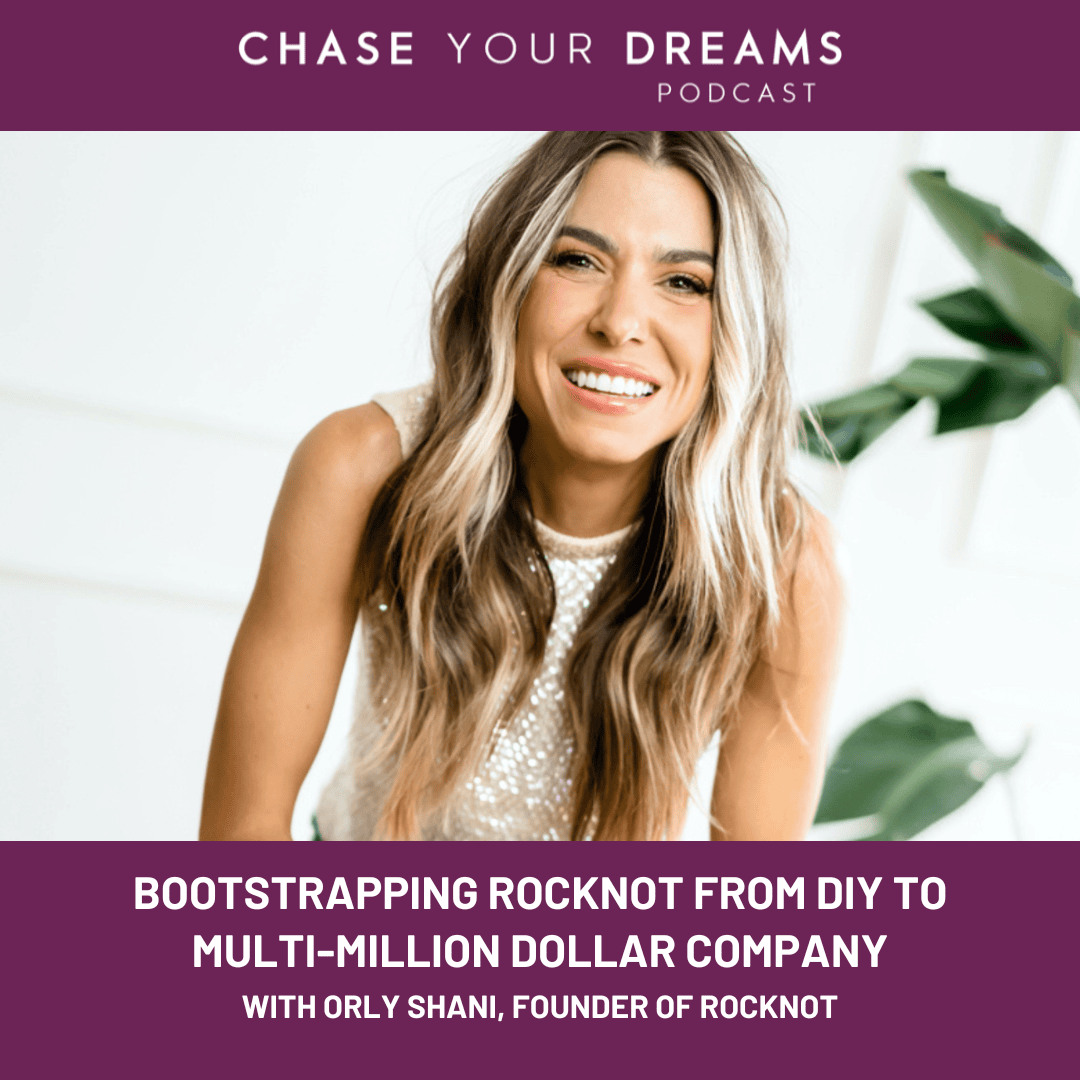
Orly Shani shares her journey from a DIY expert to the founder of ROCKNOT, a profitable and scalable fashion brand that specializes in everyday statement bags. She discusses the importance of profitability, storytelling in marketing, and the lessons learned from her DIY days. Orly highlights the significance of customer feedback in product development and the evolving nature of her brand, which aims to fill a unique gap in the handbag market. With exciting new products on the horizon, Orly reflects on the continuous journey of creativity and innovation in her business.
About Orly Shani
Orly Shani is a Los Angeles–based television host, personal style expert, and DIY innovator. Orly first gained the fashion world’s attention on NBC’s Fashion Star, where her designs were picked up by major retailers like H&M and Saks Fifth Avenue. She then went on to host and contribute to shows including E!’s The Fabulous, The Today Show, and Access Hollywood. As a lifelong DIYer and personal style expert, Orly founded ROCKNOT, a multi-million-dollar accessories brand known for its everyday statement bag system built around interchangeable straps, handbags, and accessories. Orly’s work blends creativity, practicality, and storytelling, turning everyday ideas into standout products, experiences, and profitable, scalable businesses.
Contact info
Website: rocknot.com
Instagram: @shoprocknot
Instagram: @orlyshani
Takeaways
- Orly Shani's journey showcases the power of creativity in business.
- Prioritizing profitability ensures sustainability.
- Storytelling is crucial in marketing and customer engagement.
- Personalization and individuality drive product design and customer satisfaction.
- Encourage and adapt to customer feedback.
- Quality customer service enhances brand value and customer loyalty.
- Communication strategies will differ depending on the social media platform.
Interview Themes
How does storytelling strengthen customer engagement and brand loyalty?
Storytelling helps customers understand not just what a product is, but why it matters. When brands educate and demonstrate how their products fit into everyday life, it removes confusion and builds confidence. Clear, authentic storytelling creates trust that turns first-time buyers into loyal customers.
Why is focusing on profitability essential for long-term business success?
Revenue alone doesn’t build a sustainable business—profit does. When a brand is profitable, it can reinvest, grow strategically, and operate without relying on outside funding to survive. A healthy profit margin signals that the product delivers real value and that the business model is built to last.
How should brands approach customer feedback?
Customer feedback gives insight into how products are used and perform in real life. Brands that stay flexible, by starting small and iterating often, can adapt quickly and improve without unnecessary risk. Treating constructive criticism as data, not discouragement, allows businesses to refine their products, build trust, and deepen loyalty.
Why does customer service impact brand value?
Customer service shapes the full experience of owning a product. When support is responsive and thoughtful, customers feel secure in their purchase and confident in the brand. Strong service reinforces pricing, builds credibility, and turns transactional moments into long-term relationships.
Chapters
00:00 From Creativity to Business Success
10:39 The Birth of ROCKNOT: A DIY Idea to Business
28:54 Bootstrapping for Profitability in Fashion
39:50 The Power of Storytelling in Marketing
51:41 Lessons from DIY: Personalization and Individuality
53:17 Exciting Future Developments for ROCKNOT
Transcript
Orly Shani
I think that there's a lot of intangibles when it comes to how a customer feels about the value. And I think that like a huge piece of it is your quality and your customer service. I totally get it's a splurge, no problem. But I have such confidence in the price point now because of the value that we offer across all areas, the product, the experience you have when you're wearing it in your life, the intention that's put into it. So it's versatile and multifunctional and you're getting a lot of use out of it. The customer service, and the fact that, I think that's a big part of it. I really do. The product itself is only worth so much for the customer. There is a whole other experience that they have that you really have to think about. We're customers, we've all been there, we know what it feels like. the experience like you would want for yourself. It's easy. Imagine your mom shopping. How do you hope she's taken care of? Like, what do want that to look like? Your sister, your best friend. so I feel like to me that is absolutely the most important and that's big chunks that I feel like add to the value, of the product on a whole.
Glynis Tao
Welcome to Chase Your Dreams, a podcast for fashion entrepreneurs who want to build a purposeful and profitable clothing business so they can make a living doing what they love. I'm your host, Glynis Tao, an apparel business consultant and SEO specialist with 20 years apparel industry experience. I'm also a mom to a wonderfully energetic little boy named Chase.
Glynis Tao
Today’s guest is someone who truly embodies what it looks like to turn creativity into a profitable, scalable business. Orly Shani first captured the fashion world’s attention on NBC’s Fashion Star where her designs were commissioned by major retailers like H&M and Saks Fifth Avenue. From there, she went on to host and co-host multiple fashion and entertainment shows, including E!’s The Fabulous, and became a familiar face as a style and DIY expert across platforms like The Today Show, E! News, and Access Hollywood.
But Orly didn’t stop at media success. As a lifelong DIYer and personal style expert, she noticed a gap in the market. Women wanted the glamour of a statement bag without the cost of impracticality. That insight led her to create ROCKNOT, an everyday statement bag system built around interchangeable straps, handbags, and accessories.
What started as a DIY idea has grown into a multi-million dollar brand bootstrapped, profitable, and built with intention. In this episode, we’re talking about what it really takes to go from idea to product market fit, how to build a fashion brand without chasing hype or funding, and why storytelling and clarity are just as important as great design. So let’s get into it.
Welcome Orly. It’s so nice to have you here today. Thanks for joining me on the podcast.
Orly Shani
It's my pleasure. Thanks for having me.
Glynis Tao
Orly, I'm so excited to have you here. Your career spans television, fashion, DIY, and now a multi-million dollar product brand, which is not a typical path. And that's exactly why I wanted to talk to you. You've done everything from competing on Fashion Star to hosting major fashion shows and building a brand that solves a very real problem for women.
When you look back now, what do you see as the common thread that connects all those chapters and ultimately led you to ROCKNOT?
Orly Shani
God, that's a great question because it has been a journey of unexpected redirections. I did not plan to go from A to B to C to D. But I think that one of the things that I've realized has been a big piece of all of it. It has been my driving force behind all of it is my obsession with individuality and expressing who you really are and feeling really comfortable in your skin and not thinking or feeling like you are supposed to behave or think or look like anyone else.
I felt that when I was a kid. I had this desire to be my own person and carve my own path and I felt that as I started working, the content that I created was all about how can you communicate who you are? How do you own who you are fully and without apology so that you just feel completely comfortable and confident? And so I think that that was a lot of what I did when I was doing DIY work. It was empowering people to do that on a budget because obviously it's very expensive to go out and buy the thing that fits you just right and the this and the that and the style and the whatever. Some people have really expensive taste, and so DIY was a fun way to say like, “Okay, if you are deeply inspired by this really cool new whatever Louis Vuitton gown, let's find a way to take all of that fun inspo and turn it into a jacket that you could wear on a daily basis.” What are the elements that we could apply? How are the ways that we could do it on a budget?
Even when I had my personal style concept, which I still believe is going to become a book one day. I had a book agent and had all this stuff creating it and that's a whole long story. The show that I was cast on went away and then so did the book, which was devastating. But there’s this concept of style language—the idea that we each have a unique style language, almost like a love language. It's the unique way that we communicate who we are through our physical appearance and that's really specific to each of us. Even when I was doing that and doing the online course and working with women, it just was always about understanding who you are, owning it fully, and then showing up that way.
And that's exactly what ROCKNOT is all about as well. An accessory is such a fun thing that can be worn in an entirely different way, depending on who you are and how you style it, the rest of the clothes, the hair, the makeup, the location. It just feels like it's always been about that individuality and self-expression,
Glynis Tao
Your career really took off on Fashion Star. What did that experience teach you about designing for real customers versus designing for creativity or press?
Orly Shani
You know, I would actually argue my career took off with Fashion Star because I remember so vividly when the show was on NBC, right? It came after Project Runway and it was a huge show on a huge network with big names. Elle MacPherson hosted it and Jessica Simpson and Nicole Richie and John Barbados were our judges, kind of like mentors on The Voice. And H&M, Saks Fifth Avenue were the quote unquote judges because they would buy what we designed if they liked it and that was essentially them casting a vote. I remember when we were filming it, we had all of the producers being like, “Your life is never gonna be the same when this thing comes out. You better be ready.” Because it was like it had all the makings of a hit.
One of my closest friends from the show, this guy, Zamiro, who I became very good friends with. There was maybe like a six month gap between when we filmed the show and when the show was gonna come out because they had to actually produce all of the garments. The way that the show worked is the show would air and if, let's say, H&M bid on my piece at midnight, it was available to buy. So we needed that chunk of time for them to actually manufacture the goods, have them in store, and have imagery and all of those things. So we filmed it, six month gap, and then the show came out.
And in that time, I remember he and I, we both lived in New York City and I was a bartender and he would come into my bar all the time. That's how we stayed deeply connected. And I remember he and I being like, “When this thing comes out on Tuesday, I mean, are we even gonna be able to do this? Like, are we able to sit here at this bar? Like, what are we gonna… am gonna have quit my job? Like, what's gonna happen? Like our whole, like, we're gonna be famous. Like, we're gonna get stopped in the streets. We're gonna be taking… we can't take the subway anymore. Like, what are we doing?”
Glynis, that is not what happened, okay? I bartended straight through the entire airing of that show up until the finale, I was behind the bar working because not a damn thing changed. Nothing. No opportunities came.
Glynis Tao
I mean, did you even get recognized on the street?
Orly Shani
No. Nothing. None of those things happened. They had some press events and we went to press events and they made us feel special because we were the cast. They took our picture and did our thing. In real life, nobody gave a shit and nothing changed. Literally nothing changed. And I stayed bartending until how many years later?
I got pregnant with my son when we were living in the city and I was hired on season two of Fashion Star to be like a behind-the-scenes correspondent because they were basically like, “Season one wasn't a huge hit and we think it's because the show is too big. It's like shiny floor, big stage, big lights, big performances, and people aren't connecting to the designers in the way that they do intimately on Project Runway, which feels very intimate and it's a different experience.” And so they thought, we want to do a behind-the-scenes series that connects the two worlds together. And I had come out of season one, not as the winner, but as a bit of a fan favorite, according to them. So they were like, “You're the right person to be this voice because you're familiar from season one and you can kind of exist between these two worlds. And so I did a series for season two. I think it was about a year and a half later, on my first day of filming, I found out that I was pregnant and I did that. I filmed that show in LA.
As soon as that show was done, we moved from New York to LA and I stopped bartending. So like my whole career, there was nothing in the world of fashion that had come. I was bartending and then I got a job as a host. That then led me on this path of hosting and I was on E! and I had my own show on E! with Kristin Cavallari and I would do Fashion Police and Live from the Red Carpet and Live from New York Fashion Week. And then I was on this show called Home and Family and this career of me being an on-camera fashion style personality where those two things came together is what came out of that show, but it was not recognition as a designer in any way. That was just not… nothing changed in that way at all.
Glynis Tao
I guess it was sort of a launching pad for you, for your career as a TV personality. I guess you sort of had that sort of taste of what it was like, being on camera and being on a TV show and having that spotlight, but then eventually leading you to where you are now. It's never just a straight, easy path that people seem to think it is.
Orly Shani
Absolutely not. When you look back on it, it all makes perfect sense and it connects in such a way that had this not happen and this not happen and this not happen, you know? It is such a wonderful thing and I happen to be someone who is very comfortable on camera and really likes connecting and communicating with women in that medium. And so it has felt very natural for me to go along that path. I think that had I started focused as a designer only and not had this detour as like an on-camera personality at a time when social media was really developing, I think that I probably wouldn't have been… I wouldn't have been successful because I would have followed an outdated path.
Once I was more in an on-camera social media type of world, my ability to communicate what I had to offer was so much more innate and it was so much more comfortable and it was so much more a way of doing things that I think it was just kind of the perfect storm. I needed those years of building that up without actually having a brand or anything. It was really just about providing valuable content and being a teacher—teaching people how to do things for themselves. And I think, you know, had I not done that, none of this really would have happened.
Glynis Tao
ROCKNOT became a brand. It started as a DIY idea, right? Do you remember the exact moment you thought, wait, this could be a business?
Orly Shani
Yeah, I just got stopped everywhere I went. So for anyone that doesn't know, ROCKNOT is a collection of sparkling rhinestone statement straps and those straps click onto any handbag, transforming that handbag into a statement bag. So instead of having this really beautiful piece of art, a small little statement bag that is absolutely stunning, there's no denying that, but incredibly impractical, doesn't fit things, can't be worn on a daily basis, I thought it would be really cool to have the strap be the statement piece. And that strap could switch bags because I was so obsessed with individuality and personal style. I'm like, “How am I supposed to decide what your perfect bag is? Like, are you a person who carries the wipes and the pharmacy in your bag? Like you're that person who always has all the things or you're the person who 's like a cell phone and a pack of mints.” The size of the bag, the shape, the color, the slouch, the prints, the whatever. So I liked the idea that this sparkling piece could go on any bag and it could change on a daily basis. It could change midday—that's really cool.
And so I made this DIY and I was wearing it in my regular life, but it is a damn disco ball, no joke. It sparkles like you would not believe. And so I got stopped everywhere I went and I kept sending people my YouTube video and I was like, “I don't make them. Here's my video. You can buy the materials downtown and I'll show you how to make it.” And a lot of people started making it, but a lot of people, understandably so, were like, “Girl, I'm not gonna DIY this thing. Like, I'm just trying to buy it. Just what would you charge me? Just charge me something. Tell me what it would be. I want one. I'm not gonna make it. I'm never gonna make it. I'm not that girl. Charge me.” And I said no, and I said no, and I said no, because I had had two failed clothing lines. And I was like, “I learned my lesson. Like, I'm not a designer. I'm a teacher. That's what I do. I teach. So I'm going to teach you. I'm going to teach you. I'm not interested.” And it just got to a point that it was like a joke.
My husband looked at me and he was like, “This is enough already. You gotta just make these things for people. I can't do this anymore.” Everywhere we went. I had a friend of my sister's who is very successful and can buy anything she wants from any brand she wants. She asked me to make one and I told her the same thing and she said the same thing. “I'm not gonna make it, just tell me what it'll cost, whatever, just tell me I'll do it.” And so I came up with some ridiculous number for one strap. I was like, “It's gonna be like $475.” And she's like, “Great, I will take 10 because I'm doing a Christmas dinner with my girlfriends and I'm gonna give them each one.” And I was like, what? And I'm like, she can buy whatever, so if she's buying this, there's something there.
And with that, I decided to start it and I decided to really look into what it would take to be able to make them at an affordable price because $475 for a purse strap did not feel right to me. That was very misaligned with my messaging of versatility, functionality. I wanted it to be a special piece, but I was not spending $475 for anything. So that didn't feel right to me. So it then led me on the journey of figuring things out like manufacturing and finding the materials elsewhere and all of that. It came out of customer desire and like, saying no, no, no, no, no, and eventually being like, okay, maybe this is different and maybe I need to pay attention to this reaction because I have made a DIY video every week for five years and I have never had this. This is different. And that's just, it was undeniable.
Glynis Tao
Yeah, that's your proof of concept. And you DIYing this strap and getting such a positive response to this product, right? Then I guess that's sort of what that light bulb moment went off and you went like, “Oh my God, this is it!” right? And so at the same time, like you said, you saw a gap in the market, right? A woman wanting statement bags, without the cost or impracticality.
Orly Shani
Yeah.
Glynis Tao
So what do you see as working in the existing handbag market at this time?
Orly Shani
Well, I think what I realized was that women wanted like a hack or a cheat code for feeling done and cool and polished without all of the money and all of the knowledge about what are the cool brands and what are the right silhouettes and what's in and what's out. That's exhausting for most women. Some women love it—it's a sport for them and they love it. Most women I have found are overwhelmed by it. It doesn't come naturally to them. There's an expectation and they don't feel like that girl. And so what I found was that ROCKNOT checked this box of jeans, t-shirts. With ROCKNOT, you look like you tried. And that's kind of what the gap was that it was filling. It wasn't so much that women wanted a statement bag as much as they wanted a statement that did all the talking. So they didn't have to have just the right jewelry paired with just the right shoes, paired with just the right belt like that was too much for them.
ROCKNOT really takes the most basic outfit across the finish line and that's really what worked. As the brand evolved and went from two purse straps to 70, and just purse straps to rhinestone bags, and just rhinestone bags to basic bags and leather bags and nylon bags and phone straps and all of these things, what I realize now actually is that I feel like ROCKNOT's almost carved out a brand new category in handbags. If you think about it, handbags are an absolute necessity in a woman's life, right? Like practically we need it. We need to carry our things. We need to have everything in one place. Sometimes you're just grabbing your phone and your keys. But like most of the time, women need a practical solution to carry their things.
There are two categories currently. There is an everyday basic bag, which is great because it is normally a little larger in size. It's basic and boring. It's supposed to be that way. That way, no matter what outfit you're wearing, you can grab it and go, and it's gonna work. It's just kind of supposed to disappear into the background. It's all about function over form. And then there are evening bags and statement bags that are like a work of art, and they get people talking, and they're show-stopping, and they're special, and they're outfit-making, but they are super, super limiting and delicate, and you cannot wear them on a daily basis. And so they spend more time sitting in our closet than they do in our regular life.
What I have found is that ROCKNOT has created this hybrid category where it's the glamour of a statement bag with the functionality of an everyday bag. And so you get the best of both. And if you want to click that purse strap onto a rhinestone bag for a red carpet event or a wedding, you can. If you want to click that purse strap to a belt bag and wear it to a baseball game, you can. And so that's what I have found now as the brand has grown three and a half years into it. I realized now there was a gap in the market, and we sort of smushed our way in there, but I don't think I saw that when I started. I just thought, “Man, I love the versatility of this. This is cool. She's going to get a lot out of this. She can wear this every day on any bag. That's fun. I like that.” And it was the versatility and customization that I really liked. And now that we have a full brand, I'm like, “Whoa, there was a gap and I think we smushed our way right in there.”
Glynis Tao
It's really evolved like on your website. Like you've got straps, handbags, accessories, jewelries. Like you really expanded the line.
Orly Shani
Yeah, 100%. Like even if you go to that ‘game day’ tab… if you click ‘game day’ and click the button that says ‘customize your set’, it gives you the ability, because one thing that I was realizing is I'm like, women love to look fabulous, right? Like in their own way. And for some women that is super casual, laid back, don't look like I tried. For some women that is like uber glam, bombshell. Everyone's got their style language, but a lot of women love to show up for their team, for the sports that they love, for the kids who play sports, for their college. Whatever it is, they go to a bar to go watch their college team play in some championship and they want to look the part.
We created a game day collection that is 13 rhinestone colored straps with 13 rhinestone key chains. So you can combine your team colors, but then you can separate them and still wear it for a night out. So like, for example, let's say you're a Packers fan. When in the world are you wearing a yellow and green purse strap if not just for game day? Like, you're not. Those colors together are not like a fashionable combo. You know what I mean? So like, no, you're just wearing it for game day and then it's sitting in your closet. But I was like, with the game day collection, you get a stunning emerald green strap that would look beautiful on a black clutch with a black dress for like a date night. Amazing! But you click on your yellow keychain for game day with a clear belt bag. So even that, it was like, how can I let her show up for game day? But when she's off the field, still use these pieces in her regular life so it's worth her money. Like, it's got to do a lot for her for her to spend her money on it and so everything has that multifunctionality in the way that it's designed so that if you're going to splurge on it, it's like girl math. By the time you're done, it's free. Basically, it's free, you know.
Glynis Tao
Yeah. I mean, you didn't set out to start a business, right? You just created your own strap out of thinking like, “This is something that I need”, and you started wearing it. And then it kind of took off. I mean, like, what were the early signals that told you that customers really understood and wanted this concept? And was there anything about the product that surprised you once real customers started using it?
Orly Shani
Yeah, ooh, that is such a good question. I'm gonna jump to that second one first because there is something that I think when you make something with your own two hands, you inherently know it's weak points because you made it, right? So you know how to be delicate with it where needed and where you don't need to. Your customer doesn't know that. And so customers can be rough with their products, right? They just can be, and it's not a bad thing, they just can be. And I had things break in the beginning that I was like, “I have worn mine 742,000 times and it's never broken.” But it was like, yeah, but I know it's weak points. So I'm taking it off.
Like, for example, we used to have these rope chokers that were a piece of the rhinestone cording in a magnetic clasp and it was adhered with glue and it had a lock on it. So in order to open it, you had to twist the lock and pull it out. Well, people weren't twisting the lock and pulling out—they were just pulling to try to open it. And so it was, over time, weakening the adhesive and breaking. So all of a sudden, a rhinestone cord end would come out of the clasp. And I'm like, “I've never had that happen”, but I made it. I know the clasp. So when I take it off, I reach my hand behind me, I twist and I open. Great. People aren't doing that. So even in moments like that, I was like, “We can't do these clasps anymore. It's not intuitive. People are yanking on them, we can't do these clasps anymore.” And so we had to create different clasps. We had some products that we realized the weight, it wasn't strong enough to hold the weight of an everyday heavy bag because there was an issue with the adhesive early on. So I redesigned every single strap so that there was no glue at all. It was made out of one single 20 or 30 yard piece of rhinestone that was put through the clasp, put back through the other end, and then woven back onto itself. So there was no end with cut ends sitting inside of glue. That didn't happen. So there was literally no way that this strap could ever break on a duffel bag. We changed everything.
The biggest advice that I will, if I'm given the opportunity and I can say it, I will say it to anyone that will listen, is you need to start with the smallest possible quantities allowed. And if that means you are paying double, pay double because what happens is your customers will teach you what needs to change. If you have bought into so much inventory that you can't afford to make that change or make that tweak or pull back the ones that didn't work or were broken because you bought into so much that it would literally put you out of business, you are not able to evolve and you're not able to improve.
And so because we'd started with such small quantities, when there was an issue, it was an absolute no brainer to change it. And that's it. If I had to lose the remaining inventory, I couldn't fix it, it couldn't be saved, so be it. And I had to make new ones. And I did that with every single product and I still do. My manufacturers are, I could not have gotten luckier. We will start, they'll let me start, no joke, with like five pieces. I'm like, can I just get five? And I wear mine. My sister takes one, I sell one, I do a little and I give it a month. And if we're good, we're good. And then I move forward. But it is an absolute blessing because every time I get thoughtful feedback from a customer who wears it in a way that I didn't and is like, “You know what? I really wish the inserts had a zipper. It's nice, but the snap, like I'm wearing this bag actually like all the time.”
So what I'm talking about is this. Our first, my first real bag was this bag. It's called the Transformer. It's a woven rhinestone shell with a removable vegan leather insert and I originally had it with just a snap because I thought when people are wearing it, they're just going to want to be able to reach in and grab something out of it. Well, one of the ways that I marketed it and promoted it is this is a fully functioning bag. It's got a zipper closure. It comes with its own strap. It has rings to be able to attach and detach straps to it. It's a clutch. So like, this is a great bag. People were wearing this as an everyday bag and it just had a little snap. And so I got all this feedback about like, “Could there just be a… is a zipper doable maybe?” And we come out with new colors like every year. There's 10 or 15 new colors so that you bought your rhinestone bag once and now you just buy fun colors and it constantly changes for you.
So I made the change. We did a zipper. We recessed the zipper so that there would be no visible hardware so that if you were wearing a strap with a gold clasp or a gunmetal clasp or a silver clasp, you're never gonna see it. These little bags are like little workhorses on the website. They were never intended to be a bag. They were always intended as an insert for this bag. And so little things like that. It was fine because I was only buying 100 in each color. And so by the time it was time to do a new color, I was able to say, “Okay, for this next round, I'm ordering five new colors. Can we redesign it and put zippers in them?” And I was like, “Yeah, sure. Easy.” You know what I mean? So to me, I think that the greatest gift is your customer wearing it and telling you its problems.
The five star reviews that tell you it's the most perfect thing they've ever had in their whole life is the best moment ever, always. But those reviews that are like, “I really love it. I just wish dot dot dot”, that is like my dream. Because I'm like, well, I can do that! You just wish and I can do that, no problem. And it's like, your customers are so smart, they're so smart.
Glynis Tao
Yeah.
Orly Shani
They're wearing it every day. They're putting it through the ringer. And their feedback, they're not charging you for it. You know what mean? Like it's free.
Glynis Tao
Yeah, they're literally testing it for you and giving you their feedback, which is gold in a product business.
Orly Shani
Gold. Yeah, 100%.
Glynis Tao
Like, I mean, you came up with a great design and found the product market fit fairly early on—proof of concept and demand. Then getting it made is a whole other thing, right? And being able to scale that and reproduce a product that you had previously had started as a DIY thing that you made yourself. So I think that is a whole other thing that people have to deal with. I guess I'm sure that was a big learning curve for you at the beginning, but it's just this constant refinement process, I think, in making things better based on the feedback that you receive.
Orly Shani
Yeah.
Glynis Tao
One thing that really stands out about your journey is that you bootstrapped ROCKNOT and built it profitably, which seems to be a bit rare in the fashion world these days. People often go out for funding right away. But why was profitability important to you from the beginning and how did that influence decisions that you made early on?
Orly Shani
Yeah, so it's interesting, because in the beginning I did not know what I was creating, right? I didn't set out to create what ROCKNOT is today. It was a collection of these straps that people wanted and they didn't want to DIY them. They wanted me to make them and I was just going to create a handful of these straps. That was very simple. Investment into manufacturing was easy. I could easily afford to do that. The margins on it were really strong. So when I sold through the first, I had plenty to do a little bit more and do a little bit more and do a little bit more.
And it was all done organically because I had a decent following on my social media from my previous career on camera and doing all of that work. I had this organic audience that was excited and interested in going on this journey with me and buying the products that were now finally available to them. And so there was no need for funding at the time because the investment was so small and every batch that I sold gave me a chunk to do the next one. And I didn't at the time have any overhead. I did every job. There was not a single piece of overhead other than the item itself. And then as I grew, I started doing marketing and so I brought on an ads team and we started running ads and I had a really, really small budget because I am inherently risk averse. I am willing to invest a little bit, but like, let's wait till this thing gets rolling before we invest a lot. And I found an amazing ads partner who was willing to work with me on a really low ad spend daily budget ad spend and a lot of them are not. I didn't know that going into it. So I was really annoyed when I was taking meetings where you were like, “You need to spend a minimum of like 5,000 a month.” And I was like, “5,000 a month?” Like at the time, that just seemed insane to pay their retainer plus 5k and ad spend and not know what was going to happen. And so I worked with someone who was willing to do really low ad spend and we started running these ads and it very quickly hit. We figured out what was working. We figured out how to communicate to the customer and it started working. And so then my little investment into ad spend gave me back a lot and I had even more for the next thing and even more for the next thing.
I think that in a way I never needed it. I never needed the investment for the way that I had because I didn't plan on launching a huge business where I needed to really make a big splash and do a bunch of hires and get all you know. It was like there was no need. It was fully sustainable in itself.
But I think there is also a gut. My dad is an entrepreneur. My dad moved here to the United States when he was 22 years old and didn't speak the language. He took English classes at night, started a business, and took his business. He became incredibly successful and watching him as an entrepreneur, I think that I always felt like a business needs to make money. All of these businesses that have all this revenue and there's no money. I was like, am I crazy? Like that's not a business, Like businesses have to actually make money. Businesses have to be profitable. Like to me, it didn't register as being a real business if you made no money. If your product didn't have enough of a margin to function as a business, you're broken. Like I didn't get that. That was a thing that I genuinely didn't understand. And so to me, it was like, that was the only way to do it. And I think in large part, because that's how my parents were. My parents were entrepreneurs and their business had to provide a good enough value that they could charge enough money to support themselves. And so you have to provide value if you want top dollar. And my dad was high-end in what he offered. And so the value of what he provided had to be so exceptional that it would bring back new people and new people and new people, and that there was enough when everything was paid out for him to have a beautiful life. And that to me is what a business is. And so I didn't go to business school where there were these other ideas of like, you build up a business with high enough revenue and eventually you get acquired even though there's no profit and like, they can get it profitable. Like that thing did not register to me ever. So I think that part of it was inherent without realizing it is that I just was like, that's how one does it, right? You know what I mean?
Glynis Tao
Yeah, yeah. And so many founders are struggling with pricing. This is a big topic, right? How to price your products profitably. So how do you gain confidence charging what the product was truly worth?
Orly Shani
Yeah, I think that there's a lot of intangibles when it comes to how a customer feels about the value. And I think that like a huge piece of it is your quality and your customer service, especially now with brands that are built on social media and TikTok and you see something on some cute girl and she's like, “Oh my god, look at this amazing whatever and I just got it on TikTok Shop and like it's only $20 and like isn't that cool?” And then you get it and the quality is so bad and the experience of trying to return it or trying to get it is so bad and the whole thing just leaves a really bad taste in your mouth. And then sometimes you splurge on something and it's gonna last you forever. And if there is an issue, the customer service is there to handle it and there to fix it and it's worth every dollar. Because the confidence you know that you're not out on your own, if God forbid something happens, is a huge value. So for me, customer service was always like a really big deal. And that's actually last year, not 25, but 24, like, so I guess technically two years ago, that was my big change was hiring a customer service team who's local. They're all local and they're incredible because I found myself tethered to my computer an hourly basis because if someone was introduced to ROCKNOT through Instagram, placed an order, had a concern, sent an email and didn't hear back within an hour, my worry was that they would think we were an internet scam because they've never heard of us before and they just saw us on Instagram and there's a million fake Instagram-y, TikTok-y brands that are not for real. And so I was obsessed with replying right away, replying right away, getting back to them right away so that they knew it was a real person and a real company and we got it, no problem. Yes, of course, we'll change the shipping address. You know, you wanna cancel it, you wanna add something, you got the wrong link, we got you, no problem. And so that was so overwhelming to me. And at the end of 24, we grew so much and so fast that I was drowning. I mean, I was drowning in everything that I had to do in marketing the new products and getting all the things on the webs. I had a full warehouse team at that point, but it was all of the other jobs were so overwhelming to me. And so at the end of 24, I hired a customer service team and I've had them this entire year and I get maybe 10 or 15, I'm very grateful and appreciative of this, five star reviews submitted a day on the website. And I would say 30 to 40% of them mentioned the customer service, which is fucking incredible.
Glynis Tao
Hmm, that really says something.
Orly Shani
Incredible. And I think that has a lot to do with it. I could price something because I think it looks like it's worth 200 bucks and then the experience of owning it is not worthy of $200. It's not worthy of $200. Like that's it. It's just not. So what it looks like is high value. It is beautifully made, handwoven, constructed impeccably. It's going to last you. You're gonna get the compliments in the street and God forbid you have an issue, you are taken care of. And I think that has allowed me to maintain real confidence in my price point. It used to really bother me if someone was like, “$150, what?” and get pissed. It used to like really hurt my feelings. And now I have such confidence that I'm like, it's okay.
I totally get it's a splurge, no problem. But I have such confidence in the price point now because of the value that we offer across all areas, the product, the experience you have when you're wearing it in your life, the intention that's put into it. So it's versatile and multifunctional and you're getting a lot of use out of it. The customer service…
Glynis Tao
You've thought of it all through all the touch points.
Orly Shani
Yeah, I think that's a big part of it. I really do. The product itself is only worth so much for the customer. There is a whole other experience that you really have to think about. We're customers, we've all been there, we know what it feels like. Create the experience like you would want for yourself. It's easy. Imagine your mom shopping. How do you hope she's taken care of? Like, what do I want that to look like? Your sister, your best friend. I feel like to me, that is absolutely the most important and that's big chunks that I feel like add to the value of the product on a whole.
Glynis Tao
Yeah, especially being an online DTC business too, right? You don't have that benefit of being in person—people having the customer service, one-to-one experience and holding, touching, feeling the product—so you want to ensure that people can feel confident and trust. Well, not only is the product good quality, but they'll also like to be guaranteed if anything were to happen or it doesn't work out for them, that they'll be taken care of. And so I think, you know, thinking about an entire loop from beginning to end product and beyond is really important. I think you did a really great job of that. And thank you so much for explaining it. I think that's such great insight.
Orly Shani
Exactly. Thank you. Yeah.
Glynis Tao
So you have a huge advantage that many founders don't. Having years of experience in communicating on camera and telling stories at scale from The Fabulous to the Today Show and beyond. How has a storytelling background influenced the way you market and explain ROCKNOT to your customers?
Orly Shani
You know what's so interesting? When I first started and I first hired that ads team and we were going to run ads and do the thing and it wasn't going to be organic anymore, I had this idea of what that was supposed to look like and it was based on what other brands that I admire did. And they were fabulous photo shoots and they were editorial looking pictures and it really built out something that felt aspirational. And so we started with these photos and it was mainly photo-driven and it was very glossy and it was pretty videos and slow motion. And the ads just tanked. Just nothing. No clicks, no engagement, no shopping—nothing.
I was still doing my YouTube channel at the time. I was doing both at the time for a really long time. I did a video for a DIY and at the top of the video, I was like, “Oh my God—this new necklace just launched on ROCKNOT. I just want to show you guys, I'm obsessed with it. It's really freaking cute and there's two different ways you can wear it. And so I'm just going to show you and then we'll get into the DIY.” And I filmed this necklace and it's called the Crystal Knot Necklace. It doesn't have any glue in the knot and the reason for that is so that when you're wearing it as a choker or you want to drop it down as like a low collarbone necklace, you adjust the knot so that the knot itself is always facing forward and the slope of the necklace is a natural slope because if you think about like a track, know, the innermost lane is smaller than the outermost lane. So when you're thinking about a necklace like that, if you're going to create a U shape, the outermost lane has to be bigger than the inside or it's going to flip on you. And so I was demonstrating why there's no glue and how you can wear it like this versus like this and we clipped it from my YouTube channel and we made it an ad. It exploded. And so Angie, who was in charge of my ads, was like, “Girl, screw the pretty pictures. You just need to make like a million little YouTube videos. You need to just teach. Teach like you teach on your YouTube channel. Teach about every product.” Because in our meetings, when I told her about a new arrival, I would do that. I would show it to her and I would be like, “Look at this and this part goes like this.” And I would explain everything. And she's like, “All of this that you're doing right now, this is your next ad. Do that as an ad.” And so every single new arrival, I teach what it is, how to wear it and why it's going to be an everyday workhorse in your closet. And that's how every single product has been launched. It’s literally me teaching it. And so I think that it has been a really natural and organic way where I'm able to market what's unique about it, but in a way that is educational. So for the customer, by the time they buy it, they feel like they have a full understanding and there's not much surprise when they get it. They're gonna have seen it, they're gonna have seen it move and come off and click and switch and all of these things. And so that's been a huge gift is the fact that I like to teach and I'm very comfortable doing it on camera has allowed me to very organically teach why this product is fantastic and why you need it.
Glynis Tao
Wow, I love that aspect of it. Just combining an educational component to what you do for product business, right? That's not usual. So if someone is building a brand without a big audience, they're just starting out and even like with a new category like yours, where should they focus on first in order to reach their clients and tell the story better. What would you say would be the first step?
Orly Shani
So it probably depends a little bit on their target demographic. Generally, younger is gonna be on TikTok. Little older is gonna be on Instagram and Facebook, so Meta. So that's something to consider. I think you should be on both. I think existing on both is important and this is what's hard for people because if it's not your comfort zone, you don't wanna do any of it, much less all of it. The way that you communicate on TikTok is very different than the way you communicate on Instagram. People are more used to polish on Instagram. It can feel a little bit more perfectly packaged and polished and presented and photos and it can be a little bit more like a magazine. Whereas TikTok should feel like your Instagram stories, where it was a random moment. You threw up your phone, you shared a little something while you were doing something else and you posted it. If it's too like, “Hey guys, I'm here to show you my blood”, like swipe, swipe. No one's watching that. No one's watching that period by the way. Hey guys, should be removed from your language by the way. Just a side note.
On TikTok, you need to just exist very naturally, very organically as you are, very little polish, very little planning, just content consistently and getting it out. And I think it just takes getting used to. And so if you're someone who it's really unnatural to you and it's really out of your comfort zone, I would recommend creating a private account and just recording and posting all day that no one's ever gonna see, just so you can get comfortable and get in the habit of doing it before you feel the extra pressure of people seeing it and having judgment around it. So doing it privately, creating a private Instagram page where you post stories that no one's ever gonna see is really, really valuable. You should watch them back and you'll start to notice habits that you have that you didn't realize you have because we all do it. I realize a lot of the times I start new stories or videos by saying “so.” I'll be like, “So I made this new dress. So I had this thought.” After watching it, I realize I do it and it's annoying. So I'm aware of it and I stop doing it. But it's very hard to notice those little things in ourself if we don't watch it. So I would think that's really important. Start to create that content and do it privately if need be, if you are worried. If you're not and you don't care, then just start. Just start sharing it. And I would always recommend that people break it into 100 tiny pieces.
So if let's say your brand, like for example, we'll take ROCKNOT, right? ROCKNOT is an accessories brand. If I were to do a video and I just talk about ROCKNOT as a concept, the big idea, right? It's like this big, right? And I'm saying ROCKNOT is a collection of interchangeable purse drops and handbags. It's gonna elevate everything you have. Okay, cool. Now I can take a smaller chunk like right here, and I can say, I'm gonna just talk about purse straps for right now. So I'm gonna say, “So the way that we make our purse straps is they're all handwoven and we have stainless steel clasps and they're swivels so that, you know, they're never gonna get twisted on you.” And I can describe the different details of the straps. Well, that's straps in general. I can divide that again into weaves. So now I can do a video on each weave. So that's like eight videos, right? Well, now we have 13 colors, I can do videos specifically on certain colors. By the time I'm done, there can be hundreds and hundreds of videos if you segment yourself into talking points and not try to have the one video that says all the things. It's like you take each thing and then that can become five videos. And that can become five videos. And so you'll have never ending content if you divide it up as best you can. And even if you only have one product, it doesn't mean that you have to have a collection of a million products. You can divide up your product into use cases, into storage, into care, into frequently asked questions,
There's a million things that you can do to take your big concept and slice it up into a hundred tiny ones. And that's why like one of the best things you can do is create videos based off questions. So you do a video, look at the comments. If someone asks you a question, that must become a video. It's a free idea. Take it and run with it and make a video on it.
Glynis Tao
I love it.
Orly Shani
And try to get comments. Say like, “Do you have any questions? Ask them down below. Is there anything that's unclear? Let me know any suggestions you have. Please tell me.” if it's not a gimmicky sales, like, you know, “tapping comment below”, like if it's real, if it's for real, if you're genuinely asking, people will feel that they will give you ideas and questions and you will make content answering all of those questions. It will just become a cycle.
Glynis Tao
How much time do you spend on creating content for your business?
Orly Shani
It goes in waves. So depending on when we have new arrivals, right? So like, as soon as new arrivals come, it's like a sprint to create content. So I need to shoot all of the photos for the website so that we've got all the beautiful photos with all the details. I need to get all those photos over to the ads team so they can start creating visuals off those photos. I need to create my video, my teaching video. So that has to be done. I try to create a styling video that's like, this is how you can wear it. Look at all the different ways. Like this is going to be so versatile this spring or this fall or this winter or whatever. And so it's like a sprint when a new collection arrives. And then it's a little bit of a downtime when I'm posting all of that content and I'm not doing as much. And it's a little bit more, you know, stories. A little BTS. I'm at the warehouse today. This is what I'm doing. And it's more of the founder journey. And that's just a little more laid back, you know, a different kind of content.
But I have found it's easier to get into a head space and create when you're in the right head space. So my first few takes of any video suck because I'm not there yet. I'm a little rusty, it's the morning, I dropped my kids off, I haven't really talked to anybody today, I'm not sparkly and on, I'm quiet. And when I turn the camera on, my energy is quiet and it takes me a minute to get into it and then I'm just talking. And now once I'm in the mode, I might as well make three or four other videos with three or four other things, because I'm here now. My hair and makeup's done, my background is set up, my camera's out, I've got the microphone on, let's do it while we're here. You know I mean? Because it's like half the effort is all that other stuff.
Glynis Tao
Yeah. Yeah.
Orly Shani
You know, the talking takes a minute, but like feeling cute enough to want to talk on camera is one thing. Having good lighting is, you know what mean? It's the, all the other stuff, you know?
Glynis Tao
It is, yeah. So I always like to zoom out toward the end of the conversation. What's a lesson from your DIY days that still guides how you run your business today?
Orly Shani
I think it's actually funny. It kind of perfectly bookends it. It's exactly how we started, which is the focus on personalization and individuality that continues to drive like everything I'm doing. So when I'm coming up with new products, I am envisioning 40 uniquely different women wanting to be able to wear it and making sure that it is going to be something that's going to be able to work for all of them in a different way. And so as I'm working through an idea, making sure that everybody is going to feel like it was designed for them is what is driving me over and over and over again.It's made it really fun for me and it's made it very clear. It's a very clear mission statement. It's just felt very natural, you know, and I think that's what DIY is all about. You know, it's about making it for yourself so that it's perfect for you. You're DIYing home decor, it's meant to fit your unique space, and that's what is so cool about it is that you don't need to buy some store bought thing that’s a little too big or a little too short. You're able to customize it exactly as you want it for your unique space. And when it comes to fashion, it's the same thing. Your unique style language and the way that you want to present yourself every day, we want to make pieces that can support that. That's what DIY is about. And for me, I think that's really what ROCKNOT is about. And so as I'm designing pieces, I always put it through that lens.
Glynis Tao
And finally, what's next for you and ROCKNOT that you're excited about?
Orly Shani
Oh my God. So, so many fun pieces are coming for spring. This has been really exciting as the pieces start to arrive. We have our first drop coming next is all these really beautiful lavender straps. The color is so pretty. Two new inserts for the Transformer that work with the lavender strap. So that's exciting. New spring colors for people who have bought into the Transformer system. They get new colors. We have this new shell necklace, which is the one that I'm wearing that I made last year and I wore it so much. But I sort of missed my window of like summer and then I was like well. Then we're going into fall and then it's a holiday. It's not like seashells. It's not really relevant. So I've been waiting and waiting and now it's coming for spring. We have a new strap called the Confetti strap, which is the first time we've ever made it. It's a mix of six different rhinestone colors and it literally looks like confetti and it is just the most joyful, beautiful happy little strap you ever did see. Three new handbags are coming. New colors. There's so much really fun stuff coming for spring. Some new tops. And there's a new idea, which I think is probably not coming until September for fall, but it's something that I patented—well, patent pending. I'm really, really excited about. It's like a new category.
And so I feel like it's proof to me that all of the ideas that I have for ROCKNOT really does have a home as I start sort of stretching into these new little areas. There's this through line that it feels really easy. It just feels like the easiest thing I've ever done. And so some of these new ideas and new categories and new things are giving me a lot of joy for the future because it feels like I'm never gonna get bored. There's always another idea, you know? And luckily I now have the platform to be able to release those ideas and put them out into the world somewhere and have an audience that's excited about it. So it's pretty cool. So yeah, in the short term, it's really all about the spring and just excited to start sharing it and seeing people wear it then some really, really cool things that'll be coming for the fall.
Glynis Tao
That's so great. I follow you on Instagram. So I follow you along your journey. Where can people find you if they want to get in touch with you?
Orly Shani
Thank you. So the Instagram page for ROCKNOT is @shoprocknot. That's what it is across all social. So @shoprocknot is how that's spelled and it's across all social for shoprocknot.
My personal Instagram is @orlyshani, which is O-R-L-Y-S-H-A-N-I. I'm there personally. I don't post too much other than stories. Like I sort of stopped using it as an influencer and I really share my personal life and what's going on in my life there. That is a place to get in touch. But yeah, I feel like ROCKNOT is probably the best place because it's where I'm most excited to exist right now. So I'm all over that page. My personal, I'm like, eh, whatever, but my ROCKNOT is where I'm most excited to exist. So I'm quite active on there.
Glynis Tao
Orly, thank you so much for being here and sharing your story and journey with us today.
Orly Shani
Thank you, this was so fun.