
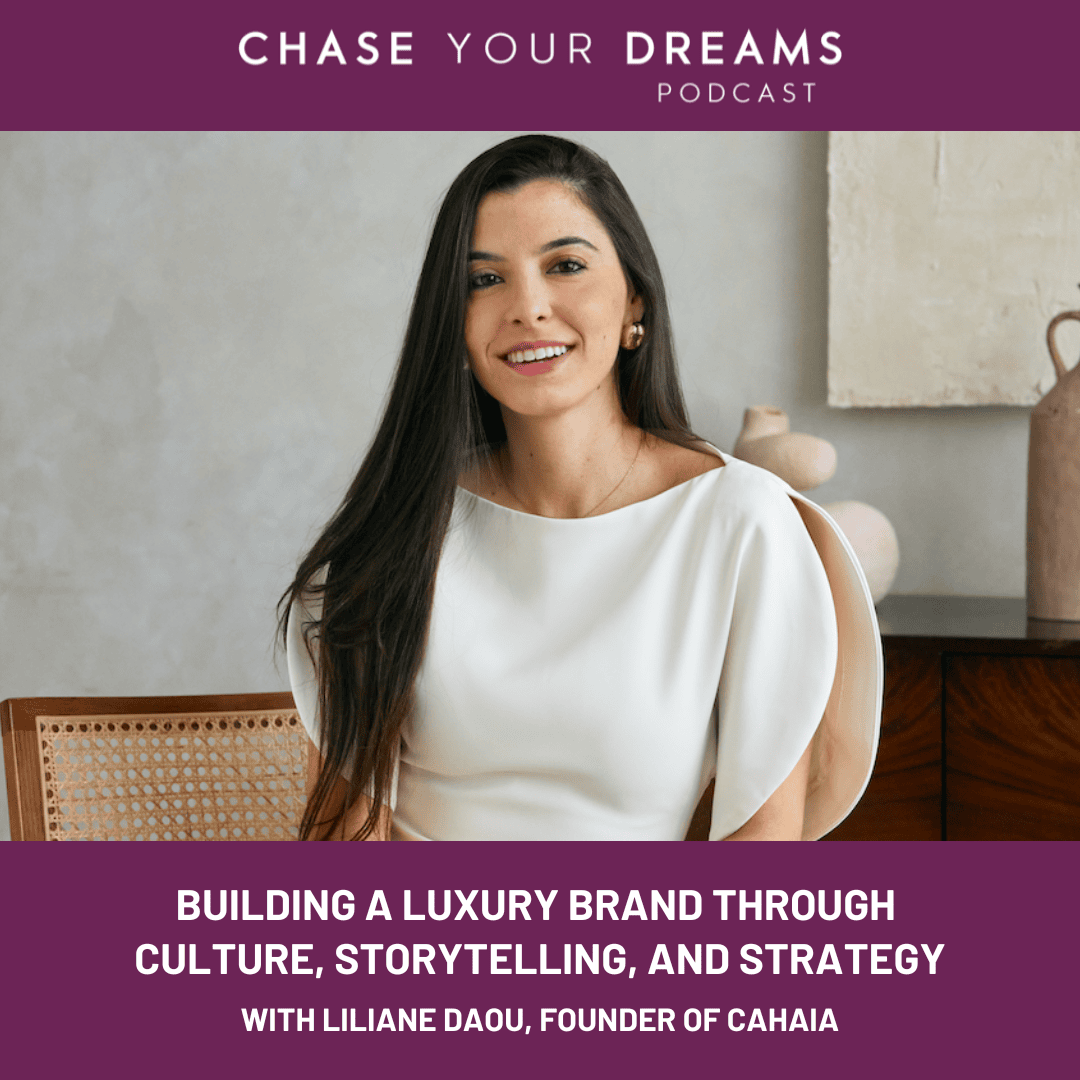
Liliane Daou shares how she moved from consulting to building CAHAIA, a culture house that designs wearable accessories and objects with the intention of spotlighting different cultures. CAHAIA was created through a series of intentional steps grounded in skill-building, financial planning, and long-term vision rather than a leap of faith. Liliane emphasizes how her strategy background informs her approach to business, and how that execution and iteration matter more than ideas alone. The conversation also challenges common myths around the luxury industry, revealing that building a meaningful brand is a slow process rooted in storytelling, trust, and world-building before sales. This episode encourages founders to think long-term, embrace uncertainty with structure, and build sustainably by combining creativity with strategic discipline.
About Liliane Daou
Liliane Daou is a former BCG consultant, cultural storyteller, and founder of CAHAIA, a culture house that transforms the identity of cities into design objects, beginning with handbags crafted from vinyl records. After six years advising global media, technology, and consumer companies, she stepped away from a structured consulting career to pursue a more creative and purpose-driven path at the intersection of strategy, culture, and design. Today, Liliane continues to work as an independent strategy consultant, partnering with leading organizations including The Business of Fashion, while building CAHAIA as a long-term luxury brand rooted in cultural narrative rather than scale. Her work is defined by a rare ability to bridge high-level business strategy with deeply intentional storytelling, helping reimagine how brands can create meaning, relevance, and lasting cultural impact.
Contact Info
Website: http://www.cahaiaculture.com
Instagram: @cahaiaculture, @liliane_daou
Linkedin: www.linkedin.com/in/Liliane-daou-9b7040b0
Takeaways
- Start small and intentionally to strengthen your brand positioning early on.
- Stay anchored in a long-term vision while detaching from short-term fluctuations and comparisons.
- Surround yourself with a strong support system—entrepreneurship is easier to sustain when shared with people who challenge and encourage you.
- To minimize risk when transitioning to entrepreneurship, build financial buffers, test the market, and create fallbacks.
- Focus on execution and iteration over perfect ideas.
- Build luxury (or any meaningful brand) through storytelling and world-building before focusing on sales or scale.
- Prioritize awareness and cultural relevance in the early stages as trust and desire take time to develop.
Interview Themes
What does it actually take to build a luxury or meaningful brand?
Building a strong brand requires more than a product—it requires world-building. Storytelling, cultural relevance, and a clear narrative create desire and emotional connection, which must come before focusing on scaling or driving sales.
Why should you start small when building a brand?
Starting small allows you to test your idea, refine your product, and build intentional brand positioning without overcommitting resources. Limited production not only reduces risk but can also create scarcity, which strengthens perceived value—especially in premium or luxury markets.
How should founders think about risk when transitioning to entrepreneurship?
Risk shouldn’t be seen as a leap, but something to manage strategically. By building financial buffers, testing the market, and creating fallback options, founders can make more confident decisions while maintaining flexibility if things don’t go as planned.
Why should early-stage brands prioritize awareness over sales?
In the beginning, people need a reason to care before they’re ready to buy. Focusing on awareness and cultural relevance helps build trust and familiarity, which are essential for long-term conversion and brand loyalty.
How can founders stay grounded while building something long-term?
Staying anchored in a long-term vision helps navigate the inevitable ups and downs of entrepreneurship. Detaching from short-term results and avoiding constant comparison allows founders to focus on their own path and pace.
Why is having a support system so important in entrepreneurship?
Building a business can be emotionally and mentally demanding. Having people who challenge, support, and share the journey with you provides stability, perspective, and motivation—making the process more sustainable over time.
Chapters
00:00 Introduction to Liliane Daou and Her Journey
03:54 Transitioning from Consulting to Entrepreneurship
10:08 Leveraging Consulting Skills in Building CAHAIA
12:13 The Evolution of CAHAIA: From Handbags to Cultural Storytelling
19:24 The Reality of Building a Luxury Brand
24:35 Manufacturing Challenges and Processes
29:07 Defining Culture and Its Role in CAHAIA
31:28 Balancing Patience and Ambition in Entrepreneurship
Transcript
Liliane Daou
I think the biggest thing for us is mindset launching. I think we launched and thinking we need to convert, we need to sell. But then now, with time, we realize that there is a big part in the beginning stages of a brand that is trying to position itself in premium or luxury. There's a big part of world building, creating that desire, creating this culture and relevance.
The storytelling, which I don't think we're perfect at it in any way or another. We're still learning, but just having this mindset that we should focus on sales, world building and awareness and this traffic is as important and it should potentially, in the first initial stages, the first year be the main focus of the brand versus trying to sell.
Glynis Tao
Welcome to Chase Your Dreams, a podcast for fashion entrepreneurs who want to build a purposeful and profitable clothing business so they can make a living doing what they love. I'm your host, Glynis Tao, an apparel business consultant and SEO specialist with 20 years apparel industry experience. I'm also a mom to a wonderfully energetic little boy named Chase.
Today's guest is Liliane Daou, a former BCG consultant turned founder and cultural storyteller who is redefining what it means to build a brand at the intersection of strategy, culture, and design. After spending six years advising global media, tech, and consumer companies, Liliane made the decision to step away from a prestigious and structured career to pursue a more creative and purpose-driven path.
She is now the founder of CAHAIA Culture House that translates the identity of cities into design objects, starting with handbags made from vinyl records. Alongside building CAHAIA, Liliane continues to work as an independent strategy consultant, advising leading companies, including the business of fashion. What makes her perspective especially unique is her ability to bridge two worlds that don't often intersect, high level business strategy and deeply intentional cultural storytelling. In today's conversation, we are going beyond the highlight reel. We're talking about what it really feels like to leave stability behind, how to think long-term when building a luxury brand without scale, and how to use your existing skills to create a more sustainable path into entrepreneurship.
If you've ever felt pulled in a different direction, but weren't sure how to navigate the uncertainty, this episode is going to give you both the mindset and the strategy to think differently about your next move. Welcome, Liliane. It's so nice to have you here today. Thanks for joining me on the podcast.
Liliane Daou
Thank you so much. What a nice introduction. I'm honored really. Thank you so much. Everything is spot on.
Glynis Tao
Well you have such an interesting story and I'm so happy to share it.
Liliane Daou
Thank you. And yeah, we're going to dive into so many different topics. So I'm excited to share it with your audience.
Glynis Tao
Yeah, absolutely. Liliane, I'm really excited for this conversation because your journey sits at such an interesting intersection of strategy and creativity. You started in a world that's very structured, very analytical, advising global companies at BCG, which is one of the world's top strategy consulting firms. And now you're building something that's deeply rooted in culture and storytelling. I’d love to start at the beginning of that transition. Can you take us back to the moment you realized you wanted something different from your career and what that actually felt like?
Liliane Daou
Yeah. And at the base, I also studied electrical engineering, which is very different from what I'm doing now. It's interesting because I always knew that the career path I took right after college, which is working in one of the biggest management consulting firms such as BCG, was not really what I wanted to do long term. I knew that I was taking this path as a step towards a longer term goal or dream that I have. And I knew that I needed it. I needed the skills, the expertise. I needed the confidence. It was going to give me credibility. Now that I'm building a business, I feel so much more confident or capable and more credible to go and pitch it to investors if I ever need that. So it wasn't really that I woke up one day and I realized I want to completely switch. I kind of knew from the beginning that I had to do this because it will arm me to be able to build whatever I want to build later on. And creativity has always been something I enjoyed doing. I never really pursued it. I always liked writing. I published a book very early in my life. I have a travel blog. So I've always kind of had it in my career. I think very recently I decided that I want to make it much more bigger than just a hobby. And why not try to pursue it and make it my career eventually? Sometimes in life you just have to do things that on a day to day are not really what you want to do, but they arm you for your future self. And that was me, I would say, with the career that I took until now.
Glynis Tao
Walking away from a prestigious stable career is something a lot of people dream about but don't actually do. What did that transition really feel like behind the scenes?
Liliane Daou
Definitely not very easy. I think mentally I was very prepared and ready for it. I knew that this day would come, this transition would come. I think it was harder emotionally or psychologically because the career that I had was very demanding. It was kind of all my life. I would spend very long hours in the office with a specific set of people, traveling all the time. So I really had a specific lifestyle and walking away from it felt like an identity shift. It's not that I'm losing a job. I'm losing my routine and the people that I was surrounded with, the lifestyle it gave me. So I think this was harder. But I think I was ready for it. I knew that I was planning for it over the years. And honestly, I'm still very pragmatic now. It's not that I walked away from corporate and I'm never going to do corporate. As you mentioned in the intro, I'm still freelancing now as an independent consultant. I also believe that I might need a full-time corporate job at some point because building a business, in my industry, which is like culture, fashion, luxury, takes a lot of time. It takes a minimum three to five years until you see the fruits of it. And so the reality is like, I am going to need another job. And there is also so much still to learn from corporate, I believe.
But I think the role that corporate plays in my life has kind of changed. Initially, it was my life. That's what I spent my time doing, always working. It was a very demanding job. And now the way I see it is, OK, I want to build my business. Being realistic, how can I use corporate to help me do that? Is the job that I can get that gives me the flexibility time-wise that also positions me in an industry or next to people or topics that will help me with my business and my brand versus doing something that's like, completely different. So just changing the role that corporate would play in my life is a shift that I had. But yeah, I think any change that happened in your life is hard, but change is also good. So like sometimes you just have to like make the decision and like proceed, you know?
Glynis Tao
So was your decision to leave more of a leap or series of calculated steps? And how did you think through risk at that time?
Liliane Daou
Yeah, definitely not a leap. I'm very much a planner. I have like a plan A, B, C, D that I always return to. And so like, yeah, I think like I looked at it from a different perspective, like from a career perspective, did I achieve all the milestones I wanted to achieve with my previous career? Like, did I get the promotion or the title I wanted? Did I work in the country that I wanted? Because I moved from Dubai to New York. Did I get the degree or did my company also support me in my MBA? So did I hit all these milestones before leaving? So this was one thing.
The other thing is I also took some time off before leaving to just test the market and have conversations with people in the industry I wanted to build my business in or potentially find a part-time job and see what's my value in the market? Would it be easy for me to find something that sustains me while I build my business? I did that to kind of be more sure of my decision. Also like financially, I made sure I have savings that can help me sustain myself without a source of income for a certain period of time. I live in New York. It's like one of the most expensive places. So these things, and I think also having a support system is very important. And for me, I'm lucky like, I'm building my business with my siblings. We're four kids. We're all partners in the business. All very close, very supportive of each other, and just having them being supportive of the decision that I'm taking and literally being like, Liliane, leave and fail and we will pick you up. This helps so much. So yeah, I think the way I thought about risk was, OK, I had an amazing career. I looked at the market, and I feel like I can find something else. I have some buffer and I have the support, like, let's do it. What's the worst case? I go back to BCG, you know? a lot about rationalizing in your brain, taking these small steps, but also having the people around you that support you in this decision and are always there to like with you when you're in moments of doubt.
Glynis Tao
How have your strategy and consulting skills shaped the way that you're building CAHAIA today?
Liliane Daou
Yeah, I think consulting or like the path I had really helped me from like a business perspective. It taught me all the foundations of a business. I think being a founder, it's very important, especially in the creative world, like it is important to have the creative aspect, but it's as important and even more important to know how to run a business eventually. Like you want the money, want the sales. And so like I got all these foundations from my career, like how to build a strategy, how to put a plan, to analyze numbers, and how do I price my products, how do I sell? All of these foundations, I'm very grateful that I got them from being a consultant. It also, I think, taught me discipline and being able to adapt quickly. Because when I worked in my previous job, it was very demanding. You had to be online 24-7. One day, you're working on something, the next day the client wants something else. So you need to adapt and pivot quickly. And I think these are also very important when you're building your own thing. But I do think there's a big aspect that I did not learn. And it was a big gap for me, which is execution. And yes, in consulting, we put things on paper. We give it to our clients. And then they have to execute. So we leave then. But in entrepreneurship, execution is everything. If you have something on paper, it means nothing until you do it, you fail, you realize that you have to change. And I think that's one skill that I had to teach myself and push myself to be okay with just doing things. And even if it's not like the accurate thing to do now, just like trying this thing and learning from what we see or like the data, what the data is sending us. So, it definitely helped me a lot, but there are certain things that I wish I had more exposure to.
Glynis Tao
CAHAIA is positioned as a culture house that translates cities into wearables and objects, blending fashion, music and travel. How did that concept first take shape for you? And how has it evolved from starting with vinyl record handbags into a broader creative vision?
Liliane Daou
This is a very long story. I think our vision and our journey has evolved so much over the launch four months ago, so we're still very, very, very new. I don't want to speak as an expert on anything. I'm sharing what has happened with us. People see the product, but they don't see that we've been thinking about it, working for years around that concept. At the base, just quickly, our story is we are originally Lebanese. We grew up in Lebanon, which is a very small, beautiful country in the Middle East. But growing up, my parents would always send us to cultural exchange programs. Since we were 10 years old, they would send us alone, me and my siblings, to travel and talk about our culture, but also learn other people's cultures. And it was just so embedded in how we grew up. From a very young age, friends from all over the world visited us, et cetera. So the culture piece and travel piece was ingrained in us. And particularly for me, at the age of 22, I lived on a ship for four months. traveled around 11 countries in these four months. And I saw so much of the world at a very young age, which kind of accentuated our love for culture and travel. And we've always wanted to work in that space.
But the way our idea came about, honestly, we've always tried to think about different things we can do and wanted to share what we had experienced with people. We felt very privileged that we saw so much of the world from a very young age, and we wanted other people to see what we saw, especially in today's world where there's so much instability and wars, even in my country. And sometimes countries are reduced to a very negative headline. There's so much more than that in a city. There's so much beauty and traditions and depth. And that's what we want to shed light on. But so honestly, over the years, we never had an idea that really clicked. We would pitch ideas. We would think about stuff. And so at some point, we just took a step back and we were like, maybe we shouldn't do this or pursue culture and travel. Until one day, a few years back, my brother, my twin brother actually he comes to us and he just pitched this idea of vinyl handbags. And at the time, I had just moved to New York and I started getting so much into fashion. I've always loved fashion, but New York had kind of expanded my style and taste and I started appreciating statement pieces. And so when he pitched this idea to us, we were like, my God, interesting. Like, okay, vinyl handbags. He also has a lot of vinyls at home. So we decided to produce one prototype and for me to walk around New York with that bag. And so like I did that for a few months and in three months we were able to kind of get almost 100 followers on CAHAIA's Instagram with no photos, no website, nothing. It was just me walking around New York and people stopping me and asking me, your bag is so cool. Like, where is it from? And so we just tell people like, follow us on Instagram. We're launching soon, you know? And that's when we realized like, okay, this could be a business idea.
It started really as a fashion piece. And when we started producing our handbags, at some point we got a legal hiccup. We realized that we can't choose any kind of discs. If they have the names of the artists, we might get into copyright issues and stuff like that. And so really, midway through us doing all of this, we had to take a decision. Do we drop the idea or do we recreate the vinyl and recreate the label? And that's when we decided let's recreate it, but everything clicked. We were like, my god, because now we can recreate the vinyl, can write about the music scene in cities. We can use that object or product to tell the stories of cultures and sounds in cities. And it's not anymore about the handbag, but the meaning behind it. And so that's how it evolved into becoming very cultural.
Again, over the years now, we're like, OK, we don't need to stick to handbags. We need to do more objects or maybe spaces. But at its core, everything needs to translate cities and cultures, whether it's a fashion piece or an object. We see these as mediums and tools for our
Glynis Tao
So you started with vinyl record handbags, it's like a signature item I see on your website right now. It's very unique. It stands out. What drew you specifically to vinyl records as your starting point and what did they symbolize in the context of culture and storytelling within your brand? I think you touched on that in terms of your background and story, but maybe expand more into how you are able to take the handbags and then to turn it into an actual piece.
Liliane Daou
Yeah, so basically like the way we see culture is people express themselves in a place or a geography. And it could be through things like the music they produce, the arts they produce, the way they wear their style or the architecture that they make, which eventually creates the city and this whole ecosystem. And so music is a very big cultured expression wherever you go. And that's our idea. We took a symbol of music, which is a vinyl record that also was once destined to waste. take vinyl records and we upcycle them. it's like a music symbol and we kind of give it a new life and we make a handbag out of it. And our concept is like every city, every collection is going to be a city and every handbag will tell the story of a music genre from the city. And so the design of the handbag, the design of the label needs to kind of say this. Like we started with New York and we have four handbags. Each one is a sound that is very prominent in New York. We have the jazz, the hip hop, the blues and disco and all of these sounds. Like if you live in New York, you come here, you will definitely will encounter them and hear them. And in different settings and setups and ways, you know, like when you think about jazz, it's like these very elegant jazz bars in New York. And we tried to replicate or translate that with the burgundy color being very minimalistic. But then when you think about disco, it's a bit more courageous and it's more fun. So our label has like a small illustration that we used silver to translate that. So this is how we took like a symbol of music and we turned it into something that you can own. And also we wanted it to be a handbag because we wanted the culture to be carried like culture isn't always something you can get a souvenir and put it at home like we wanted that to symbolize something that you can have with you and wear around and carry with you every day. So this is how we thought about it and like music is one cultural expression Our vision is to also translate other things in a city like the performing arts scene the street culture Everything that makes up a city and its culture. This is what CAHAIA is aimed to do. Again, this is our vision. We're still in very early stages. Things can change. The market can tell us, people love your handbags. You just need to double down on handbags. But our vision as of now is how do we expand beyond that, keeping the culture at its core?
Glynis Tao
There's often this perception that luxury brands launch and quickly gain traction. What has your experience actually look like?
Liliane Daou
I think this is very different than reality. Honestly, luxury is very slow. In our case, we thankfully got a lot of traction in the first few months of launching, maybe because it was the launch hype, but friends and friends of friends and even complete strangers heard about us somehow and were curious and were buying our handbags. But in general, luxury is very slow because you are convincing someone to buy a piece for $600 plus when they don't know who you are, they just discovered you. They want to dig deeper and try to learn more about you, you haven't had the time to build that. You probably have one blog on your website, a few posts on your Instagram. There is a whole world-building phase that needs a lot of time. And so in general, luxury is on the contrary. It's very slow, I would say. It's different than what people think. There is overnight stories, definitely, but it would be outliers, I would say. It would be people who already are in that scene, already have the connections, or have a lot of capital for marketing or the PR. I think in our case, we started off very strong, but we're aware that this might slow down because like, building a world, you know, and you're trying to build trust and repetition and storytelling and all of this takes time.
Glynis Tao
And I think you're building a lot of that trust through your storytelling on your social channels. I think you do an amazing job on your social Instagram telling a story behind the brand. And one post that really caught my attention was you saying that, well, most brands launch within a year, but for us it took three years. So what are some things you wish you knew before starting a luxury brand that would have changed how you approach the early stages? You're in it, still in it right now, right? Because you just recently launched, but maybe some of those things that you've learned along the way.
Liliane Daou
Yeah, I think the biggest thing for us is mindset launching. I think we launched and thinking we need to convert, we need to sell. But now with time, we realize that there is a big part in the beginning stages of a brand that is trying to position itself in premium or luxury. There's a big part of world building, creating that desire, creating this culture and relevance. The storytelling, which we try to do. I don't think we're perfect at it in any way or another. We're still learning, but just having this mindset that we should focus on sales, but we're building awareness and this traffic is as important and it should potentially in the first initial stages, like the first year be the main focus of the brand versus trying to sell.
To convince people, you need to let them want to be part of what you're building, even if eventually they will not be the customer or people who are going to buy your product. But I think that this is one thing that we kind of knew about, but not as much as when we started and we were like, OK, we are a premium brand. We need to build a world around it. We need people to really understand what is the culture house. It's much more beyond than a handbag. And we need to have, I don't know, blogs. We need to have stories, all of these things. Our campaigns always need to be top notch. A lot of these things that we knew about, but I think once you get into it, it becomes very concrete. So I think this is the biggest learning and the mindset switch from conversion to awareness and word building.
Glynis Tao
Many founders think they need to scale before they can position themselves as luxury. What's your perspective on that?
Liliane Daou
I think the opposite, when you like so much scale can dilute a luxury positioning. And for me, luxury is not equal to volume. Luxury really is based on quality storytelling, the brand perception you're creating and the price point that you have. And if you have these nailed down properly, then whether you're selling or producing 10, 15 handbags or thousands, you can still be associated with luxury. And I think these things are very important. They should become part of the identity of your brand, like who you are, what is your price point, et cetera. You should have them from the beginning of building a brand. I don't think building and scaling and then waking up one day and being like, I want to shift is very hard. I think you should start it from the beginning and compound and let it evolve. So they should be part of the core values or identity of a brand. But I don't think scale is really what matters. And on the contrary, I think having scarcity, being small, having limited editions is a powerful thing because then it adds more value to whatever product you are trying to sell.
Glynis Tao
This first launch of your vinyl records handbags collection, did you produce a limited run? Is there a limited quantity available?
Liliane Daou
Yeah, we have a limited quantity. One, it's because we didn't want to accumulate inventory. This is the most important thing when you're starting a brand. It's better to have pre-orders to be out of stock than to have, I don't know, 500 pieces laying down in your apartment and not knowing what to do with it. And eventually, if you have limited pieces, what's the worst case? If it doesn't work, you can stop and give them to your friends, your family, you know. But I think just having limited inventory is important just because you're still testing the market. But also, like for us, producing these handbags is not easy. It's a very complicated process. It's very long. So it's not like we can produce thousands and thousands all at once. And so we wanted to be conscious about the production that we want to do, how much we want to invest in, at the same time testing the market. Are people going to like this or not? Do we need to pivot and create a completely different product? And when you're still asking these questions at the beginning, it just makes more sense to have a fewer number of inventory.
Glynis Tao
Yeah. And whoever loves these bags should get their hands on them because there are very few in production that have been produced, right? How did you go about finding the manufacturing for these? These are all handmade.
Liliane Daou
Yeah, we already sold out one of the colors. It's a whole supply chain. The way it starts is like we decide on what is the city we want to focus on. For us, it was New York. And then what are like the sounds or the stories of New York that we want to highlight? So we said like, okay, jazz, hip hop, et cetera. For each one of these, then we work with a designer, ideally like a local designer that also understands the culture of New York that helps us design the label of the disc. And then what we do is we ship that design or we send that design to our factory, the vinyl factory in Europe that basically recycles vinyl records and presses the record with the label design our label design. Once that's done, then they send it back to our atelier where we choose the leather, the stitching, and we assemble it.
There are so many different touch points. A lot of people ask us, can you customize a handbag for me? Can you do a design? We can't just talk to the factory and be like, okay, test this disc for me and do it. Yet, I think later on, if we scale and we're bigger, then we would love to do that. But it is a long process. There is so much in every step that needs to be done. We need to see the sample, do we like it or not, et cetera. Yeah.
Glynis Tao
It's so interesting. I love to hear more about that. It's sort of the process, you know, in terms of how you make your products. Is there a story that you could tell?
Liliane Daou
Definitely. We have a bit of it on our website. I think that's another thing that we need to shed more light on. When you start a brand, there's so many things you want to talk about, and you don't know whether you should talk about the process, the product, or even the family dynamics. We're four family members doing all of this. There's so much, and I think it takes time. But I know a lot of people are always curious with how we do our handbags because it is a very interesting and long process.
Glynis Tao
Is there somebody in your team or your family member who has a background in fashion, production, manufacturing?
Liliane Daou
No, not at all. We are all engineers or doctors, literally. Like me and two of my siblings were engineers and then my younger brother is a dentist. My parents are both doctors. So we really come from a very different background. Like we never had any connections or knowledge in the fashion space or culture. Like what we had is passion, dedication. We have a vision. We love storytelling. And we believe that, okay, like we've worked long enough with other people and other companies solving other companies' problems. Like we can figure it out, you know, but yeah, it is challenging because especially with fashion, which is like our first medium, you need to have a lot of connections. You need the PR, like the market is saturated. So it's a lot of things that we are building brick by brick. And now for example, I like freelancing in fashion companies because that helps me a lot more understanding like the dynamics of the fashion industry, the business behind it. I also get to know people that might become very valuable in our network. We don't have that background at all. I would say we're potentially creative. Like we love creativity, but we don't know how to sketch. We have a lot of very good freelancers that help us though, so we've been blessed to work with very talented people.
Glynis Tao
Yeah, that's important. Your partners that you work with on the product side of the business. Really, it's important to ensure a very well-made, high quality product.
Liliane Daou
Yeah.
Glynis Tao
Your work sits at the intersection of culture, travel, and fashion. How do you personally define culture?
Liliane Daou
Yeah, like it's what I mentioned before. I think culture for me is like how people express themselves and a specific place. Music, art, fashion—all of this sits under the umbrella of culture. And so it really is like how people gather, how do they dress, how do they communicate in a specific geography or place. I feel like it is like the umbrella that has all these other pillars. But yeah, it's the way that people express themselves in a place. That's how I think about it. I think culture could be defined or understood in very different ways to different people. But that's how I think about it. Yeah.
Glynis Tao
Yeah. And I think also you mentioned that your idea behind the brand was most of the time when you travel to a new city and then you leave, you have a feeling, but you don't have anything you could take with you from that city. And I think that's sort of the idea what you wanted to take, to be able to translate the culture of a city into a wearable object.
Liliane Daou
Yeah. And like for us, it's like, how can we get, I don't know, Rio de Janeiro closer to you without you having to travel there? And it can be through like a fashion piece, which are like our vinyl handbags. It could be through objects or artworks. We have a very big vision in like, what are the things we want to do? In your space, in your home, how can we bring this culture closer to you without you having to like travel, you know? We go to these places, we fall in love with them, we try to reinterpret them ourselves and create something that is tangible that people can hold. That's our vision now and our goal with CAHAIA.
Glynis Tao
Before we wrap up, how do you balance patience with ambition when you're building something long-term, especially in a world that pushes for fast growth?
Liliane Daou
Yeah, very good question. It is honestly one of the most challenging things because when you're building something, you're so excited, you want to see results the next day, you want to sell out and tell your friends, we're doing amazing. And the reality is things take time, especially in that space. You just need to be patient. And the way I handle it is a few things.
One I try to always stay very focused on the long-term vision like where do I want to get? Okay, maybe I don't love what's happening on a day to day or things are not progressing the way I want to etc. But then I'm like, okay, what's my long-term goal? That's the goal. That's what I need to focus on.
The second thing is I try not to compare myself to other brands that are way ahead of me and that's something like we all fall into that trap of looking around and being like, oh my God, like this happened with them. Like, why aren't we doing the same? And especially in the first phase or first few years where you're still building your identity. And so I try to just remind myself like, that's me. That's my timeline. And I try to look at other brands or companies for inspiration, for learning, but yeah, I try not to fall into that trap.
The third thing is try to do side gigs or have other jobs where you see momentum and you see growth and you have a source of income and you see money coming in. And I think this balance is very important because like your business, you're going to have weeks where you're doing amazing other weeks where it's slower. And these lower weeks could be demotivating and hard. But if you have another side gig that you still are seeing momentum there, you're still seeing cash coming in and you know, then you can balance that. And I think it's very healthy.
And I think the last thing is the support system. Again, I think I am so lucky that I'm doing this with my siblings. And so like whenever we want to see growth, we never, you know, we're in doubt or we just go back to each other and talk through together. We motivate each other. Even like sometimes we think about it like, even if a year from now we realized that this was such a bad idea, we failed, we need to close the business, we will never regret doing that because investing in that meant that we invested in memories together and we can never regret that. So I feel like having a partner, a co-founder helps so much because it's like a constant reminder that someone who's motivating you, who's in it with you. And also like someone you're sharing memories and learning and growing with which is like one of the best things, I think definitely it's hard and sometimes I wake up and I'm like I want this to happen by tomorrow. But then yeah, I take a step back and I'm like, okay, that's my long-term goal I should just look at my timeline. I pick up the phone and call my brother, you know, and we talk it through.
So there are a lot of things that you should do to keep your mindset positive. But yeah, it takes a lot of like practice and being in the now and like believing in yourself that if you have a dream and a goal, like it will just take time by why wouldn't it work if you're dedicated enough, you're adaptable enough, you can just read the market, the data and pivot, we started with handbags. If it doesn't work, then we can pivot into another product, you know, it doesn't work. We can put it into something else.
Glynis Tao
Where can people find you if they want to get in touch with you?
Liliane Daou
They can find me on Instagram. My handle is @liliane_daou. Also the handle of our brand, CAHAIA, is @cahaiaculture. If they want to visit the website, it's also cahaiaculture.com But yeah, mostly on Instagram, on LinkedIn, of course, Liliane Daou also.
Glynis Tao
If you’re listening and this conversation resonated with you, I highly recommend you to check out Liliane's work and follow her journey with CAHAIA. It's a beautiful example of what it looks like to build with both strategy and soul. Liliane, thank you so much for being here today and sharing your perspective.
Liliane Daou
Thank you so much. I had such a good time and it was so nice talking to you. Thank you.