
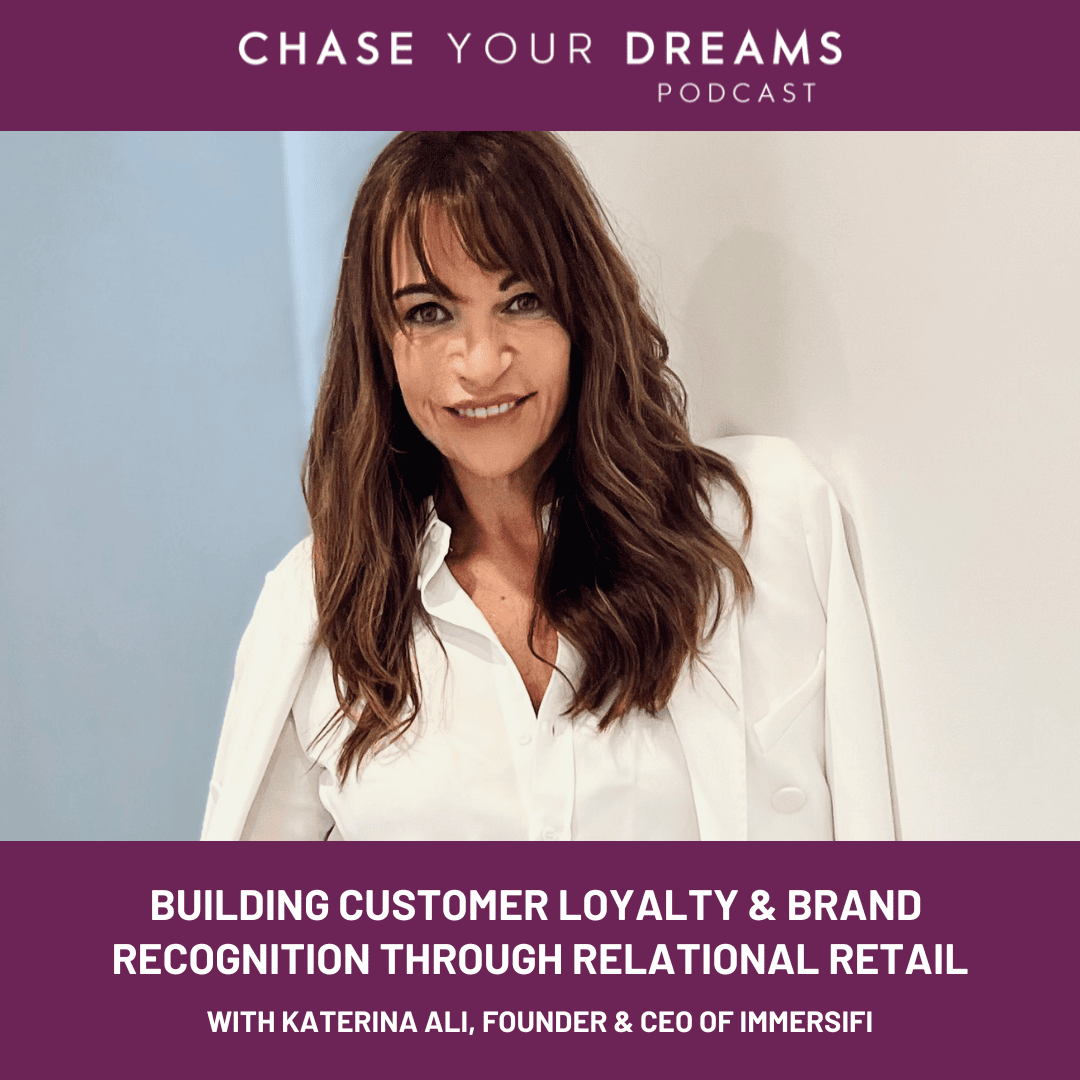
Katerina Ali, founder and CEO of Immersifi, shares how she is rethinking retail by focusing on customer recognition and relationship-building rather than discounts and automation. With over 25 years of experience across fashion, marketing, and technology, she offers a fresh perspective on why traditional loyalty programs fall short and how brands unintentionally train customers to wait for sales. She introduces the concept of relational retail, a proactive approach to customer experience that uses data and technology to better understand and serve customers before they even make a purchase. The conversation explores how brands can unify online and in-store experiences, use AI to support human connection, and create more personalized interactions that drive trust and long-term loyalty. This episode reframes customer experience as a key competitive advantage, where recognition and personalization are essential to building a brand that lasts.
About Katerina Ali
Katerina Ali is the founder and CEO of Immersifi, a clienteling and loyalty platform designed to help physical retail brands better recognize and retain their customers. With over 25 years of experience across fashion, marketing, and technology, she has built her career at the intersection of customer experience and brand growth. After identifying a gap in how brands fail to recognize loyal customers in-store, she created Immersifi to support what she calls relational retail, a more human, data-driven approach to building trust and long-term loyalty. Today, her work focuses on helping brands move beyond discounts and automation to create more personalized, relationship-driven experiences.
Contact Info
Website: https://immersifi.xyz
Instagram: @katerinasstyle, @immersifi_xyz
Linkedin: linkedin.com/in/alikaterina
Takeaways
- Recognition drives revenue; customers who feel known buy more and stay longer
- Discounts do not build loyalty; they train customers to wait and weaken your brand
- The shift from transactional loyalty to relational loyalty builds on trust and experience
- Use AI to support human connection, not replace it
- Personalization only works when it is relevant and based on real customer data
- Retention starts before the sale through proactive, seamless experiences
- Stay flexible in execution but grounded in your core mission
Interview Themes
What is relational retail?
Relational retail is about building a relationship with the customer before they even make a purchase. It focuses on understanding who they are, what they want, and why they are coming into the store, so that you can create a personalized and seamless experience from the start.
How can brands improve brand recognition and build customer loyalty?
Brands can build loyalty by remembering and getting to know their customers. With that customer knowledge, sales associates can create better experiences for their customers. Simple things like knowing their preferences, past purchases, or personal details help customers feel valued and more likely to return.
How can I combine the online and in-store experience for customers?
Nowadays, customers move between online and in-store, so their experience should feel seamlessly connected. By sharing data across both online and in-store shops, brands can offer consistent personalization, better recommendations, and a smoother journey no matter where the customer shops.
How can brands use technology to enhance the customer experience?
Technology should make processes that can be automated easier so the people behind the business can focus on creating more meaningful, human interactions. It can help organize customer data, suggest products, and reduce guesswork. Technology should free up time for people, not replace them.
How can sales and discounts harm my brand’s image?
Frequent discounts can lower the perceived value of your brand and train customers to wait for sales. Over time, this can hurt your profit margins and, more importantly, your brand positioning.
What are the benefits of bootstrapping?
Bootstrapping gives founders more control and forces them to be thoughtful with decisions. It helps build a stronger foundation and puts them in a better position if they choose to raise funding later.
Chapters
00:00 Introduction to Relational Retail
02:27 The Importance of Customer Recognition
06:36 The Loyalty Paradox and Discount Trap
11:48 Defining Relational Retail
22:42 Enhancing Customer Experience Through Automation
25:11 The Role of AI in Retail
28:17 Integrating Online and In-Store Experiences
31:01 The Founder Journey: Building Immersifi
35:32 Recognizing and Retaining Customers
37:07 The Future of Retail: Customer Experience at the Forefront
39:14 Core Beliefs for Building a Lasting Brand
Transcript
Katerina Ali
Bootstrapping it means you're looking at every single detail that comes in. It’s about making sure you're understanding where it's all going as long as you're in it for the long term and seeing what will happen in five years time. So if you want to give your equity away early, that's fine. If it's something you can't, if you can't bootstrap, that's fine as well. But just keep your wits about you as you go on. Don't think about today or tomorrow—think about where you want to be in a few years. I think that's been something that I've learned well.
Glynis Tao
Today's guest is Katerina Ali, founder and CEO of Immersifi, a clientele and loyalty platform built for physical retail brands. With over 25 years of experience across fashion, marketing, technology, and business development, Katerina has seen firsthand how brands spend heavily to acquire customers only to fail at recognizing them once they walk through the door. And that's exactly the problem she's solving because in a world where brands are competing on discounts, automation, and pay traffic, Katerina is taking a very different approach. She believes the future of retail isn't more automation—it's deeper recognition.
In this conversation, we're breaking down why traditional loyalty programs are failing, how brands are unintentionally training customers to wait for a sale, and what it actually looks like to build what she calls relational retail. We also get into why physical stores are far from dead, how to rethink the in-store experience as a relationship driven environment, and why in an increasingly AI driven world, human connection is becoming your biggest competitive advantage.
If you're building a fashion, beauty or lifestyle brand, and you're thinking about long-term growth, retention and brand equity, not just short-term sales, this episode is going to challenge the way you think about your customer experience. Let's get into it.
Welcome, Katerina. It's so nice to have you here today. Thanks for joining me on the podcast.
Katerina Ali
Thank you, Glynis. I'm so happy to be here. So happy.
Glynis Tao
I'm happy that you're here. You've spent 25 years across fashion, marketing, and technology. What's something you've consistently observed about how brands treat their customers that never sat right with you?
Katerina Ali
It all started with personal experience. When you come into some stores and you've been an avid loyal customer for so long and staff change or what have you, and then you walk in and you have to tell this new person, not their fault, but you tell them everything that you like, everything you want and all of that. And every time I kept experiencing that, I knew I bought less. So I'm like, well, if that's me, let me check out who else is doing the same. When you walk into a store and they recognize you or they know your name, they know what you like, you are welcomed. You are recognized. You are felt and made to feel amazing. Even more so you, okay, let's be honest. You're going to buy more at the end of the day, you're probably going to buy more because you’re trusting the sales associate there, you're trusting them. And when you don't have that trust, brands suffer. And we're seeing that. So a lot of it all starts from my personal experience of walking in that door and going, can I help you? Please, no, no, Just acknowledge I mean, just acknowledge I've walked in. Oh my goodness, how many places I've walked into, not even acknowledged. And know if I am a loyal customer, know that I am. So, yeah, that's what, that's what sort of sparked it all.
Glynis Tao
So it all started from a very personal problem that you had experienced yourself. That's always, you know, a good thing as founders. I think, you know, having experienced this firsthand and now coming up with a solution to it is a great idea. And I guess a spark for your business idea. You talk about this idea that your best customers feel like strangers. What does that actually look like in a retail environment?
Katerina Ali
Well, for example, say you have a store that has several stores, and you always go to the one on Fifth Avenue. Like that's the store you go to all the time. But you know, I'm in LA and I actually want to pop in and they don't know you at all. So you're a stranger. That's one scenario.
Another scenario is staff turnover. I've had so many brands come and say to me, we've lost thousands of dollars because the staff didn't know who that person was and that they were a VIP or a loyal customer or regular or whatever it may be. That's where not being recognized hurts the brand and hurts us too, cause we don't get that beautiful experience and we're going back and typing away to figure it out. So yeah, it hurts both sides.
Glynis Tao
Customer service is such a big part of the overall experience. I think, oftentimes it makes or breaks your experience, even though, you know, perhaps the products are great. But if you didn't have a good customer service experience, then yeah, it just sort of ruins it all.
Why do you think so many fashion brands invest heavily in customer acquisition but fail at something as fundamental as recognition?
Katerina Ali
No one has pinpointed recognition before. I have researched, so correct me if I'm wrong, but I have researched and researched. No one has come in and realized how powerful that recognition is in customer behavior. And the reason I'm seeing brands go elsewhere, especially in this AI era, is there's so much hype out there. We've got to step back and really turn around and go, what does the customer want? And it's funny, being so personal for me and experiencing it, I then went to my friends and then their friends and their friends when I did the research to go, hey, is it just me or are you getting this too? Then, you know, all these sales associates are also saying to be recognized. The customer wants that great experience. So recognition is huge.
Glynis Tao
Let's talk about the loyalty paradox and the discount trap. Okay, so let's talk about loyalty. Many brands think they have a loyalty strategy, but it often revolves around points and discounts. Where do you think this model falls short?
Katerina Ali
There are a few reasons the model falls short. Number one, if you're just doing points and you're building towards something, they call that earn and burn. It does cheapen products. Our main market is that mid to contemporary luxury fashion. So we're not fast fashion. We're not luxury fashion. We find that that will actually cheapen the products. Points just cheapens it. It gets aligned with say your supermarket brands and that sort of thing, which is great—you’ve got your points there. That's for that. You make it more about the experience and you're building even more loyalty for the customer because it's not just about points to get a cheaper deal. Then you don't have to have these sales all the time. I know we've got some amazing designers in Australia and unfortunately, how many times have I gone on board something and bang, there it is on sale. So guess what? I'm waiting now. And we're not talking from drop to six months away. We're talking from drop to a few weeks later. So they're just losing so much. Instead of making it about points, making it about sales. Make it about experience. We can keep that exclusivity there. We can keep that brand equity building. Then hopefully, we then turn it around. And it's not just about the brand spending money either. It's the little things. And we've actually built this in the style lessons as well. Maybe it’s their pet's birthday, their anniversary, all this sort of thing. This clienteling site to go, Hey, we know your anniversary is coming up. Do you want us to book that restaurant? We have partnerships with restaurants and so forth. Do you want us to book that restaurant for you? And here's a great idea for an outfit. you know, and all these, just those little things that we've been able to automate for the sales associates. So taking it away from points, but we do have tiers and customer behavior does show unless you're actually wanting or you're trying to get to that next level, because if you attain that top level, if you've got nowhere to go, that's when the drop off happens. So that's in airlines, that is in any type of loyalty program. You've always got to have them striving for more. And it is up to the brand. Like what do they want to offer as an experience? Because that is remembered long after they've paid that money for that outfit.
Glynis Tao
Yeah. So a lot of brands sort of fall into this discount trap. I guess I have this question in two parts. How are brands unintentionally training their customers to wait for a sale and what's the long-term impact of this behavior on brand perception and profitability?
Katerina Ali
On brand perception is, that’s nice. I'll give it a week and I'm sure I can get it on sale. I find that if it goes on sale and maybe they don't have your size, that's the risk you're willing to take. Unless you absolutely love it and have to have it and you’re willing to buy it at full price, why not just make it the discounted price to start with? And don't discount at all because that even that would be better and, build better brand equity because, this is the reason luxury don't discount like top end luxury don't discount because you don't want the people who've paid full price to come around and go, well, Oh no, great. I've just paid $5,000 for something. And now it's, you know, they have a $3000 or $2000, whatever it might be. The way people are made to feel that when they see something on sale, I think it's doing such a disservice. I think they still need a discount. Like they have a, a bi-yearly sale because you do need to get rid of product. But make it at a price that, you know, okay, that's it. Like bang, you're going to do it. You're having it once a year or twice a year, but make it an event. Make it an absolute event to do that. And I think that's where the brands that I see are missing out a lot. Cause you could do so much with that as well.
I was thinking of it the other day, like that, even if they had a health and wellness thing and then they brought their product, even if they're not health and wellness and they've got nothing to do with health and wellness, you could bring your product into that. You could introduce things and make these opportunities to introduce them into new spaces. Why wait so long? There's also someone we talked to that we can incorporate as well with and it helps them actually buy better and produce better. But it's all about them bringing the community. That's part of the membership that comes with it that you have a voice as well. So the brands get to know their customers even better. That way it helps them design better, buy better, all of that sort of thing. Don't take their creative flair away, but they're coming from a more informed space then. And these are all the things to help avoid a discount trap.
Glynis Tao
You're a big advocate for what you call relational retail. How would you define that in a way that's actionable for founder listening today?
Katerina Ali
Relational retail for me, it's a play on clienteling. So right now, clienteling happens after the fact. It happens after the sale or happens after they've walked in. Relational retail is about knowing when they're coming in, why they're coming in, what they want, and having everything ready for them. So you're creating trust. Relational retail is going to be building trust. So when you have that ready for them, and you know, we're using AI in it as well to help suggest, but nothing will beat that human connection. So when you have that relationship, whether you've met them before or not, you know all about them. You know what they need and what they want because of the way we've designed the platform. So that relational retail has come in and gone, okay, we're not waiting till after the fact to come and say, hey, thanks for shopping with us. We're actually thanking you when you're coming in. So to help founders for businesses, designers and so forth, this is where having something that's going to understand why they're coming in first or when they're coming in helps them understand the person.
We do a lot of analytics to understand the customer's behavior as well inside. The founder, the store, the brand, get to know the what we call zero party data because the customer has released that to them. It's all about the customer, willingly doing things. If they don't want to share some of their data, if they don't want to do any of that, no problem. Switch that. We make it so simple to switch that off, but they're just not going to get as great an experience. And if they do, the brand wins, you win and you're made to feel like a million dollars and the sales associates love it because a lot of their work is done and they don't need to fumble about. They already know how you like to be served. You're coming in, how do you like to be served? You know, we'll have a double espresso ready for you. It's down to those little details that don't cost a lot, but make us feel amazing.
Glynis Tao
Can you walk us through how your platform works? How does it help recognize your customers then help with that experience in both in-person and online? Is it strictly… you're talking in store, not online?
Katerina Ali
For now, for now. Because we are a startup, I believe they need to work together. Online and in-store need to be the same, almost the same experience because we spend a lot of time… we do most of our research online, yet more purchases are done in-store in the area we're in. Right now it's a membership.
Back in the day, so I am going to go back a little bit back in the day, you had to spend a certain amount of money to get a VIP discount or you had to be approved by the manager in the store. All these levels you had to go through to become a VIP in one of these stores. Whereas having a membership, if you really want all these experiences, but who's got the patience to do all that anymore? And also for the brand, let's grab their loyalty earlier. We've got a membership available. So then in that membership, this is where the customer fills out all their details as well. Also in-store can help them fill it out. They can actually help them do all of that down to, as I mentioned before, their style essence.
Being a previous personal stylist as well, I understand the nuances of how we feel when we get dressed, men and women. Understanding their style lessons, what looks great on them? What do they like? All those sorts of things. It's like, well, you know, they love the beautiful flowy style. That's what they're saying they want. But they also really love that New York chic edgy style and cycle. Hang on, which, are we doing? How are we going to do this? So understanding that. So that's all part of the platform that they're going to fill in. And we're talking five minutes. We're not talking, you know, an hour of filling all these things in and they can come back. They can change, they can do whatever. The sales associate can go, well, hang on. I think they're more like this and, put notes in and do all of this sort of thing. So it starts with the customer coming in and becoming a member, filling out that. Then, it will either be them notifying the store. There's a little thing to say, hey, I'm coming in at two. and I'm coming into this store. This is the one I want. Or it could be if they allow the GPS to the Bluetooth notification. So when they are close by, the store will know that they might be coming in. But if they're coming in for a purpose, they want to come in for a purpose. I'm looking for a wedding, an event, whatever it may be. Or, you know what, I just want to browse. You know what, I just want to chat. It can just let them know that that's what's going to happen. Then the store can have the change room ready for them, but let them walk in and breathe first and, and wander around and get it in. Then, that's where a little coffee or a drink or something like that comes in. Brands don't lose that side of things because that's a big upsell there too sometimes when they're looking around. But then they've got that change room ready. It's like, oh my God, they know me. They may never have met them before, but they've all this information at their fingertips. The notification comes through, it's like a ping, but they have to go in it to then see why the customer's coming in because we don't want private information displayed on a computer that could be seen by public. So it's just like, ping ping—someone's coming. You also can chat in-app as well. In the platform, they can just chat away. So it's all kept in there, but they will find out why they're coming in and be ready for them. And that builds trust. And again, back to that trust thing. When you trust someone, you're going to, yeah.
Glynis Tao
You'll retain them for that much longer and build up loyalty over time. Amongst the data that you are collecting for this customer profile, you also have data on their preferences, like size, styles, like what they've purchased in the past, like their previous sort of buying habits and stuff like that. So that becomes more tailored, right?
Katerina Ali
Yes, and that leads to the suggestion box. So in the platform, it will be fed through. Okay, they've got that skirt, those bottoms, that top. This blazer will go well because that suits their style. It will get pushed through to them in-app as well as in the platform. So it's tailored to them. Also the marketing stuff. The brand will be able to see dwell time, which is something that is not really measured at the moment. So it could be, hang on. This person was in for 15 minutes and bought thousands of dollars worth or that person was in for three hours and walked out with nothing or something. What's going on? So it also helps them identify weaknesses in areas for their sales associates as well as the strengths. Or it could have just been a one-off. Like it's the data that will come through with the dwell time and how they look. The customer can also request a certain sales associate if they want, but you know, it's more about anyone who's in there can pick it up. They're also with the brand, with the marketing side of things, like, please don't market a mini skirt to me, but you know, you've got a great blazer. You know, great. I don't want to be like me. And again, it comes down to how I like, cause I love to shop, but I'm very, very picky in pieces and all that sort of thing. So if something comes through from one of my favorite brands and it's selling me mini skirts, it's like, girl please. I know I'm not doing this, but you, show me a few blazers and great, some great tailoring stuff. I'm like, you've got me. So we have that marketing as well so that it will go, okay, this is what we'll automate to the people who have this type of style essence or whatever, or this is for all these people that have bought this. It also will differentiate if they're buying something for a present because that can skew the data. So, okay, I've gone in and bought this beautiful flowy top, but it's a present. It's not for me. That skews data, so we differentiate that as well. Just really getting to know the customer, but we've made it so simple to do that. Not, on the back end. That's been it. That's been crazy. We're actually in version two because it wasn't flowing enough for me in version one. So version two, we're flowing a lot easier and the data is just coming through a lot easier now. So that's been great.
Glynis Tao
So you beta tested it in several retail locations and getting that feedback. How's the usability on it? Like, is it pretty easy for someone to learn how to use it?
Katerina Ali
It's so straightforward, so straightforward because in my corporate life, I've been part of so many new software being brought in. Why is it being brought in? We weren't part of the conversation. I don't know how to use this and what am I getting out of it? So I've got all that experience behind me going, okay, well I know what it was like when this new stuff came in. So I actually went to the people who have wanted this the most, when I've done my pounding of the pavement, door to door, email, surveys—I've done all of that. Then, it was the sales associates going, this is amazing. This is exactly what we need. So when you have their buy-in from the sales associates who are using it the most, and then you've got the customer going, of course I want that experience. I love that experience. So they're the two that are using it the most. And then it's like, well, why not? Why wouldn't the brands sort of want to take it on because there you go. They're already got the buy-in from these two and are making it so simple. Like I had to pull back a little bit because I was making it more difficult and they're going, this is just too simple. Like this is what we, you know, it just looks too plain and this, and they're like, you know, my CTOs they're going, yeah, but we want that. We want them using it. So I had to catch myself with that as well. And it was making it just going bang, bang, bang. I don't want them clicking through too much. I don't want them scrolling down a page too much. I want it in their face. So that's for the customer. And when the sales associate, they come in, they open up and they'll say, they'll see who's coming in that day. What clienteling needs to happen? Who hasn't been in? What loyal customers haven't been in for six months, three months, whatever we've set it to. What can we do to do it? These are the birthdays coming up. So it's right there as soon as they come in and they've got their day ready, ready to go. And they don't have to think. They don't have to write because we've made it so simple and everything's there for them. Even down to when a customer finishes, there's a little questionnaire. It's like tick, bang, bang, bang, bang. It would take 30 seconds, but that information to go back to the brand is priceless.
Glynis Tao
There's so much focus around automation and AI in retail. You said the brands winning today aren't the most automated, they're the most present. What does presence look like in practice? And how should founders think about using technology without losing the human connection that actually drives loyalty?
Katerina Ali
I think… who was it the other day? Gary B's just like, yep. I'm getting so much validation lately at Gary B's and all these people are coming, even Brunello Cucinelli. Like all these people are going for human connection. Why we need AI is just to make the mundane type of stuff simpler for us. So for example, things that will just fit in a box, you can get AI to generate for it. And if I am someone who likes pants and I like blazers, I like that sort of thing, then when the suggestions come through, either on my side or the sales associate side, that will be there and it's based on previous data. You need human connection and that takes so much guesswork for the sales associate and for us as well. You know what, it's, it's there. The data says it will, but that human connection will put that edge on it. Will put that flair on it. Will put that extra bit on it. Go, you know what? Yes. That jacket is good, but I know that one will be better because it might be pinched in a little bit more. Whatever it may be in the, in their styling side of things. So as great as it is to suggest things for you, having that personal touch needs on top of it. But it gets rid of probably 80% of the guesswork as well. So it's just like, straight into relational retail. You're straight into that relationship with them. You’re not fumbling around in the dark trying to figure out, do they really like this or what are they doing? So that's where the AI can really come in and help that.
And obviously on supply side, AI is brilliant for the supply side. It also is great for the data to come through and inform better for better decisions because a lot of fashion brands have so much data and they don't know what to do with it. So we've gone, okay, well, what, what do brands need to know? Like what's going to make them money? Cause at the end of the day, they, know, yes, we want absolutely beautifully curated, things to come through, but at of the day, we, we're making money as well. So what is going to help them make money without, the guesswork? We've tried to make sure we've got all of that.
Glynis Tao
Exactly. The industry is changing so quickly with the emergence of AI being a part of every level of the journey and from the buying journey through to marketing. I mean, I'm hearing about all this technology just in terms of how, you know, AI is able to sort of scan somebody's body and immediately be able to recognize and recommend, you know, certain styles based on what would look best on them and that sort of thing. I'm just like, wow, this is like so insane, just in terms of what this technology is capable of doing. Now people are talking about, agent in commerce and now you can have an agent to help do your shopping for you. So it's just happening so fast, but it's just like at the end of the day, still people who are buying the products, right? That you still need to keep that in mind.
Katerina Ali
And brands have to realize that loyalty data is gold. It is absolute gold for them when it comes into agentic AI. So back in the day, when you searched in Google, I think an average was seven words, seven or eight words, you know, long black dress, you know, evening attire, something like that. Whereas it's found, now when we're in ChatGPT, we’re going, okay, I’m going here. I’m going to this place. It’s an average of 38 words now to search for something. So what brands need to do in all of that is that the detail in their site needs to be even better. But also, having that loyal data, all of that, will then be gold for the agentic era because they're honing in even more and really getting to what a customer really wants at the end of the day. In my stage two, by the way, in Immersifi, we have the body scan and everything. A lot of it's about fit, as well. So if they're ordering online, because we know when you're online, you like something, just like it and the store's gonna know and again it's all gonna feed to your data. That body scan's there, we can't always get to a store. So this is where we're bringing both sides into it. You need that experience for both.
Glynis Tao
Yeah, that's great how you are thinking of integrating both online and in store experiences—those two together. Because I mean, there's different touch points, I guess, in the customer's journey, buying journey. Going in store is a different experience than going online, shopping online. But I think the biggest challenge for brands is not being able to try on something online, right? If it's your first time shopping, and the fit. If somebody has the data there that they can access within the online platform or someone, you know, wants to shop online, then they'll have all that data ready for them. They'll know exactly if something's going to fit them, what's the size. That'll probably also help with lessening the amount of returns that a store gets as well.
Katerina Ali
Yeah, that cost stores and brands so much. And then we haven't even touched on the third part when in the most part, that is the store. So you're going to be online. You’re going to be able to shop in the store online, so you're walking through it and that's another experience, but that is a little bit down the track. We've had that from day one. That was what we wanted to do. But day one, when I first started this three years ago, that was called the metaverse. We’re renaming that now, but it's an immersive experience. And all that data is going to feed in. So having the, having the body scan… I know we've tested a few of the body scans online and then gone into store to see what the difference is. Look, it's getting there, you know, like it's not, it's not perfect and nothing is at this early stage, but it's getting there. The only thing is you don't know that the pull, the feel of the fabric, the stretch of it—that doesn't come into account. How that will evolve. Who knows? Someone may think of a great way to incorporate that. I'm not sure. I love all the technology. I think there's a place for all of it to come in and why not think of it instead of being online only or in-store only, let's think of it as a whole. Because it's all about the customer experience. Whatever area they're in, they're going to get the same experience no matter what.
Glynis Tao
Okay. I want to shift into the founder journey and building Immersifi as this podcast is geared towards fashion founders. I just want to hear a little bit about that in terms of how you built Immersifi just based on, like you said in the beginning, it was based on a personal problem that you had experienced and you want to solve this problem. So you have a very strong why business model right now. Are you bootstrapping the platform right now?
Katerina Ali
I am.
Glynis Tao
So, from a traditional developer background, what has the journey been like for you?
Katerina Ali
I love it. Like, I know this is really weird. I think because I am so passionate about it and because I have seen the need. I’ve learned so much. I've been in corporate, I've been with, you know, companies turning over 50, hundreds of millions of dollars, like, you know, budgets, all that sort of thing. You come and you be a founder, oh my goodness. It's a whole new world, an absolutely whole new world. I find I am involved in probably too much. And this is something where I'm, at the moment, where I have to do everything, everything. I'm finding that a little bit difficult, but that's what you've got to do as a founder in the early stages. But the reason I'm bootstrapping is because I didn't want to go out for funding immediately and just have some VC take a massive percentage of the company because I actually want to make an impact. Could I have picked the hardest sector to get into? Yeah, of course I did. Did I pick something that's never been done before? Yes. Does that make it harder for me? Yes. So having all that in mind, I'm like, okay, well I need to prove myself now. Okay, so I need to prove this. So either I'm going to bootstrap this, prove it because I believe in it. My goal, the data, and everything that I've got says it's needed. I was just a bit too early in the beginning stages that people are going, well, okay. And now it's all coming out.
Bootstrapping then means I'm in a better driver's seat when it comes to the expansion and when I do go for funding, because it's not just money—it's all about who you surround yourself with—and I'm a massive believer of that. Unfortunately, my co-founder, her health, um, had, you know, some health issues. So I actually don't have a co-founder anymore. But AI took care of a lot of that as well. Although, you know, just having that girl there to chat to or what have you was amazing, but, that's just what happens. I was always looking ahead of how the company was set up. And this is by one of my advisors. I've got amazing advisors on board as well. And I've given them equity as well. So I'm like, okay, I need the best people around me. So I've got ex-Microsoft, ex-Salesforce people around me. I've got people in fashion around me and people in the founders-world going, okay, make sure you set it up like this. So from the get go, think about how the business is going to be set up because if you do that wrong from the beginning, that can come and bite you later on. And I'm hoping I've done it right. Like, you know, we live and we learn. And then I brought a CTO on who is amazing at interpreting what I need because I will go on and on and on and on and on cause I have this vision and I need to be able to get it out. So he's been able to articulate that really well and then get that to some developers for us build that out.
Bootstrapping it means you're looking at every single detail that comes in. And it's not all about control, so I trust them. It’s about making sure you're understanding where it's all going as long as you're in it for the long term and seeing what will happen in five years time. So if you want to give your equity away early, that's fine. If it's something you can't, if you can't bootstrap, that's fine as well. But just keep your wits about you as you go on. Don't think about today or tomorrow—think about where you want to be in a few years. I think that's been something that I've learned well.
Glynis Tao
Yeah, you've been in it for three years now. Is that what you said? With this business?
Katerina Ali
Mm-hmm. Yeah, officially three years. Before that, that's when I was doing all the surveys and asking and going, is this even something people want?
Glynis Tao
Research.
Katerina Ali
Yes. Yeah.
Glynis Tao
Yeah, I think that's always the thing in the beginning is sort of validating, right? Your initial business idea and getting the proof of concept going.
Katerina Ali
Yeah. I've never stopped. I've never stopped doing that either by the way, because it gives you new ideas, something to tweak here and that. So I'm forever going out going, is this, you know, are you still… you get a bit too much noise sometimes. So you've got to be careful of that, but getting all of that researching and seeing what people want is huge. You need that first.
Glynis Tao
Yeah, absolutely. For a fashion founder listening right now, what's one thing they can do to better recognize and retain their best customers?
Katerina Ali
So I really feel that even if it's just writing down something, just keep an idea of little quirks about them. Just make sure you're understanding the person about their lifestyle and what they want and have that somewhere easy for people to access—other sales associates to access—because the biggest problem is when someone leaves. All that IP about that customer goes with them. So we don't want that. You want to get your staff making sure you're understanding that and keeping an idea of that. I think with founders now, don't be afraid to bring your customers into a design meeting. Get your top customers. I'm not saying, you know, the ones that are just walking by. I'm like, the ones that are there all the time, bring them in. What do they want? Now, you're never going to forget your creative side, but you know, here you are putting out a whole collection of pants, but really everyone wants skirts. How do you know that? Like you bring them in. Bring them in. Make them part of it and make them the center of the universe. When they got buying. Even in corporate, they're going, ooh, come in, we want your opinion as well. Oh my goodness. Okay. I'm someone now. Yeah. Okay. All right. I'm going to give my opinion.
Glynis Tao
Yeah, you're like invested. Looking ahead, how do you see the future of retail evolving over the next three to five years?
Katerina Ali
I really feel like over the next three to five years, we're going to realize that not everyone is going to ChatGPT to find what to buy. I’m starting to see it now. People are getting off screens. I think we've been over-saturated with AI. So I think the retail industry is going to have to shift the way they think about a store or about how to serve a customer. I think customer service and customer experience is going to start to take even more center stage because how else do you differentiate the next brand? Like apart from a design here and there, and like, let's be honest, how many of them all look the same? Like I remember at one stage I was in Sydney, I was shopping around, I'm going to everything looks the same here. What's differentiating? It was the one store I went into and I got the most amazing customer experience. And I bought, I wasn't going out to buy, but I ended up buying, but it was because of the customer experience and that's going to be differentiating everything. And I think that's where we're going to see a big shift. Whether it be online, whether it’s in person or both… actually it's gonna be both because it needs to. As I said before, it needs to be that holistic experience for them so they know they're at the same place. And I feel like we really went into that generic of… Okay, I have to mention brands. So the Zaras and all of that and everyone's looking the same and everything. I think we're going to come back into individuality and that's why the customer experience is going to be even more important because we’re coming and going, okay, we are all looking the same. The algorithms just feeding us so much. We are looking the same about everything. What's going to differentiate? That's what it is. how I see it. That's just one of the things. I think there's so much going on and we like, who knows what AI product is going to be released tomorrow. So as of right now, yeah.
Glynis Tao
Final question before we wrap up. If you had to distill everything you've learned into one belief about building a brand that lasts, what would it be?
Katerina Ali
Wow, okay, what would it be? The belief is definitely don't be scared to change from your original thought because you need to keep learning as you go. You've gone, okay, this is exactly how I want to be, this is how it is, and you're going to stick to that. But everyone else around you is changing or saying something different. You’ve got to be open to that. But at the core, understand who you are and what you want to do and, you know, what if we fail? We fail. This is where we learn the most. Oh my goodness. What I started as to what it is now is very different and that is all based on being able to pivot a bit. The core belief is still there though.
Glynis Tao
Where can people find you if they want to get in touch with you?
Katerina Ali
I am on LinkedIn under Katerina Ali. And I am on Instagram. It's @katerinasstyle or @immersifi. The best ones are LinkedIn and Instagram, @katerinasstyle with two S's or Katerina Ali on LinkedIn.
Glynis Tao
Katerina, thank you so much for joining me today and sharing your perspective on what it really takes to build meaningful customer relationships and turn recognition into lasting loyalty.
Katerina Ali
Thank you, Glynis. I'm so glad we had this chat. I’m looking forward to hearing more of your podcasts as well. It's great. Thank you.
Glynis Tao
Thank you for being a supporter and listener of this podcast. I really appreciate it.