
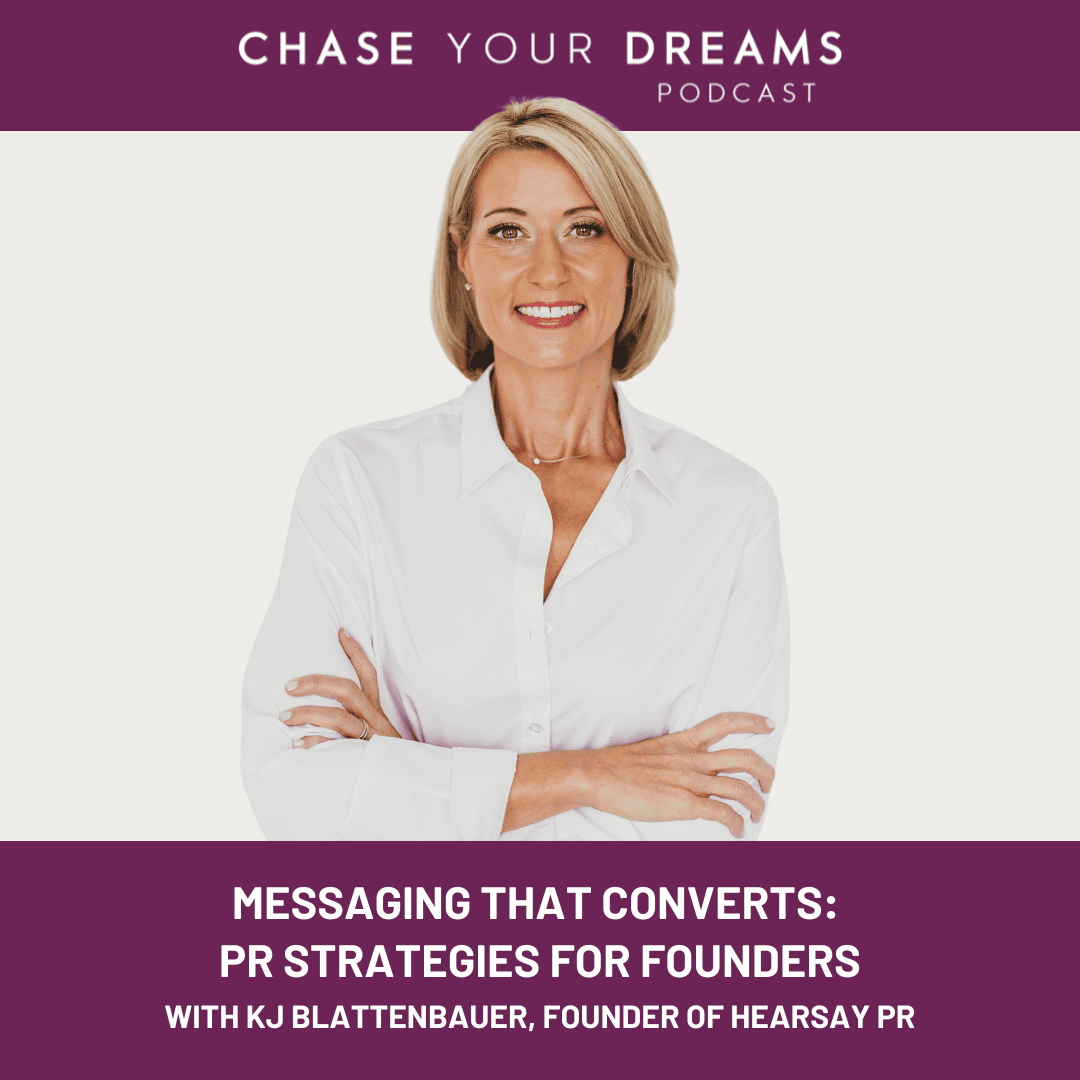
PR expert KJ Blattenbauer shares how founders can build visibility and authority without feeling salesy. She explains why great work alone isn’t enough and why clear messaging and positioning are essential to helping your audience understand who you are, what you do, and why it matters. KJ shares practical tips for crafting concise, compelling brand statements, using free PR channels, and creating content that strengthens customer connections. The conversation emphasizes the mindset shift needed for self-promotion, showing that visibility is a leadership skill and a way to serve your audience. Discover actionable strategies to communicate your expertise, attract the right customers, and grow your business.
About KJ Blattenbauer
KJ Blattenbauer is a seasoned publicist with over 30 years of experience helping overlooked experts step into the spotlight. She is the founder of Hearsay PR, the author of How to Be a Media Darling and recent release, Pitchworthy, and a trusted voice in sharing no-nonsense PR advice that gets real results. KJ specializes in helping founders and entrepreneurs craft compelling messaging, build visibility, and establish authority.
Contact info
Website: hearsaypr.com
Instagram: @hearsaypr, @kjblattenbauer
Linkedin: linkedin.com/in/kjblattenbauer/
Takeaways
- Visibility is a leadership skill that helps people understand your value
- Find your niche and speak to a specific audience
- Clear messaging is essential to attracting the right audience
- Be proactive about pitching yourself to form media connections
- Earned media builds stronger trust than paid promotion
- Visibility compounds over time
Interview Themes
Why shouldn’t businesses let their work speak for itself?
People assume that when they create a great product or service, everyone will automatically notice and purchase. The truth is, people will not notice what you offer until you tell them about it. Founders need to actively tell people what they do, how their products or service can help them, and why it matters. That’s how founders can turn their expertise into trust, recognition, and results.
Why is clear messaging and positioning important for brands?
Founders need to be able to clearly explain who they help, what they do, and why it matters in simple terms so that their audience can easily understand the value of the business. Clear messaging that avoids jargon helps attract the right customers, stand out from competitors, and improve overall conversions.
How should founders approach media outreach and PR?
Meet your audience where they already consume content. Find podcasts, blogs, and industry publications that your target audience already consumers and use them as platforms to share your expertise. When pitching, keep your pitches short and focused. Consistency and follow-ups are key to successful outreach.
What type of content should founders be producing to connect with their audience?
Use customer questions to guide your content. Your audience wants to know that they are being listened to. Creating content that answers top questions from customers will help them understand and strengthen their connection with your brand.
What’s the biggest misconception founders have about PR?
Many founders think PR is only reserved for big and expensive brands. In reality, PR can start small and be completely free. Sharing your expertise through podcasts, interviews and more builds trust and authority, oftentimes more effectively than paid ads.
Chapters
00:00 The Power of Messaging and Clarity in Building Authority
02:05 Common Reasons Founders Struggle to Be Seen
03:23 The Evolution of Visibility and Media in the Digital Age
07:19 Using PR to Build Trust and Authority
10:52 How to Position Your Brand for Media and Publicity
13:17 Creating Content That Connects
15:58 Where to Find Media Opportunities for Your Niche
18:02 The Power of Niche Focus and Clarity in PR
21:48 The Value of Free Channels and Earned Medi
26:20 PR Myth Busting: PR Is Only for Big Brands
27:47 DIY PR Strategies for Small Businesses
31:58 The Art of Pitching and Following Up
39:03 Encouragement for Founders
Transcript
KJ Blattenbauer
Messaging tweaks will dramatically change your business because building authority is about clarity. It's about who's raising their hand and making it clear. Here's what I do. Here's how you buy from me. Here's how you shop with me. Here's what we offer. That's what sets brands you've heard of apart from brands that you will never hear from. Visibility isn't vanity. It's a leadership skill. How you position yourself, how you position your business or brand, that shows the world how to talk about you in rooms you're not in. That shows your target customer how to buy from you. Don't be afraid to speak up. Don't let your work speak for itself. Choose your passion, use your voice, tell people what you do nonstop because that's the way that your brand goes from good to great and how you keep building your business year after year.
Glynis Tao
Welcome to Chase Your Dreams, a podcast for fashion entrepreneurs who want to build a purposeful and profitable clothing business so they can make a living doing what they love. I'm your host, Glynis Tao, an apparel business consultant and SEO specialist with 20 years apparel industry experience. I'm also a mom to a wonderfully energetic little boy named Chase.
Today's episode is for anyone who has ever thought, I know I'm good at what I do, so why does it still feel like I'm invisible? I'm joined by KJ Blattenbauer, a powerhouse publicist with nearly 30 years of experience helping overlooked experts step into the spotlight. She's the founder of Hearsay PR, the author of How to Be a Media Darling, and the voice behind some of the most clear, no fluff PR advice that gets real results.
In this conversation, we're doing something a little different. KJ is actually using her PR magic on me in real time, breaking down how founders can reframe their story, own their expertise, and start building visibility without feeling salesy or uncomfortable. If you've ever struggled to put yourself out there, pitch yourself, or claim the authority you've earned, you're going to have a lot of aha moments in this episode. So let's get into it.
Welcome, KJ. It's so nice to have you here today. Thanks for joining me in the podcast.
KJ Blattenbauer
Thank you so much for having me. It's wonderful to be here.
Glynis Tao
You're known for turning overlooked experts into headline news. What's the biggest reason smart, capable founders still struggle to be seen?
KJ Blattenbauer
I think it's two reasons, actually. I think the biggest reason is they think the work's gonna speak for itself. They think they do great work, what they do is amazing, they think they should just put a product, a service, a website out there, and the people will just come. And that's not true. You have to tell people what you're doing for them to know you, to like you, to want to buy from you, to know that your service can change their life, or your restaurant's the next best meal they have to have. I think that's part of it.
I think the other part is they don't know how to clearly communicate what it is they do and what they offer people. They know how to use jargon or industry speak. They know how to make really long sentences and word salad. You get nervous, you get caught up, you get a little vulnerable when you're describing yourselves. And I think what leaders need to know is the work won't speak for itself, but also you need one sentence that tells people who you are, what you do, why it matters to them, right this second.
Glynis Tao
And when someone says, I'm great at what I do, but no one's paying attention, what's usually really going on beneath the surface?
KJ Blattenbauer
The messaging, they don't know how to clearly communicate to their target audience, the people they need to sell to. They don't know how to clearly communicate what they're doing, or they're making the bigger mistake of trying to communicate to every single person and not their target audience. So it's usually a messaging or a visibility leak in their pipeline.
Glynis Tao
You've worked in PR for nearly 30 years. How has the definition of visibility changed for founders today compared to earlier in your career?
KJ Blattenbauer
I don't know if the definition itself has changed so much. I think the way to get it has changed immensely. When I started in public relations, the internet wasn't a thing and then social media became a thing. Now you have access to every single thing about every single person at all times. Silence is a leadership skill, just like visibility is. It's controlling the message the way you want it to be. I think that's what's changed.
I think people need to realize here's what you can share, should share, does this move the needle for your business forward? Here's maybe what you don't need to do. We don't all need to be Kardashians. We don't all need to have a reality show. Yes, people buy from people they know, like and trust, but that doesn't mean I have to give you my first born child, a tour of my home, let you know what I ate for my last 15 meals. We can still be selective about what we show people, what we invite them in to do. We can still let them know who we are and our value system, whether they want to work with us or not, but position it in a smart way. What's really changed is it's finally acceptable. It's okay to talk about what you do. It's not bragging, it's not boasting. Again, it's a leadership skill. You are sharing your gifts and your passion and what's changed your life with other people as a way of service to change their lives. I think that's what's great about visibility changing—the acceptance.
Glynis Tao
Many female founders, myself included, struggle with self-promotion, without that feeling salesy. How do you help your clients reframe visibility so it feels aligned instead of uncomfortable?
KJ Blattenbauer
I think it's a mindset shift. So I'm in my mid-40s. I think with age, we don't worry about what other people think, right? But for all of us, we were raised, you should be seen and not heard. Here's the box that life wants to put you in. If you brag or talk about what you're doing, if you show any accomplishments, you might make the person next to you feel small. So that's boastful. Don't be that way. But it's not true. The mindset shift we all need to make, regardless of your age, regardless of childhood trauma, whatever you have going on, regardless of your industry, is that you're coming from a place of service. You created a business, a product, a place for people to go because you saw something missing in the marketplace or a loved one saw something missing in the marketplace.
By not promoting that after you've put all of your blood, sweat, tears, and finances into creating it, you are holding it back from the people that you want to help—the reason you created it, your literal why. You need to put it out there and share it with people as a service, to help them, to make the world a better place. Not to get all woo-woo, but we're put on this earth and we're given good gifts. Share those gifts with the world. That's not bragging, that's not boastful, that's being a good human. You should want to help people move forward. Just like the National Parks slogan is. You don't want people, you come there and you're never supposed to leave a national park worse than when you got there, right? You pick up your trash, you take care of mother nature, those sorts of things. Treat people that way. Treat your business that way. Never let a customer or a potential customer leave you worse than when they came. Help that next person forward. You do that by promoting and sharing what you're good at, talking about what you're passionate about. When you feel like cowering or hiding, it's a confidence issue within yourself. Don't make it about you. Position it about them. Service to them. It will change, it will literally change your life if you start taking yourself out of the equation and putting it on the other person.
Glynis Tao
So you said you'd love to use your PR magic on me and I'm going to be vulnerable for a moment and let you coach me. So are you ready to do that?
KJ Blattenbauer
I'm ready. So I think first of all we should tell people about the process. I think that messaging is where everyone needs help. No matter who you are. Even me. If I started a new product or service tomorrow, I would bring in a peer to help me with my messaging because if I can't clearly articulate what I do, who I'm serving, what the goal is, it's a problem. Like, I don't know who to talk to. I don't know how to talk to them. I don't know how to get my target audience to come to me.
So the first thing that we did is I sent you one of my intake forms and it covers really basic questions. There was nothing in there that stumped you, right? There was nothing revolutionary in that form. You can agree, right? Very basic, very simple. It helps me gather… it's questions like, what's your main goal? Who's your audience? How do you want your target customer to think, feel after experience working with you? You know, like, what brands do you admire? Who are your competitors? It's really simple questions like that. And it helps me see your mindset and a peek into your industry, but also how you want your brand to be perceived—what your goals truly are. If you don't know again what your goal is, I can't help you find the target audience, but I can't help you figure out how to communicate with them. So through that simple form that I put everyone through, I learn a lot about people and I learn a good way to position things. I think what you do is amazing. So right now, if we were at a networking event and someone said, Glynis, what do you do? What would you tell them?
Glynis Tao
I usually tell them that I'm the founder of Chase Your Dreams Consulting and we are an online marketing agency that helps fashion, beauty and lifestyle brands get better online visibility through SEO and GEO.
KJ Blattenbauer
Right, right. So for me, I know what those things mean, right? To a point. But even I'm like, SEO and GEO? I have to think for a second about what that is. For the normal everyday entrepreneur or for people who have no clue what even being an entrepreneur is or even people who have been in the industry for a while, they can tell you're good. They can tell you're smart. They can tell you that you know what you're doing, but the positioning is a problem. It's unclear to them exactly what you want to be known for because if it's not immediately clear, if they have to stop and think for a second, it's a conversation problem for them, which will then be a conversion problem for you, right? So if I was going to introduce you, I'd say, “Glynis helps fashion and lifestyle e-commerce brands turn Google and AI visibility into predictable revenue, not just traffic.” I feel like those are things people understand AI to a point. They understand Google. They know the two brands you want to serve, that you mainly deal with e-commerce, right? Correct?
Glynis Tao
Yes.
KJ Blattenbauer
And then what you can help them do right now. Like, what's one thing that anyone's going to understand? When they hear “revenue” and when they hear “predictable revenue”, because most people, they struggle with up and down, right? Like, everybody wants consistent months. We want to be able to forecast that, especially if you're in the fashion and retail space. Correct?
Glynis Tao
Yeah, absolutely.
KJ Blattenbauer
And so I think it's not just traffic. So for me, it would be something simple like that. “Glynis helps fashion and lifestyle e-commerce brands turn Google and AI visibility into predictable revenue, not just traffic.” And I feel like people will take it faster because you've identified their pain point. Like you've already said, they're like, I'm a fashion brand. I do e-commerce. Wait, predictable revenue? She can tackle Google and AI. So it immediately pops for them. It's the who you are, what you do, right now why it matters, and their pain point. And it just, for people, lights them up. But it also becomes a magnet for media outlets because all of their buzzwords are in there and not in a jargony way, right? We've got the fashion, we've got lifestyle, we've got e-commerce, we're covering Google, AI, everybody wants to talk about AI right now. But then on the business side of things, predictable revenue and not just traffic, but also like, oh my God, send me traffic, especially when there's so much noise there. I feel like there are so many pitches. Like you could take that, throw that in AI itself and be like, help me figure out some pitches for this publication for this. And it would spew so much information for you, you would be so busy pitching, you'd be like, KJ, just, I don't have time.
Glynis Tao
I love that. Thank you so much. Like if you don't mind, I will actually use that.
KJ Blattenbauer
I’ll be offended if you don’t haha.
Glynis Tao
It just makes things so much more clear and less jargony. And shows what's that result other than just traffic? You know getting traffic is one thing but right turning like…
KJ Blattenbauer
And it just proves that you, like anyone could say, we can get you traffic. But it's one thing to get traffic that converts and you have a track record of doing that. You know how to do that. And I think it helps prove like, Glynis really knows her stuff.
Glynis Tao
Yeah, and this is the part that I think I really struggle with in communicating whether it's through a bio or through my introduction at a networking event. I mean, that was sort of the line I had been using. I guess I kind of overlooked and thought everybody knows what SEO and G-O mean, you know, that's what they're looking for. But I think that's just the wrong assumption, right?
KJ Blattenbauer
Yeah, well, I think you're in it day to day, right? Like you're in it all the time, morning, noon, and night. You're surrounded by people who are also in it morning, noon, and night. The rest of the general public, I can tell you that I have talked to 50 entrepreneurs this week in one-on-one phone calls. I bet three of them knew what SEO was and how it could benefit them. And I really think if they're like local businesses, they don't even realize they should be using SEO through their Google business to drive the local traffic. I just don't think that people make the connection.
And so like my next challenge to you would be, okay, we've narrowed down, here's how you talk about yourself, here's how you put your skills and your expertise in that one sentence. Now you have the clarity to help position yourself for people. I would take the top 10 to 12 questions people ask you all the time, and I would base my content on that. You're literally taking what your target customer, potential customers are asking you all the time. Answer their questions. That is your content on your social media, on your website and the facts. If you do pitches, position pitches around that, it's gonna not only show you as the expert who gets it, but it's also the expert who listens. Like, oh my gosh, she's talking to me. Like, that's my exact question. How did she know? You know, you're the mind reader. It helps them associate with you faster. It helps them feel more comfortable. But truly as human beings, we all want to be listened to, and we really just want someone to solve our problems. Like, I'm a business owner multiple times over. I have my PR company, I have side businesses, I have businesses I invest in. There are at least four times a week where I'm like, I will pay any amount of money for someone to fix whatever this roadblock is. And the key is just to be that roadblock remover.
Glynis Tao
Yeah, I think what most people want to do is just be seen and heard and understood and that I can relate to whatever that pain point is that they are facing. And there are several repeated questions that I get asked over and over again. And I think through the years of doing this, I mean, I've gotten a lot more familiar with the types of common questions. So definitely, it won't be that hard for me to put together this list of the 12 questions.
KJ Blattenbauer
Right, and you find like year after year, right? It's kind of the same questions.
Glynis Tao
Yeah, it mostly is.
KJ Blattenbauer
Because your experience is real. You've lived it, you know, you've converted people, you have the track record. Like if we were Girl Scouts, you'd have all the badges that prove how good at what you do is. You're that good at what you do.
You take all of that real experience and you put it out there. It's clear if people are asking the same questions over and over again if they Google it and can't find a clear answer until you put your answer out there, right? The market needs one dominant expert. They need one dominant signal to latch onto to help them find things. There are places like exactly what you do specifically for your target audience. There isn't anyone out there doing it. There's no one who is putting their stake in the sand and being, hey, here's who I am. here's what I do, gonna answer all your questions. It's gonna, like, fish are going to jump into your boat.
Glynis Tao
Yeah, and so maybe if you could give me some examples of where some of these places would be.
KJ Blattenbauer
Literally, okay, fashion and lifestyle brands, right? They're busy. They're either e-commerce, head-buried, worried about what they're launching next. What are they reading? What are they watching? What are they listening to? I'm guessing they don't have a ton of time to read. And if they do, I'm sure they're trying to read something like a BuzzFeed, something setting trends, something, you know, like they're not pulling out the latest issue of Forbes, right? Probably multitasking, right? Like I work with a lot of females. They're so busy doing a million things, they listen to podcasts. So when I want to promote anything, I go on podcasts because they can listen to the podcast to learn something while they're doing their day-to-day tasks to make their business better, right? So I would look for literally any podcast that is focused on your industries, fashion, lifestyle, e-commerce, but also that touches on AI, Google, SEO. I bet if I did a podcast search right now through one of my media databases, I could find you 8,500 podcasts that we'd have to narrow down for good fits. And you don't have to go on like the biggest podcasts. You know, it's the quality of the listener, not the quantity. I've been on podcasts that have 3.5 million downloads. I've been on podcasts that have 220. I've made more money off the 220 person podcast and it's because they are listening to someone they trust. They are looking for the resource. And if you clearly communicate your message, they're going to become your people. It's a sampling of all of this, not just the most popular.
Glynis Tao
And maybe not so general, but more niche topics and audience, which I felt I built with my platform, being so specific for fashion founders and business owners. I feel that it gets a place for a source of information and education for fashion business owners. And that's the feedback that I get from people. And so it's really aligned with what I do which overall is to support founders' growth with their business. so, yeah, I guess I spent a lot of time trying to craft and refine my messaging and it has definitely changed and evolved through the years from five years ago to like when I started to now, right? It definitely has changed and I'm still constantly in the process of refining just based on feedback mostly and what it is that people are looking for and the problems and pain points that they're looking to solve.
KJ Blattenbauer
And I think you're going to find when you get clear on your messaging, when you're out there where your people are, you're going to find that you probably don't have competition because people aren't choosing between experts. They're choosing clear authority. It's not about who's raising their hand. I'm a PR expert. I literally wrote the book on it, multiple books on it. There are a million PR people out there. I wrote the book on it twice. So it's not about how big my audience is. It's about raising my hand and letting people see clearly, I'm the expert, here's how I'm the expert. Clarity is gonna beat the comparison every time. Like yes, there might be multiple people who do what you do, but if you clearly communicate your skillset and show your track record of how successful that you've been, they're gonna choose you every time. Because when your positioning is clear, the right people are gonna self-select you before they even hop on a call. And I think that predictability comes from when you establish your authority, not the volume of how many things you're doing, how many times you're posting, all the things you're putting.
Glynis Tao
Okay, and so sometimes I feel like I've maybe niched myself too much. Like a fashion, beauty, lifestyle-y, calm SEO strategist. I don't know. I find sometimes people pigeonhole me as only doing that. Is that a good thing, would you say? Or should I sort of broaden my messaging a little bit and saying I can handle e-comm because I can, but I've just chosen to specialize for this particular niche.
KJ Blattenbauer
No, I think it's great to specialize in your niche. Think about it. We will never run out of clothing brands. We will never run out of fashion companies. We will never run out of lifestyle brands. There are so many that like there could be 15,000 of you within a two square mile radius and there would still be enough work for everybody. Everyone needs what you do. They just aren't aware that they need what you do. So you have to educate them on why they need it and show them how helpful it is.
It could be, you and I have, I think, similar issues in our industry in that most people don't understand what public relations is. They think it's nice to have when they make six or seven figures, or they have to be famous, or they have to make so much money because publicists are so expensive. When the truth of the matter is people need your skill set and my skill set, the second they incorporate the business, we are top of the funnel. When you're legalizing your business entity, when you're trying to make sure that your social media handles match and your branding colors are pretty, they should be thinking about what you do. They should be thinking about why I do. We are at the top of the funnel. People can't buy from your business, use your product, use your service, come into your store, support you or promote you to other people if they don't know you exist. Like no one can fund your app if they can't find it. People have to talk about it. They have to get traffic from you and it has to be traffic that converts, right? They have to know you exist from publicists like me. And so you and I should be at the top of the funnel. And it's just re-educating people on like, it's not going to cost you an arm and a leg. It's going to have more than enough return on investment. Here's why this should be something you do before the social media manager, before all the other wonderful, fun things to do.
Glynis Tao
Yeah, and I think I feel a lot of times people sort of really get hung up on one channel doing all the heavy lifting, being social media, like constant posting 24/7. It's like a drain on your energy and resources or paid ads. Immediately going into paid ads without even testing products. This is one thing I hear people saying, I just went straight to paid ads or paid meta ads and they spent a lot of money and did not see any return back. And I'm like, why are you still doing it, right? Because I feel like I have to do something.
KJ Blattenbauer
It's not right. So let me let you in on a little secret. Okay, so I've been doing public relations for 28 years. I've had my own agency for 14. I've never run a paid ad in my life. I've never had to. I took two and a half years off social media. I just started posting again because I want to make it fun for me. It doesn't drive my business. My business was never hurting. Nothing ever stopped. When I didn't post, when I didn't play the game, when I didn't let Meta light me. I have never spent a single dollar on a Facebook ad, on an Instagram ad. I never will. I haven't done anything digitally.
Why? I understand the need to do something. Why not use the free channels? Every public relations resource is free. You should never pay for a magazine article. You should never pay to be on someone's podcast. You should never pay to speak on someone's stage. There are tons of other newspapers, TV shows, podcasts, where your expertise can shine through and you can take advantage of someone else's audience to convert them into your audience for free. Use up all the free channels and favors first. Like talking to you or me, it might cost them money upfront, but after that, you can set up their SEO so it's running while they sleep. You can set up their SEO and their anything for Google. So their Google business can be driving all sorts of revenue for them, all sorts of traffic for them. After they use your services and pay for your services, they're not paying that Google business to run for them.
Glynis Tao
They’re not spending any more money on ads to keep it running. It's just kind of working there in the background.
KJ Blattenbauer
Right. And people can see ads are insincere. It's marketing. They know that you're trying to sell them something. When they're seeing you everywhere because the SEO and the traffic is driving them to you, no, that's the universe pulling them in the right direction. That's the sign that they need to come into your store, buy from you, wear this apparel. When they start seeing an expert all over different media outlets, yeah, it's one thing if I say, hey, Glynis is really good at what she does. It's another thing if you say you're really good at what you do. But if Forbes and Fox and people and they're like, this is the lifestyle brand person who knows how to change your business, that moves the needle. That's a third party endorsement from a reputable outlet that is going to tell people, Glynis knows what she's doing. And that eight or nine or 15 touches whatever we're at before you close a sale, the media reduces that down to three. It turns cold leads to warm leads like that, and it's free.
Glynis Tao
Right. Okay. So I feel like this is part of the misconception out there of what PR really is. Publicity versus paid media, right? Like there's paid media, like ads, paying for ads, but the PR you're talking about is free. It's publicity. It's earned media versus paid media.
KJ Blattenbauer
Yeah, you earn it with your experience, earn it with your expertise, you earn it by pitching yourself and putting yourself out there. You know, the Super Bowl is this week. I don't have any skin in that game. I don't work with any of the big brands that have ads. I don't make the ads. I don't deal with the NFL, you know? I'd probably be having this podcast from a bigger house if I did, but I've been on the radio 16 times in the last two days talking about branding and positioning and why people are spending $8 million for 30-second Super Bowl ads. And it isn't even about having the ad in the Super Bowl. It isn't even about getting people to buy what they're advertising in the Super Bowl. It's about building rapport leading up to the Super Bowl so that they can be in everyone's living room, because the Super Bowl is one of the last places where people don't skip ads when they're watching television. So it's literally a two week runway that they run these ads before the paid spot they get for the Super Bowl. And yes, is $8 million ridiculous? Of course it's ridiculous, but it's the perception. If people are sharing, talking about, you're using you in memes, having you on social media. If you're in a conversation where normally your brand wouldn't be a conversation with a certain group of people, it's because the Super Bowl is getting you in their living room. That's the success of those ads. That actually, so it's an ad buy, it's marketing, but the perception leading up to it and how they spin that is the public relations, the free part, how you control the conversation.
Glynis Tao
Right, because I mean, there's so much talk around the ad itself, right? It becomes an actual event and maybe some people don't even watch the game or only there for a halftime show and see what those sponsored media ads are going to be. That's interesting. Like, what's the biggest PR myth that you wish founders would stop believing?
KJ Blattenbauer
That they need to be famous six or seven figure earners. That it's nice to have an addition for their business at the end. That it's so expensive it needs to wait till they get to a certain part. It's literally free. Outside of paying for a publicist or like $19.99 for my book or maybe a 99 cents for the ebook version, public relations is free channels. The news doesn't have a news hour if they don't have any stories to cover. Right? A magazine doesn't go to print if it doesn't have people to feature. Podcasts can only survive on solo host podcasting for so long. That's why so many of them end so quickly. They need experts. You're an expert. It's free to be on these outlets. You can just reach out and put yourself out there.
Glynis Tao
So like you just touched on that a lot of people think that PR only for big brands or maybe people with massive followings. What do you say to that? Like for the small founder who's just listening today and thinking that maybe PR is too expensive. That's maybe my mindset around it. I always thought I have to be at a certain level to start to hire PR, but from what you're saying, I think you don't necessarily need to hire an expensive PR person. How do you work normally? Do you take sort of a consulting advising approach plus DIY or somebody who says they want to DIY their? Is it possible for someone to do that and still get good results?
KJ Blattenbauer
It's 1000% possible for someone to DIY their PR. I have freebies on my website. If they go to hearsaypr.com/freebie, I have tools that will literally walk you through here's how to convert your messaging, here's a pitch checklist, go do. You don't have to spend a dollar to get started. My new book, Pitchworthy, is literally how to DIY public relations. The pink version of the book is gonna explain every single thing about PR and have some exercises. The white version of the book is literally a workbook that would walk you through the step-by-step process that I've used for almost 30 years to help brands grow. But you don't even need to purchase those. If you can sit down and rewrite your sentence like we did for you, just to who you are, what you do, why it matters to your target audience right now with their pain point, then you can go do this thing called use the Google machine and you type in what your industry is, or you type in what your area of focus is. Put that in Google, you hit the search button, and where it says “Images”, my favorite tab of shopping, there's the next one and it says “News”. That news tab is gonna show you every single outlet that's ever written about what you're searching about. So you can start building your media list there. If you click on those outlets, it's gonna give you exactly the reporter who's writing about you. Sometimes you'll get lucky and you'll click on there and you'll have the reporter's address. Other times you'll have to do another Google search to back end it or sign up for a service like rocketreach.com. Pay a dollar a month and you can get like five or six email addresses of reporters. You don't need a media list of 5,000 people. You don't need to spend thousands of dollars buying a media list. You can find one for free doing a little Googling, which let's be honest, we're all FBI-level sleuths when we really wanna find something. If you do that and build a media list of five to 10 people and you send five to 10 pitches in the next two months, it can change the trajectory of your business. But also it's free. You rewrote your sentence, you started your media list, and then you just send a pitch. It's five, seven sentences. Hi, my name is Glynis. Use your line about what you do. Here's what I'm seeing in the marketplace. Here's how it benefits your readers, listeners, whoever you're pitching at that moment. Write the second and why I think I should come on your show, podcast, right now. That point in time, here's my contact information. Send it. If you don't hear back in five to seven days, I forward on that same email. I change the FW and the forward subject line to follow up. Then it's one more sentence. Hi. Checking in again. One more pain point you can address right this second why it matters to their audience. Let me know if you want to chat. Let it sit for another seven, 10 days. Follow up a third time. Same formula. If you don't hear back after that third one, and it's very rarely you won't hear back after that third one, the reporter's either extremely busy. Maybe they're not interested in that angle. Maybe you don't have the right reporter, but you tried. So then you try a different angle. You try a different reporter. You keep doing it.
No or no response is not rejection. It is data for you to understand things. Like literally, what's the worst thing someone's going to do if you pitch them? It's not saying no, it's saying nothing. You're already at no by not reaching out to anybody. Pitching them and having them say no just tells you, okay, not right now, not the right angle, not the right person. Go find the right angle, the right person, the right timing. That's what it is. It's an adventure. And I think so many people are scared. They think that there's like a 55-year-old white man in a business suit smoking a cigar on the other end waiting for an email to come across and the second it does, he's just going to hit reject and delete it. When the truth is, reporters, journalists, editors, podcasters, they're just like you and I. They're busy. They're getting tons of emails. They might not have seen your email. It might not be a good fit for them. They might not have the description very well on their podcast or their website or anything else. So maybe it's their fault you didn't clearly pitch them what they needed to hear, right? No one's going to be mean to you. They're not going to come to your home. They're not going to laugh at what your pitch is. No, they will be busy. I have reporters I've worked with for years. They never respond to my first email, but I get a 75 percent return rate on my second. And it's because I follow up and so many people do not follow up. I'm begging people. Pitch, follow up, put yourself out there, gather the data and keep building.
Glynis Tao
Yeah. Do you have any sort of recommendations on how long a pitch should be? How long does it need to be, actually? I always hear from lots of words to like few sentences.
KJ Blattenbauer
Think of the emails you like to read. I'm an email skimmer. If it's War and Peace, I'm not reading it. A journalist gets 16 times the amount of emails I do a day. They're not reading it. Five to seven sentences, more than enough. Two to three actually would be ideal if you can be that succinct about stuff. Like I see a lot of those podcast pitching services and their paragraphs and I'm trying to teach my interns, hey, they don't need the full bio. They don't need the full paragraph. They don't need the description. Like, this is not War and Peace. Certain people think that you should pitch, it should be long, you should include everything because you never talk to that reporter again. No, that becomes that meme, like, saying, sorry that happened to you or happy for you. I'm not reading all that. You know, it's two to three sentences, five to seven sentences max. Who you are, what you do, why it matters, write the second to their audience and why they need to talk about it or with you immediately. It's urgency and timing.
Glynis Tao
And so I guess more times you reach out and perhaps the better likelihood of getting a response if you happen to catch someone or their attention at the right time if they're looking for a particular topic and you're the subject matter that happens to show up. But if you don't pitch you have zero chance.
KJ Blattenbauer
But even like yours, okay, so Valentine's Day is coming up. I wouldn't normally associate that with SEO or what you do, but the secret weapon to helping people fall in love with your fashion brand, yeah, SEO, GEO, it's what people need. It's a love language. There are a lot of business outlets that are looking for unique spins on, well, it's the timing. People are all about Valentine's Day. Forbes isn't putting out a “Here's 17 Business Gifts to Give Your Valentine.” No, but let's worry about yours. “The Hottest Way to Get People to Fall in Love With Your Brand This Valentine's Day.” “Have you checked your SEO?” “Do you even know what it is?” That's going to get someone's attention.
Glynis Tao
Wow, I never even thought of that. So already you've given me such a great idea. I can take and run with it. And another thing I guess for me too is what's holding me back from reaching out is my fear of rejection. Like you said, if you don't try it's an automatic no. I'm just wondering sort of what's the response rate that you usually see people come with a cold pitch? And also other platforms, like have you used Help a Reporter Out? Are those even worth using?
KJ Blattenbauer
I used to use Help a Reporter Out. About four years ago, I stopped. They changed the platform. The original owner sold it off to someone else, and the other person, I think, drove it to the ground. Now you have to pay for it. It's no longer free. It's no longer a great resource. The good thing is, Peter, the founder of the original Help a Reporter Out, started a new one, and it's called SourcesofSources.com. It's free. I highly, highly recommend it. Twice a day, you're going to get an email split up by industries of reporters, editors, journalists. They are looking for experts. And it's as simple as answering these three questions, maybe your website, maybe they want an image, you get it back to the person by a deadline. You don't even have to interact with the person. You're literally just sending them something. If they use you, great, make sure you have a Google alert set because they're not gonna get back to me like, hey, you're gonna be featured tomorrow unless they need more in-depth interview from you. But it's an easy, easy way to do it.
There's also places like Founder where you can go put your expertise in a database and people who are looking for experts can find you. Or you can search through their stuff and become quoted. I've had clients everywhere from Time Magazine to Forbes, Martha Stewart, even Architectural Digest, just by being in those two outlets alone. So those are two really great free ones.
Another really good one that I love is Authority Magazine. Yitzi has done such a great job of producing, I think they have like 366 running storylines at any time. You submit for one based on an industry that might appeal to you or maybe numerous ones. They send you 12 questions, you answer them. They literally after reviewing it, if it makes sense for them, they think it's good, they think you're reputable and know what you're talking about. Copy paste your answers. You have your first press hit. You're already building a press page. That's all you need. You just need one to get things rolling, shake the nerves off to go and do.
Yep. And what's great about magazines, it's a feeder for Buzzfeed. It's a feeder for Entrepreneur. It's a feeder for Forbes. It's cool to start getting yourself established if that's where your target audience is.
Glynis Tao
And speaking of tie-in with SEO, link building builds authority as well and getting a backlink from a higher authority source. I feel like PR and SEO sort of go hand in hand together if you think about it.
KJ Blattenbauer
Truly, truly, yeah, they can only help each other. But also if you're a local business, your local newspaper, your local TV station. Every local TV station has a morning show or something that runs mid-afternoon that only focuses on local business. If you are a local business and you haven't pitched yourself to that, what are you doing? That's literally their job. Help them do their job. Show them that you exist.
Glynis Tao
So I see there's a copy of your book, Pitchworthy, there behind you. Is that the newest book that just came out?
KJ Blattenbauer
Yep.
Glynis Tao
The pink cover?
KJ Blattenbauer
The pink cover is the book book and it will walk you through everything about public relations and it gives you a pep talk. So many of us don't feel like we have a story, nothing to talk about. So it basically gives you the steps plus permission. Here's how to use public relations. And then it was so well received. People loved it and they said, hey, there's exercises, but I want to know, how do I do the work? Like people were showing me broken spines. They'd written on every page. They had post-its falling out of it. And I said, all right, like I've heard you guys. I've heard you. So I pulled a few all-nighters and I put together the white version. The white version is the workbook and it literally is step-by-step. Here's your brand words. Here's how we're building your messaging. Here's how we're building your media list. Here's how a media kit goes together. Here's all the exercises you need to think about. It's everything that's been in my head for decades.
Glynis Tao
That sounds like a dream. I mean, get your 30 years knowledge all packaged into this really nice looking book, by the way. So I think I'm going to go and buy it after I get all this call with you. Is it on Amazon?
KJ Blattenbauer
Yep, they're both on Amazon. I just think it's so important for your listeners to know there's nothing wrong with their product, their service, their business or brand. They might just have a visibility leak like we talked about in the beginning, just how they're talking about and positioning themselves for other people to know them, to like them, to buy from them. Messaging tweaks will dramatically change your business because building authority is about clarity. It's about who's raising their hand and making it clear. Here's what I do. Here's how you buy from me. Here's how you shop with me. Here's what we offer. That's what sets brands you've heard of apart from brands that you will never hear from.
Glynis Tao
And so for a founder who is listening right now and feels unseen or invisible and starting to lose, they're feeling discouraged. What do you want them to know?
KJ Blattenbauer
I want them to know that visibility isn't vanity, it's a leadership skill. How you position yourself, how you position your business or brand, that shows the world how to talk about you in rooms you're not in. That shows your target customer how to buy from you. Don't be afraid to speak up. Don't let your work speak for itself. Choose your passion, use your voice, tell people what you do nonstop, because that's the way that your brand goes from good to great and how you keep building your business year after year.
Glynis Tao
Where can people find you if they want to get in touch with you?
KJ Blattenbauer
My website's hearsaypr.com. That's H-E-A-R-S-A-Y-P-R.com. And then KJ Blattenbauer, K-J-B-L-A-T-T-E-N-B-A-U-E-R on Instagram.
Glynis Tao
Instagram and LinkedIn as well, I would assume they want to reach out to you there. So thank you so much, KJ, for joining me today and I really appreciate that clarity and practical perspective that you bring into publicity and PR.
KJ Blattenbauer
Thank you for having me.