
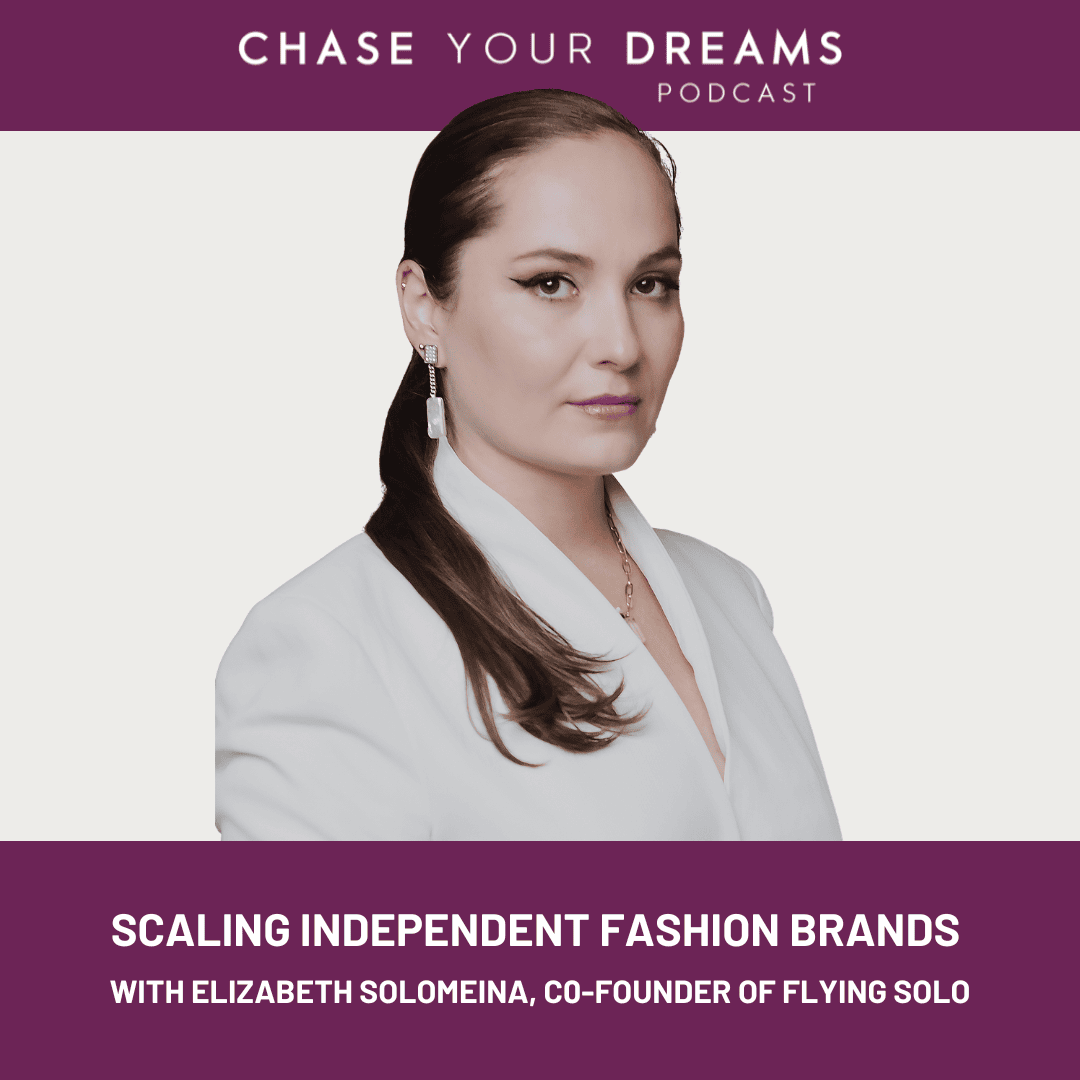
Elizabeth Solomeina, co-founder of Flying Solo, shares her insights on the challenges independent designers face in the fashion industry. She emphasizes the importance of a sustainable approach to growth, the need for strategic planning before expanding into international markets, and the value of press exposure in building brand credibility. Elizabeth also discusses the significance of separating personal identity from creative work and offers practical advice for designers feeling stuck in their journey. The conversation concludes with an exciting announcement about the upcoming Flying Solo Awards, aimed at recognizing talent in the fashion industry.
About Elizabeth Solomeina
Elizabeth Solomeina is the co-founder and managing director of Flying Solo, an innovative fashion platform with flagship stores in New York City and Paris. Since 2016, she's built a space created for designers, by designers, supporting 250+ independent brands through retail, runway shows in Paris, New York, and Milan, and meaningful editorial exposure. Elizabeth is also a designer herself, which means she understands firsthand the challenges creators face when talent alone isn't enough to build a sustainable business. Flying Solo has been called the future of retail.
Contact info
Website: flyingsolo.nyc
Instagram: @flyingsolonyc
Linkedin: @elizabeth-solomeina
Takeaways
- The slow journey is the most sustainable one for designers.
- Independent designers often face challenges in scaling their businesses.
- Press exposure is crucial for building brand credibility.
- Designers should avoid overproduction to maintain cash flow.
- Understanding different markets is essential for international expansion.
- Feedback from customers is vital for product development.
- A business mindset is necessary for success in fashion.
- Designers should separate their identity from their creations.
- The first two years of a fashion business can be particularly challenging.
- Flying Solo aims to celebrate unseen talent in the fashion industry.
Interview Themes
What should independent designers know before expanding internationally?
Expanding internationally means adapting to a new culture, not just selling in a new location. Customer preferences, sizing, materials, and buying habits often differ significantly from one market to another, and operational systems such as taxes, labor laws, and logistics can be complex. Designers should take time to research, test the market, and prepare financially before committing major resources. Sustainable international growth requires patience, flexibility, and a willingness to learn.
What is the most common early-stage mistake emerging brands make?
Overproduction. Designers manufacture too much to reduce per-unit costs, tying up cash flow in unsold inventory. It’s better to produce small runs, test demand, and scale gradually — even if margins are thin at first.
How should independent designers approach pricing?
Pricing should start with market positioning rather than just production costs. Designers need to research comparable brands, understand their target customer, and determine where their product fits in the market. From there, they can work backward to ensure manufacturing costs and margins support marketing, operations, and profit. A thoughtful pricing strategy reflects both brand value and long-term sustainability.
How do you drive consistent sales today?
Consistent sales come from treating fashion as a business, not only as a creative outlet. Strong financial planning, clear positioning, and steady customer relationship building are essential for long-term growth. Early customers should be nurtured carefully, as repeat buyers often become loyal advocates. When creativity is supported by business strategy, brands are better positioned to grow steadily over time.
Chapters
00:00 The Slow Journey to Sustainable Fashion
02:11 The Birth of Flying Solo
08:57 Understanding International Retail Challenges
13:21 Finding the Right Fit for Flying Solo
16:08 Strategic Moves for Brand Expansion
21:11 The Importance of a Sustainable Approach
22:49 Navigating Press and Publicity
29:24 Leveraging Press for Sales Momentum
35:38 Business Mindset for Designers
39:19 Advice for Stuck Designers
42:19 Future Initiatives and Awards
Transcript
Elizabeth Solomeina
It will be a slow journey at the beginning and it's fine, but the slow journey is the most sustainable one. Too many times designers get excited over produce and as a brand they will not even last two years. So that is the very sad truth about a lot of independent brands. I'm a designer myself. I want everything right now. I overspent so much money on my first collections because I wanted real golden diamonds. I wanted the best possible production. I obviously bet it on myself and produced more than I could sell at the time. So I made all of those mistakes. So trust me from both independent designer myself and someone who watched design after design after design every single day what challenges they face. Just trust me and try to avoid it. You'll thank me later.
Glynis Tao
Welcome to Chase Your Dreams, a podcast for fashion entrepreneurs who want to build a purposeful and profitable clothing business so they can make a living doing what they love. I'm your host, Glynis Tao, an apparel business consultant and SEO specialist with 20 years apparel industry experience. I'm also a mom to a wonderfully energetic little boy named Chase.
Today's guest is someone who's truly reshaping how independent designers show up, get seen, and grow in the fashion industry. Elizabeth Solomeina is the co-founder and managing director of Flying Solo, an innovative fashion platform with flagship stores in New York City and Paris. Since 2016, she's built a space created by designers for designers, supporting more than 250 independent brands through retail runway shows in Paris, New York, and Milan and meaningful editorial exposure.
Elizabeth is also a designer herself, which means she understands firsthand the challenges creators face when talent alone isn't enough to build a sustainable business. Flying Solo has been called the future of retail and in today's conversation, we're diving into what that actually means from reinventing retail and visibility to building community without losing the soul of the business. If you're a designer, founder or creative entrepreneur trying to grow without selling out, this episode is for you.
Let's get into it. Welcome, Elizabeth. It's so nice to have you here today. Thanks for joining me on the podcast.
Elizabeth Solomeina
Of course, Glynis. It’s so nice to talk to you today.
Glynis Tao
So you're both a jewelry designer and a retail platform founder. Take us back to the moment you realized Flying Solo needed to exist. What problem were you personally trying to solve?
Elizabeth Solomeina
Absolutely. So I started as a jewelry designer and I still am a jewelry designer even though Flying Solo takes the majority of my time at the moment. Any independent designer can relate to the problem that you grow a little bit. You created something and people start liking it. You start getting a few customers here, a few customers there, then you start growing your customer base. Now all of a sudden you start getting repeated customers, people here and there start talking about you. So you grow to a certain size to prove that your concept is needed, that people respond positively to it, and that they're willing to spend money on your beautiful accessories or clothing.
Then it comes to a point when you just don't know how to grow further because you either have to open your own store, which at that point, normally designers just don't have enough cash flow to do so, or you have to go wholesale. Again, when the wholesale sounds like something that you produce and they buy, reality is you have to finance everything upfront and with a lot of stores currently, not paying for wholesale and a lot of other problems that are happening within that industry. It's really hard for independent brands to go that route.
So turns out I wasn't alone with my problem. I always wanted to be the designer that is featured in Vogue and Harper's and a presentation during Fashion Week and runway shows and being in stores in Soho. Yeah, I was also dreaming about Paris, but how do you get there? That was the question that I asked myself many, many times together with my sister who is my co-founder in a jewelry brand. And then I met a lot of other independent brands that faced the same exact problem, that were all looking for the solution. So we basically were all looking for Flying Solo and it didn't exist at the time. It happens naturally. We first decided to do a few pop-up stores here and there and the concept was proving itself. So we all were very much in a collaborative spirit running those stores. First it was 10 of us, then when we opened our first flagship stores it became 30, then it's 50, then 100. Now we have over 250 designers at any given point.
Reality is we were all designers. So the very core founding members of Flying Solo are designers themselves. We knew what problems we had to solve and we're just simply solving it for ourselves. Of course, retail was the first immediate need because as an independent brand, what we all realized is the first need is not just to get to a retail store, but you need to be able to experiment with your collection.
Let's say you bring something and certain pieces are selling, certain pieces are not selling. If you go the traditional wholesale route, most likely only a few of your pieces of the collection sold, that will be it for you for that store. They'll never purchase from you ever again and you'll be just done. What independent designers really need is to bring that collection and say, hey, those few pieces are working for me. How do I build the next season on that? Or maybe I have the capability just to change it right away because customers say it's too tight on the shoulders, but otherwise they love it. The color is not what they're looking for, but maybe in a different color and they'll purchase it. So you start experimenting and bringing those pieces and little by little people start buying more and more. And that's how you build an actual brand.
And on top of it, very quickly we’ve come to realize that press is something that we all needed. You've been featured in a magazine, now everybody knows about you and runs to buy your pieces. I mean, unfortunately, or fortunately, press doesn't have that pull anymore because we are all bombarded with the social media and all the fashion starts living in the digital space. But when you are featured in a big magazine like Vogue, Harper's, L’Official, just to name a few, you start having a different status all of a sudden for a customer. All of your potential customers start seeing you differently. You know, just a cute little brand that they discover. Now someone who's been approved by the industry, it's a very big step for an independent brand. We saw it ourselves how pieces might be really great just displayed in Flying Solo, but once they get that editorial coverage, all of a sudden people say, oh, the brand posted that and this item was featured in Harper's. Can you take a look at it? And all of a sudden everybody is just interested in that particular item because they already have that industry approval behind it. So we started doing press for us, first of all, and then a bunch of other designers joined. And yes, it's been an interesting ride. We started Fashion Week half a year into Flying Solo. So we opened in, a little more than that, we opened in June of 2016. Our first runway show was February 2017. So we did our first big runway show. Honestly, even though we had so much excitement, I think only a few of us knew what the runway show really takes to produce. And thank God we somehow collaborated together and pulled it off the first time around. We did so many shows after that. I believe this New York Fashion Week, the upcoming one in a week from now will be our 46th show in total. So we did quite a bit. So we learned, we grew. Now we showcase over 70 brands in any given show and we made sure to organize it for designers the way that we want it to be organized. So all the production is taken care of. You as a brand just bring your collection and showcase it to the world. We'll take care of the rest. So that's the beginning of Flying Solo.
Glynis Tao
So, since then you've helped hundreds of brands, designers enter markets like New York and Paris. What do most emerging brands misunderstand about international retail before they try to expand?
Elizabeth Solomeina
You don't know what you don't know. The big thing is you might be successful in your own market and it's great. But first, what you're going to learn is that the taste of a customer is different in a different market. It absolutely doesn't mean that your brand should not go to a different market. It just most likely means that you have to adjust to that. Maybe different SKUs start selling better in a different market. You need to think of multiple things, including weather, including body shapes, which are very different. For example, European body shape average is very different from American body shape average and I'm not just talking about the size that Americans normally sell are bigger sizes, but also the shape itself. So in the US, for example, we have a bigger ratio between waist and hip, for example, that's much more normal compared to Europeans where the ratio is much smaller. So all of those things will impact how your clothing and accessory things will be selling in that market. Also, there are preferences in materials. For example, Europe cares much more about materials compared to the US. They want to make sure that it's natural. In terms of jewelry, they would rather buy solid silver than something gold-plated compared to the US that would rather buy gold plated than to leave it silver because shiny is better.
It's just part of a different culture. None of it is good or bad. You need to understand people. And I'll give you, I just gave you just a few examples about how different things are, but reality is so much more. And the only thing that you can do is come to the market, your collection, and see what's working, what's not working and adjust as we go. And please don't be discouraged if all of a sudden you were a successful brand somewhere else, like in maybe in your own country and came to a different market and all of a sudden nothing is selling. You know the failure. You just need to remember that even in your market you started somewhere. You started somewhere where no one knew you, no one cared about you and little by little you start building there.
Both the US and Europe are really amazing markets, but it takes time to get here. And with that said, even when the brand has enough capital to open their own stores, I advise you not to go this route at the beginning. You will do it at some point if you set for it and it's incredible. Then you can build your own store and decorate it however you see fit and all of those things and train your own sales staff and all of those, that's incredible. But at the beginning, you have so many challenges in your market that you simply don't know. You don't know the tax system. You don't know how to open the company. You don't know the banking system. And we went from the US market to the European market. And trust me, it is so different. Things that you never expect will be an issue became an issue. Things that do not exist. An issue that doesn't exist in the US, exists in Europe and vice versa.
If you sat on bringing physical retail, it's way easier to experience through us, for example, and see, okay, these things we learn and then we're ready to open our own store, which we had brands that did that. You grow sustainably, you experiment, you don't spend much money on rent, you don't need to train your own staff, you don't need to deal with taxes, with legislations, with all the laws that go within the country and if you don't know, just might do something that will not be good for your business. So you avoid all that and concentrate on your collection. Once you figure that out and learn how it works, then you're most likely ready to open your own store and that will be great. But in the meanwhile, just test it out. Trust me, everybody who went the other way and they came back to us, they're like, why didn't they just do it right away? I just simply do not understand.
Glynis Tao
Can you walk us through what Flying Solo looks for when deciding whether a brand is a good fit for your New York or Paris location?
Elizabeth Solomeina
Absolutely. So we always look for a unique point of view. So something that we have never seen before, the originality of the designs. And I would like to emphasize that we did take, obviously we take designers that are experienced already. So they’ve been in their business for multiple years. So maybe they are established in Europe and want to come to the US, but we also historically took a few very young brands. The ones that literally brought their sample collection and then we were able to grow together. One of the most incredible brands like this that literally came to us on the second month of the operation. Like Flying Solo was month one of operations and they were months too. So both baby brands. And the brand is APPARIS and now they stayed with us for a little over three years and they left when they started doing wholesale business with Saks and Bloomingdale. Now they are in Printemps, New York and they just had an incredible journey and grew very sustainably through us. But again, we took them in when they didn't know what they're doing. I mean, they admitted and they went through multiple iterations and it's a very good example how you need to think of yourself when you're starting a brand that you just don't know what you don't know and most likely it will take a lot of pivoting.
So for example, APPARIS started with shoes, then the ready-to-wear collection, then they realized that out of the entire ready-to-wear collection, only their vegan outerwear fur works and then they became known for outerwear that is vegan and majority vegan fur. So that became their niche. That's what they're known for. That's their core value right now. But again, they started with shoes and they just started seeing like what's, you know, what's working, what's not. And it took them a while, but you know, they figured out their big brand now and we're still really good friends with founders. So funny enough, their offices are very nearby Flying Solo. So we're running each other quite often and we’re so happy for them and how their journey unfolded.
Glynis Tao
Yeah, and you you’re all part of their success, which must feel really nice for you to see them as, you know, coming out as a new emerging designer and then now being so well known and successful. You were part of that journey.
So what are one or two strategic moves designers can make before expanding their brands, either internationally or just growing as a business that will dramatically increase their chances of success?
Elizabeth Solomeina
Well, you need to be ready because the new market will always take more money than you think it will. And it's very normal. So make sure that you're in a good position because no matter how sustainably you expand, it's still going to be an investment on your side as a brand.
Also, I highly advise not to overproduce ever. The urge for any brand is obviously to bet on yourself, to believe that whatever you just created is the most beautiful collection in the world that we've seen and it will be sold out. Reality, no one gets it right from the first time around. I think even the third or the fifth time around is very challenging to get it right. So the first time around when you did your samples and then you come to the manufacturer, they will say something along the lines like, hey, if you're only going to do 10 pieces, it will cost you $100 per piece. But if you make 100 pieces, it will only cost you $30 per piece. So very naturally designers always say, hey, if I'm making it only for $100, they even make any money on any sale, barely any, but if you manufacture for $30, then I'll make a much better margin, so might as well produce 100. That’s the first biggest mistake that any designer is going to make. I saw it over and over and over and over again when designers stuck with a warehouse full of their samples because the first time around, you don't know the manufacturer, but maybe they did an amazing result and everything was perfect, but that's not a given. Second, they might screw up your sizing. So maybe you thought that the sizing actually worked for your client in this market, but it just doesn't. Maybe you produce too small, maybe you produce too large, maybe it just doesn't fit the waist-hip ratio, whatever that is, it just doesn't fit the customer. Everybody might love it, but it's like, well, it doesn't fit me. It might still be very expensive for the client or so many other challenges need to be considered. So first, even if it's very expensive for you per item, produce as little as possible and bring that to the market. Bring it in front of the real customer. You might just do a small pop-up in front of your friends first and say, hey, this is my 10 pieces. I produce two of each and try it on, see if you want to buy it. They most likely at least give you feedback even if they're not going to buy, say, hey, I love this, but it really doesn't fit or I absolutely love it. Okay, here's my money, let me buy it. So this is a friends and family route. That will be your first one.
Then you can go to a little bigger crowds. You can apply to be a part of Flying Solo or you can do your own pop-ups for a bigger audience. So do something for a few days. Get someone else's place, get more people, invite them for cocktails or something. Again, try to see how they react to it. Since it's no longer friends and family, try to see what they're actually buying. Everybody wants to be nice to you because you're a founder, you put a lot of sweat and tears and soul into your creations. Reality is if they actually purchase it, it's a very good sign. So it means that the product market fit is there. And then you can go to bigger places again. Flying Solo could be one of places that you can go, but you can go other routes as well. So see what's actually working and produce little by little.
What I suggest to designers, the rule of thumb is even if you barely break even on your first production, so let's say you produce for $100 and with everything else that you had to pay for the drinks for the cocktail hour and for your friends space somewhere, you barely made any money or made zero on this. This is still a very good result. Now you learn out of 10 pieces, maybe five are selling or two are selling. And then you invest in production of those that actually sold and the rest you don't need to produce. So you won't be stuck with the warehouse of items.
On top of it, don't scale right away. So don't go from two to a hundred again. Do little by little. The very first group of your clients are most likely just your fans. Somehow they like you, maybe they like your personality, maybe they are friends of a friend, which is great. I mean, this is your first demographic of the ones that really like you. But then you will start expanding and it will be other people who might not be so kind to you and might be saying, I don't like myself in it. So things like that you need to consider. It will be a slow journey at the beginning and it's fine. But the slow journey is the most sustainable one. Too many times designers get excited, overproduce and as a brand, will not even last two years.
So that is the very sad truth about a lot of independent brands. I'm a designer myself. I want everything right now. I overspent so much money on my first collection because I wanted real golden diamonds. I wanted the best possible production. I obviously bet on myself and produced more than I could sell at the time. So I did all of those mistakes. So trust me from both independent designer myself and someone who watched design after design after design every single day and what challenges they face. So just trust me and try to avoid it. You'll thank me later.
Glynis Tao
I think everything you said was great advice and a lot of things that I hear is common amongst new brands and startups who tend to spend too much money in the beginning on inventory. Perhaps, they overproduce and all their cash flow is tied up, right? That is correct. And imagine that a lot of your brands are self-funded brands.
Elizabeth Solomeina
We do have a lot of self-funded brands. We also have brands that are a little bit on the bigger size. So they might already have a few stores in Europe, like their own stores, and they're going to, for example, to the US market. Or sometimes they even have stores in Europe, but they go to the French market through us because the French market is notoriously hard to deal with, with all their labor laws and a lot of other challenges that I don't even want to get into. Today, there are a lot of challenges to open your own company and run it there. So a lot of people just simply want to avoid it and just outsource this, that part of operations to us.
Glynis Tao
Mm-hmm. Yeah, and so you help them with that. Sounds like there's also a coaching component, a mentoring aspect to your business model, and on top of that, giving them space, right, a platform to sell their products. So yeah, like you mentioned, the one thing that designers often get wrong is overproduction. The second thing is pricing. So they're pricing their products properly for the market because in the beginning they just don't what. So is that something that you also help the designers with?
Elizabeth Solomeina
Yeah, well, we always say that it's up to them to put their first pricing based on their knowledge. But then once we see market reaction, we will advise them what people are saying and it is completely up to them what they want to do with this feedback. Because what everybody needs to realize, we only suggest something based on actual customer feedback.
I'll give you a really good example of how I personally, internally was probably very wrong and I never voiced my advice, but if I would, I would be completely wrong. We had an incredible brand for a very long time with us, Fiona Franchimon. And she'd been in both the New York and Paris stores. Right now, she grew to the point when she's in Galeries Lafayette in Paris and that's basically why she left us because she expanded too big. What she is as a brand is a tiny plastic hair accessory. So it's something between a pin and it's very cleverly made. It was basically, I don't remember the exact price, but it's somewhere about $25, $30 for one plastic clip. And when we receive it, we always have a policy of testing the product first in front of the customers and then giving feedback. Too expensive or maybe too cheap or whatever they say, so we'll give them feedback. And I was like, oh my God, this is like, it was only an internal thing. And I was like, oh my God, this is expensive for one thing. I was like, I hope she'll sell, but you know, in my opinion, in my limited research. What happened is what I didn't realize is she created a very unique thing. So the way it holds the hair was very unique. She was a hairstylist herself, so it didn't come from nowhere. And she created a lot of awareness around her brand. through bloggers and social media and things like that. So that was our best selling product in the beauty category for quite a bit. So it was just tons of people constantly, like, I heard that you sell Fiona Franchimon. Let me try it on. And as soon as they tried, they realized how good the thing is because they actually, kind of half of them didn't believe that it's going to work the way bloggers who presented like how easy it is. They come to the store, like, let me try it. Oh my God, it really works. I need to buy it. And she sold like sets of three and five and whatever the sets were. So I'm just saying like, we do not give that a feedback ahead of time because we only rely on the market.
Regarding the pricing and educational part in general, we do do quite a bit of education now and we posted on our YouTube channel, it's called Flying Solo TV. I talk a lot about different topics, but I repeat a few things like in a recent one that I did on pricing. So there are two ways of pricing. The first way, the most traditional way for how majority designers price it and it's basically manufacturing cost. That includes labor and materials and whatever else goes into production. Multiply by 2 is wholesale price, multiply by 2.5 is retail price. So basically if your production is 100, then the wholesale is 200, then your retail is 500. Simple. If you're never looking to go wholesale, then you multiply by three. But I do not think that in the age we live right now, this is the very best way to price your item. I would say go the other way around.
So the other way to price your item is to do your market research first. So let's say you're an independent designer who is doing bags. Find a successful business and successful is the main word here. So find a bag brand that's already doing good business. You know that they're selling in those price points, visible for people and find a similar bag. I'm not saying that, not saying design wise, but more or less try to understand what's there for the consumer—how it will look the same, maybe the same type of size material. Let's say it's a work leather bag that can fit a laptop so the same more or less type of person will consider it and see what the price point is from that work backwards. So if you ever consider doing wholesale divided by five, not doing wholesale, which is a very good idea right now, just going direct to consumer is a much more sustainable way for a lot of younger brands right now. So then divide it by three. And I'm saying by three because this way you allow yourself to have more marketing budget because you as an independent brand, if you go the online direct to consumer route, you need quite a bit of margins to support all the outreach that you're going to do, whether it's through Instagram ads, Facebook ads, whatever ads you're going to do, bloggers, whatever else.
So let's say your target price is 300, then you need to figure out, and that will be your job to figure out how to manufacture it up to 100. Lower if possible, but 100 should be your maximum price if you're never going to do wholesale. Then one third will be most likely your marketing budget and you'll have some logistics and whatever, and then the rest will be your profit. So that's how I advise all the brands to price their items right.
Glynis Tao
Great. I'm glad that you explained about your pricing strategies and the way that you see it and what is actually working because it can be a big challenge, I think, for a lot of brands. Just not even knowing how to price their products properly or understanding what the value of the product is.
So I just kind of want to switch to PR and publicity press exposure because you offer designers access to press and editorial exposure. So what do you see in terms of what separates designers who turn that exposure into momentum from those who don't?
Elizabeth Solomeina
Absolutely. So as I mentioned, at the moment that we live in, press is no longer just. It used to be 20 years ago. You open Vogue magazine, you sell something in it, you go in the store, see it and most likely purchase it. That's how it works right now. Right now, most likely you saw something on social media. That's how the majority of us will discover brands at the moment. Think of yourself as a customer. You're scrolling through Instagram, right? So you scroll and say, cute bag. All right, let me see him. Let me follow the brand. You go to the brand page and say, amazing designs. I like it. Price is good. And you need to see some kind of social proof that that brand is legit because you as a customer right now, you don't know. Maybe it's just a beautiful picture, but they will not ship it. Maybe it's terrible quality. So many questions will be in your head and for those designers who would argue saying like, hey, but we offer free returns. They can just order it and they'll return. It really doesn't work this way because just think of you as a customer. If you don't know the brand, you won't be just randomly ordering things.
You want to make sure that at least there is some kind of proof that it's a good brand. And that's when the press comes in. When you open the page and all of a sudden see that they've already featured in magazines. They've been in Harper's and Elle and other magazines. You saw it on their page, on the Instagram page. All of a sudden you start thinking, oh, they must be more established because otherwise how would editors hear about them? How would they even get to those editorials? Truly, there is a truth, a lot of truth in that because if you haven't been in the fashion game long enough, stylists would not know you. They will not pick you up for editorials, you will not be placed there. So there is already proof of how it went. And on top of it, it's a proof of the editor. The editor chose the picture, including, let's say, your bag, to be featured in their magazine. So that's the proof. And this way, it becomes much easier for a potential customer to buy.
On top of it, when you receive press, don't be shy about it. I always encourage all of our designers to just brag about it. It's your achievement. Your item went to the magazine and it got featured. So put it in your newsletter, put it on your wall in the office, in the frames like a lot of people do. It turns out they said that they sell a lot of things. Anywhere you can, maybe you go to a trade show after that, put it in the book. Maybe you are trying to offer your product to the stores to sell. Put it in. It works because even other stores are looking for the proof that you're already needed by someone else. No one wants to, I mean, very few people want to take a chance on a young unknown brand and God knows if they're going to sell. Everybody needs to make sure that you're going to sell in this this day. So that's how press works.
One thing that I want all of the brands to understand about press is there are a lot of press showrooms in New York and Paris and major cities. But unfortunately, the press showroom has a very bad reputation in general. Oftentimes when designers come to us, a lot of them are very skeptical about press and there is a reason for that. The reason is they've been to a few showrooms that told them that we're going to put you in all those magazines, all those celebrities half a year later after paying for six months, they get nothing. And their answer is that editors saw it, but they didn't like it. Showrooms normally work as if you've never been to one. It's a room full of racks where multiple designers are showcased. The stylist comes over and picks a few items, takes them to the photo shoot, and returns it back. If your item somehow is not appealing to their roster of talents that they have, it will just be there. And no showroom, at least in everybody who we knew about, never guaranteed any results, but we do. So we are Flying Solo. If any brand is signed up with us to be featured in our press show, we guarantee at least one editorial per month, and that's the very minimum. And the only way we do it is because we've been in the industry for 10 years, so we have a lot of friends in the industry that work with us. So it's happened from day one. We didn't promise it from day one.
Second, we collaborate on productions with magazines. So a lot of magazines co-produce photo shoots together with us. So this way we make sure that every designer that is a part of our press showroom, I mean, we have obviously a very big planning, it's very complex, but we know, okay, so we're shooting for this magazine and this type of editorial. So this and this and this and this brand will be a very good fit. So let's put it in front of this team so they can actually feature it. And this and this and this other brand will be a good fit for something else that we collaboratively shoot with another mix. And that's how we can guarantee that they will get those results that we need because really what breaks my heart about this industry, and I experienced it myself as a designer before flying, so everybody promised you the moon and then you pay the money and it's just not there. So we guarantee that and it also came from the needs from our designers because we know how important it is to get the press. But that's again just the beginning. What you do with this press is the most important thing because we deliver ourselves and then you are the one who has to go into the world and say, hey, my piece was featured there and there. And that will bring you a lot of results.
Glynis Tao
Okay. So you help them get there, get the press, but then what they do with that afterwards is on them, right? So from everything that you've seen across working with over 250 brands, what are those elements that you see that truly drives the consistency sales for a small fashion business today?
Elizabeth Solomeina
I would highly recommend any designer who is starting this game or in this game already. First, think about it as a business. So you're lucky if you have a business partner. So you're the creative side and you have someone who is in business. You're also lucky if somehow you happen to be business first and designer second. But if you consider yourself a true artist, you have to be careful here because fashion is not just about art. It's wearable pieces, the one that you have to consistently produce and consistently sell, and if your business has money, you can move forward. You can create a new collection. Even if, let's say, you make your money on the collection, but editors are not over the moon about your collection, but you still make money, you still have a customer base. So that's first. Then you can have the money to experiment and impress editors and impress the industry, but if you don't have money and you make something that is mega impressive and few people will feature it, you'll be done as a brand. So running out of money is the hardest, I mean, the saddest thing that can happen to the brand, but unfortunately the most common.
So you are a business first and every brand that was successful with us, they either had a co-founder that was in business or they literally said, I have never been a designer. I first was a businessman, a business woman and I just wanted to solve that problem that I had. Let's say I wanted to have the best work bag I can ever have and I went to a designer and we collaborated together and then I figured out how to manufacture it. So business first. And that's how I encourage everybody to think about it.
Glynis Tao
I think that's great advice just from myself talking with many founders and designers who have been in the industry and endured like decades in the business. And I just asked them, sort of like, what's the secret to your success and longevity? And they're like, well, they have that business support. If they are not, you know, experienced or business savvy, like themselves, they have someone that is. And typically how I see it is there is a designer who's the creative head, and then they have the business person and a marketing person. I see that as important elements in the business's success.
Elizabeth Solomeina
Exactly. And just to add to your thought, just as a designer, try to separate yourself from your creation because what happens really, and I experienced myself again, I'm a creative, I know exactly how it feels. Someone say, let's say says, I really don't like this drink. and you hear like, I don't like you, you are not good enough, you take it as part of you, your creation is an extension of you and you start, that's when the whole thing starts. So you are not your creation. You are a person and your creation is your creation. So separate them. And any critique, there'll be a lot of critique and there'll be a lot of people who don't like it. It's fine. You just need to get used to it and adjust as you go. Listen to the feedback, but not necessarily adjust to everything that you hear. So just separate yourself. Your life will be much easier.
Glynis Tao
I love that. And that kind of leads me to my final questions here before we wrap up. If you could give one piece of advice to a designer who feels talented but stuck right now, what would it be?
Elizabeth Solomeina
Absolutely. Well, first of all, go to the fashion industry only if you cannot do anything else. When you have the desire and to those who know what that is, you know exactly how it feels. I have this creation in me that needs to get out. You cannot imagine yourself doing anything else. So if you have this in you and I need to get out, I need to get out. So then start creating. But again, be business savvy and thoughtful of how you're going to do it at the beginning. Whatever your budget, even if you are really smart, it will take you three times more money than your budget initially. Just it is what it is. Just make sure that you have money in the bank. Maybe you have something else to support your business at the beginning. Maybe you work for someone else's design or however you make that additional income because it will be hard at the beginning, no matter how amazing your designs are. But that's when, that's what will separate the brands that are going to die within the first two years from the ones that succeed. The first two years of operations are hell. I mean, that might still be fun. You still might have a lot of celebrity wearing things. Maybe they right away start liking it, but it doesn't mean that you'll have a lot of sales. Maybe you'll have a lot of super fun parties like together with your friends and all dressed up, but it doesn't mean that you make sales. It might be on your lot and it's like, okay, if this one doesn't work, then I'm closing my business. I heard too many stories like this, but then just make sure to persevere through that part. And then once you figure out what you start figuring out, okay, this is one client, another client, another client, another client, you start building the database of your clients that constantly buy from you.
Season over season, they'll keep coming back for your items and they will be the ones, so appreciate them the most. They'll be the ones who'll be bringing their friends to your pop-ups. They'll be the ones who will be advocating on social media. That will be the one that will be posting your pieces on their own Instagrams, tagging you and saying, hey, this is the best thing ever. I know the person. They're incredible. The best quality, the best feed. Guys, look at it. It's not a paid promotion. I just love it.
So treat that first initial group very carefully, like one by one, it's fine. Don't expect it to be like hundreds of people right away know about it. If one more person likes your collection today and purchases from you and you maintain that collection, that might be a repeat customer over and over again. So don't underestimate it. Prepare for the first hard two years, I'm not saying they won't be fun, but it might be challenging otherwise. And then more likely you'll make it to the top.
Glynis Tao
Looking ahead, what excites you most about the future of independent fashion and the role Flying Solo will play in it?
Elizabeth Solomeina
Well, we have an incredible initiative called Flying Solo Awards, which is coming in June 2026 and it is open for everyone and applications are completely free. So what we decided to do is reward and showcase not just designers, everybody, including designers, but also photographers, hand makeup artists, set designers, the one that often goes unseen in the fashion industry.
So we'll celebrate those people. It will be an incredible gala with a big red carpet reception and we'll help those who deserve that. We already have incredible judges. We have Sophia Ellis-Bextor who is a British singer, as you know, that sings more on the dance floor. We have Stuart Trevor, who is the founder of AllSaints. We have Ty Hunter, who is Beyonce's stylist for 15 years. And many, many other incredible people that are already involved in the project.
If you're someone, including designers, we have the best editorial accessory and best editorial garment category. It’s a completely free application, please go to designer.flyingsolo.nyc/awards and apply within editorial where your products were featured or you were a stylist or set designer. We'll open the applications. We're open till the end of March. So hurry up and some people will be noticed and we'll give them that exposure that they really need.
Glynis Tao
Sounds amazing. I'll be sure to share that link with everybody in the show notes for this episode. Where can people find you if they want to get in touch with you?
Elizabeth Solomeina
Absolutely. So our tag is flyingsoloNYCM. So we have a team that monitors all the comments and DMs and everything. And if you're looking to apply for Fashion Weeks or Flying Solo stores, there are links in the bio about how to do that. So feel free to get in touch.
Glynis Tao
Thank you so much, Elizabeth, for joining me here today and sharing your story and journey with us. I really appreciate it. so thanks for reaching out and thank you for being here.
Elizabeth Solomeina
Of course, Glynis, thank you so much. It was such an honor to be on this podcast and I absolutely love our conversation. I really hope that it will help designers around the world.