
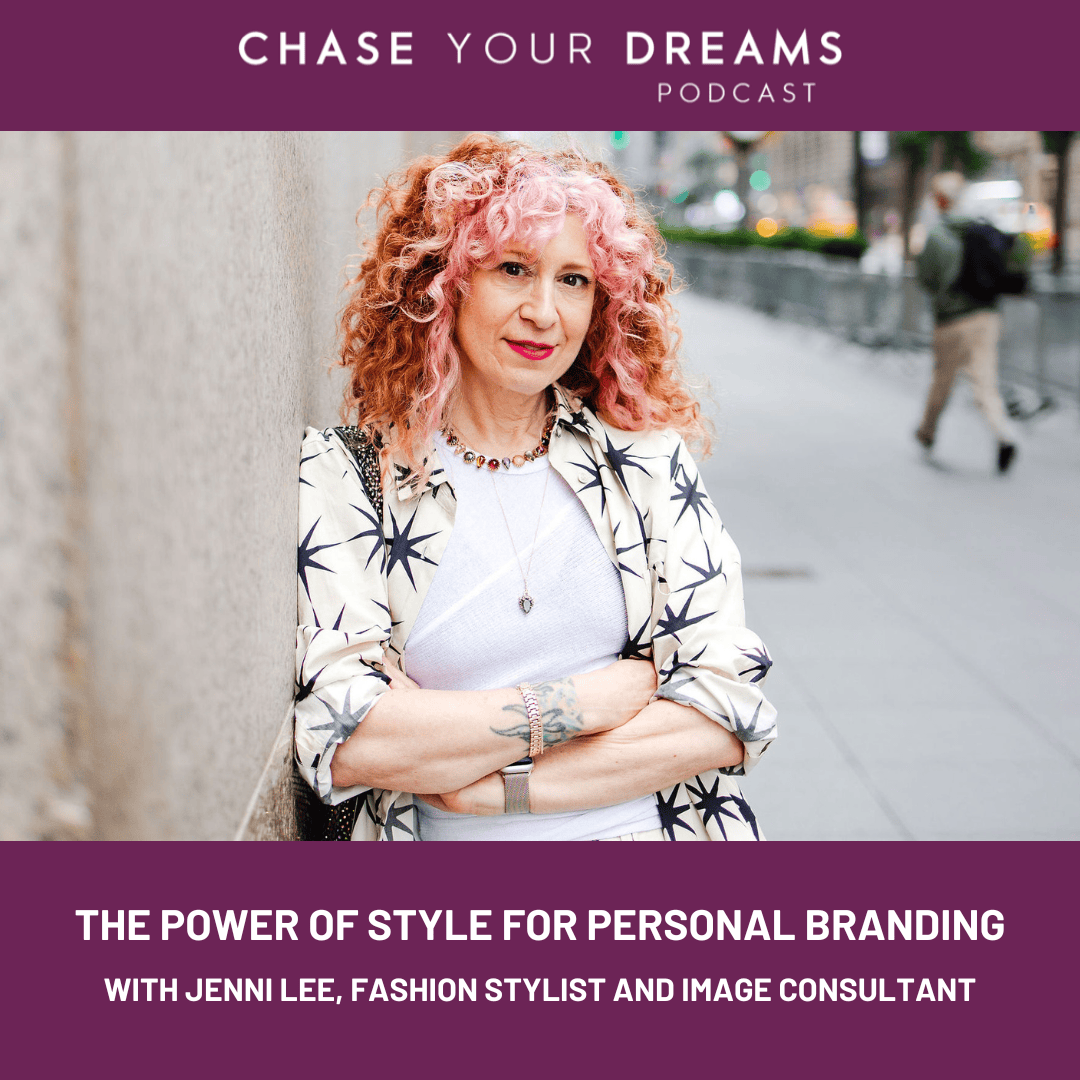
In this episode, fashion stylist and image consultant Jenni Lee shares how intentional styling can be a powerful tool for personal branding, visual communication, and professional growth. Drawing on more than 20 years of experience working with celebrities and major publications, she explains how clothing acts as a visual language that shapes first impressions and opens opportunities. Jenni discusses her philosophy of “more styling, less shopping,” encouraging people to make better use of the clothes they already own while building wardrobes that align with their personal brand and future aspirations. She also reflects on her pivot during the pandemic from celebrity styling to helping female entrepreneurs and founders use style to express authority, creativity, and authenticity in their businesses.
About Jenni Lee
Jenni Lee is a fashion stylist and image consultant with more than 20 years of experience shaping the visual narratives of celebrities, artists, and public figures. Her work has appeared in major publications including Harper’s Bazaar, Rolling Stone, People, and InStyle, and she has styled notable names such as Lauryn Hill and Scarlett Johansson. When the pandemic paused the entertainment industry, she pivoted her focus toward helping real women, such as female entrepreneurs and founders, use style as a tool for confidence, creativity, and personal branding. Today, she leads Style Club, a membership community built around her philosophy of “more styling, less shopping,” where she teaches ambitious women how to transform their existing wardrobes into powerful expressions of identity and authority.
Contact info
Website: http://jennileestylist.consulting
Portfolio: jennileestylist.com
Instagram: @jennileestylist
Linkedin: linkedin.com/in/jennileestylist
Takeaways
- Style is a visual first impression of your personal brand
- Dressing aspirationally can shift your mindset and perception
- Invest in high-quality clothing that lasts
- Regular closet reviews help keep your wardrobe aligned with your goals
- Think of styling as a form of self-care
Interview Themes
Why is style a powerful language tool?
Jenni explains that clothing communicates powerful messages before we even say a single word. A doctor’s coat or a bus driver’s uniform immediately signals trust and authority just like how our outfits suggest our professionalism, credibility, and identity. Style is a visual language that shapes how others perceive us. By dressing with intention, you can guide the narrative others form about you.
How can a wardrobe be used as a business asset?
Clothing reflects your personal branding and messaging. Entrepreneurs and founders alike can talk about their value, but a strong visual identity and presence can amplify that message. Style and brand messaging that is aligned creates a more cohesive public image.
Why is it important to dress for a role that you aspire to have?
Clothing can help people step out of their comfort zone and into the next version of themselves. By dressing aspirationally, people will begin to embody that desired identity. This shift can change how people are perceived while boosting confidence.
How can you start aligning your wardrobe with your personal brand?
Identify your brand message and the impression you want to leave on others. Using those ideas as a foundation, review the current state of your closet and identify pieces that support the story you want to tell. Look to film characters, public figures, etc. for style inspiration.
What does the philosophy “more styling, less shopping” mean?
After years of helping clients sort through overflowing closets, Jenni realized that most people don’t actually need more clothing and instead need to discover better ways to wear what they already own. Maximizing existing pieces through thoughtful styling is miles better than constantly purchasing clothes that often go unworn.
Chapters
00:00 Jenni Lee and her philosophy of more styling, less shopping
03:15 Jenni's journey from film school to celebrity stylist
06:07 Style as a powerful language tool
07:55 Why a wardrobe is a valuable business asset
10:06 Choosing outfits that reflect authority and expertise
12:16 Evaluating your closet through a brand lens
14:09 Jenni’s styling process with clients
15:38 The inspiration behind more styling, less shopping
16:45 Impact of styling existing wardrobe on confidence and value
23:28 Building the Style Club community and its purpose
24:52 Success story: wardrobe transformation for a European work trip
29:27 First steps to using wardrobe as a personal brand tool
Transcript
Jenni Lee
What I like to do is start with what you have. My whole philosophy is more styling, less shopping. So I really want to know what we're working with and whether we're doing this over Zoom or if you're in the New York City tri-state area, I come over and we really do go through your closet and really every single piece, you know, we go through, we figure out does this work for the version that you want to be? How can I help you make more outfits with this? Is this tired and worn out and not worth keeping because it was something you bought 10 years ago and it's outdated. Let's get rid of it because I do feel like most people have too much clothes in their closet and it creates really intense decision fatigue and overwhelm. And you're not getting the most out of your clothes because you can't really manage what's in there because there is too much.
Glynis Tao
Welcome to Chase Your Dreams, a podcast for fashion entrepreneurs who want to build a purposeful and profitable clothing business so they can make a living doing what they love. I'm your host, Glynis Tao, an apparel business consultant and SEO specialist with 20 years apparel industry experience. I'm also a mom to a wonderfully energetic little boy named Chase.
Today's guest is someone who truly understands the power of image and how the way we present ourselves can shape the opportunities that come our way. Jenni Lee is a fashion stylist and image consultant with more than 20 years of experience, working with some of the biggest names in entertainment, including Lauryn Hill and Scarlett Johansson. Her work has been featured in publications like Harper's Bazaar, Rolling Stone, People, and InStyle, and she has spent decades helping shape the visual narratives of artists, celebrities, and public figures. When the pandemic brought the entertainment industry to a halt, Jenni Lee didn't just wait for things to go back to normal. She used that momentum to reimagine her work and shift her focus towards something more personal: helping real women and founders build wardrobes that communicate confidence, authority, and intention.
Today, she leads Style Club, a membership community built around her philosophy of more styling, less shopping, where she teaches ambitious women how to stop buying more clothes and start using their wardrobe as a powerful tool for personal branding and self-expression.
In this conversation, we're here to talk about why a wardrobe is actually one of the most underused assets in your business, what celebrity styling can teach founders about building authority and how intentional style can help you step into the next version of yourself.
Welcome Jenni. It's so nice to have you here on the podcast.
Jenni Lee
Thank you so much for having me. I love having these conversations.
Glynis Tao
Absolutely. You've styled icons like Lauryn Hill and Scarlett Johansson, which is an incredible career path. Can you take us back to the beginning of your journey into fashion styling? What first drew you to styling as a profession and how did you land those early opportunities in the entertainment industry?
Jenni Lee
Yeah, when I started, I didn't even know what a fashion stylist was. I just was someone with a strong personal style. And I knew I wanted to work in an aspect where I was able to do storytelling. So I wanted to be a filmmaker. And I went to film school and I dropped out of film school and moved to New York and just started working on movies in every department, meaning everything from camera to art department. And then I tried wardrobe and everything clicked. Every decision I made was the right decision and the producers and costume designers that I was assisting working with saw that and believed in me and gave me opportunities. And from there it just expanded because I met more costume designers and one of them was a fashion stylist and she really taught me about styling and fashion and just my innate sense of style, which all kind of stemmed from my relationship with my grandmother who really used clothes as a way to make her day. She said making her look would make her day. And that creativity, I just sponged all of it. And she taught me at a thrift store shop and like shop for designer clothes that way and it really just took me on my path. And those first opportunities just came, you know, really from what I was wearing and how I expressed myself and people seeing that.
Glynis Tao
After working at such a high level in celebrity styling, what did that experience teach you about the relationship between image, identity, and influence?
Jenni Lee
I think the components are not only are you dressing for yourself and how you need to feel comfortable in that day, but it’s really thinking about your audience. And this again stems from that filmmaking experience of storytelling. So if you put yourself as the main character of your movie, of your television show, and each day is an episode and there's scenes in that day and there's locations that you're going to shoot on and there's other characters crossing paths with, what do you want them to think about you and just understanding that how you dress for the day is a language, style is language. And what do you want them to interpret very quickly? And how do you want them to react to you and how you can really manipulate the narrative of your day by what you're wearing?
And the other thing is, all of us, no matter how famous someone is, everybody has their own personal insecurities, whether that's emotional, mental, intellectual, or body. And you can use your clothes as a way to help strengthen you and overcome those things.
Glynis Tao
Yeah, so you often say that style is language. What do you mean by that and why do so many professionals underestimate the power of what they wear?
Jenni Lee
I think that, you know, think of it this way. If you go to the doctor, you're trusting the doctor because they are wearing a doctor's outfit. You get on the bus and trust that that person can drive the bus because they're wearing a uniform. So many subconscious things we do because we believe in the outfit that somebody is wearing. And you can use that same sort of language to have someone understand something about you so quickly. And I tell a lot of my younger clients who are, you know, stepping into new careers, look at how your bosses dress and how can you replicate the way they dress, but your own personal spin on it? Dress for the next level. Don't be invisible. Don't be so comfortable. Push yourself a little bit further so you can be, so that those around you who can give you opportunities can see you in the position of the opportunity that they're considering you for.
Glynis Tao
So do you work with a lot of founders and entrepreneurs or professionals and sort of like what type of businesses or niche are they in?
Jenni Lee
I think that the main connection between all the women that I work with is that there is an element of creativity and ambition because I do work with women from all different fields; from film directors and production designers to high level executives to financial coaches, spiritual coaches. I work with artists, I work with academics. So it really does cross zigzag all across industries, the type of women that I work with.
Glynis Tao
Many entrepreneurs focus heavily on marketing, messaging, content strategy, and overlook their personal presentation. Why do you believe a wardrobe is actually a business asset?
Jenni Lee
I think that this was personally when the pandemic happened and I realized that I was going to pivot into personal styling and I, being a very introverted, behind-the-scenes person, understood I have to start promoting myself on Instagram and what is that going to look like? Who am I talking to? And I was looking at all these other entrepreneurs, mine entrepreneurs, and everyone was just in yoga pants and I couldn't wrap my head around the disconnect between what they're selling, whatever industry or brand it was, and how little consideration they took into their personal appearance. And I just saw a big gaping hole of, you know, we're scrolling endlessly. And if you want to have someone stop, you need to have a full picture there that is polished and together and enticing. Not just the words that you're yelling out at people, but make the whole image work to your advantage is just such an overlooked tool in that toolbox of branding.
Glynis Tao
And what are some common mistakes that entrepreneurs make when it comes to building a wardrobe that aligns with their brand?
Jenni Lee
One of the things that… it's twofold. There's one mistake of always wearing your brand colors, which actually means you're blending in with your fonts and your background and things like that. Your brand color should be an accent that you can tie through everything, if you feel that your brand colors are that necessary. I don't dress in a rainbow of colors. I don't dress in my brand colors.
I think the other side is never considering if what you are wearing gels with and is cohesive with your brand color. So then you're making a reel cover or an Instagram post and you're wearing something that just looks jarring or it doesn't look aesthetically pleasing with the text and the caption and all of those things that you have to do. I think really just being considerate about your audience and what you're wearing and where it is going on any given day.
Glynis Tao
You appear to be quite colourful and like I've seen what your feed looks like and what you're wearing today is nice. How did you choose your outfit that you're gonna wear today?
Jenni Lee
For me personally, I'm like, I just moved into this new office. I don't have anything on my walls. It's white background. I know that I want to pop from my background. I don't want to blend in. So I have a very defined color. You can see my body and that I'm in front of something. I'm not blending. Same as you, you're wearing black and I can see you not blending from the wall and just having a foreground and a background. And this is all that filmmaking stuff that is just embedded into me. And I knew I wanted to be comfortable. I'm going to be sitting here having a conversation. It was really, you know, I got dressed in five minutes.
Glynis Tao
But I think that color looks great on you.
Jenni Lee
Thank you.
Glynis Tao
Yeah, I don't normally wear a lot of black. Like I have a very colorful background behind me, so I kind of thought, why not?
Jenni Lee
You’re defined! I can see your definition.
Glynis Tao
Thank you. So when someone wants their wardrobe to reflect their authority or expertise, where should they start?
Jenni Lee
I think they need to think about, you know, their authority and expertise is personal to whatever their industry is. So they need to think about, again, their audience and who are they getting in front of and what do they want those people to believe about them and make sure they're dressing in a representation of that, of their personal authority, whatever brand or industry that they're in. Like I gave the analogy of the doctor and the bus driver. We trust these people because we see their uniform. I think that physically some people need to be very comfortable in soft things. They may have skin issues, allergies. So I think another thing that's really important to think about is don't put on anything that is not tried and true. If you are doing something out of the ordinary, you want to make sure it's not something so new and so uncomfortable that it messes with your mind. You don't want anything that you're thinking about that you're concerned with. You want something that you put on and it's easy.
Glynis Tao
And how can someone begin to evaluate their closet through a brand lens instead of a shopping lens?
Jenni Lee
I think that there's no shame in asking for help. You know, there's a belief that hiring a stylist is not something that anyone can do, but no one questions hiring a hairstylist or hair colorist or facialist or a fitness coach. There are lots of stylists out there that can help you identify what is going to work for you, but if you're on your own, the thing to do is set time aside, whether it's an hour on the weekend, put on some music. If you need to make some mood boards ahead of time, whether they're characters from TV shows or celebrities, whatever it is, have some images on your phone or on your laptop. Go to your closet and you have to try the things on. And this is something that should be done about every three months because our bodies fluctuate, they change all the time. We have differences in our life and in weather. And the more you're actually trying your clothes on and mixing and matching them with things, the more outfits you get and the more that you can think about what will work.
The other key thing to do is once you put on an outfit, I want you to try it on with three different types of shoes. So try it on with a sneaker, try it on with a flat, a loafer, something daytime, and then try it on with a nighttime and evening shoe and see how that outfit changes and how you could wear it to three different places. And take a photo.
Glynis Tao
So can you describe your process and how you work with someone? If someone has never worked with a stylist before, like I guess most people probably don't even think of asking for help from a stylist. They just try to figure it out themselves or go shopping and try on different things that they think may look good on them, but they don't really get that, you know, extra help or feedback. So how do you work with people?
Jenni Lee
Yeah, I mean, I think that, you know, everyone's really accustomed to shopping either online, so they're doing it wholly all by themselves and they get a bunch of stuff and it can be really overwhelming. Or if they go to the stores, there's that strange pressure of a salesperson trying to sell you things. And the difference with working with a stylist is, you know, we're not trying to sell you clothes, we're just trying to deliver your dream of yourself into reality.
So what I like to do is start with what you have. My whole philosophy is more styling, less shopping. So I really want to know what we're working with and whether we're doing this over Zoom or if you're in the New York City tri-state area, I come over and we really do go through your closet and really every single piece. You know, we go through, we figure out, does this work for the version that you want to be? How can I help you make more outfits with this? Is this tired and worn out and not worth keeping because it was something you bought at H&M, you know, 10 years ago and it's outdated. Let's get rid of it because I do feel like most people have too much clothes in their closet and it creates really intense decision fatigue and overwhelm and you're not getting the most out of your clothes because you can't really manage what's in there because there is too much. So that's like the first step.
Glynis Tao
Yeah, your philosophy, more styling, less shopping, is such a refreshing perspective in a world driven by consumption. What inspired that approach?
Jenni Lee
I've been watching all the documentaries and I care about the environment. I care about the planet and you know, the future for all my nieces and nephews. I also care about designers, like real true fashion designers and this like onslaught of cheap plastic clothing that just keeps getting made and made and made and the idea that you just have to keep buying and like showing all these trash clothes. Like look at my haul. It was really starting to turn my stomach and again going to women's homes and helping them, you know, unload 12 bags of clothes that they're not wearing with tags that are really cheap and don't do anything. Don't feel special. Don't inspire them. I was like, there's a real problem here and how can I address that? More styling, less shopping just kind of like fell out of me and it just seemed like a really simple way to start encouraging people to make the most of what they have and make really smart, intentional decisions about what they are bringing into their home.
Glynis Tao
And how does styling what you already own create more impact than constantly buying new things?
Jenni Lee
I think that once people break that habit of always getting the dopamine hit of shopping, and you can start elevating the brands that you're buying because maybe you're not buying 10 pieces for $200, you're buying three pieces. And teaching my clients how to shop resale. I love encouraging people to buy better quality things that have already been used and then they get to experience these finer fabrics and better construction. They really start to value what they're wearing and it helps you carry yourself differently because you know that you're wearing something that has more meaning to it.
Glynis Tao
And when the pandemic shut down the entertainment industry, you made a deliberate pivot in your business. And what did that transition look like behind-the-scenes?
Jenni Lee
Well, I touched upon it before. I mean, I realized I had to market myself, which I'd never really done before. When you work in the entertainment industry, producers, photographers, band publicists, people called me. They were like, hey, we have a shoot. We're doing this commercial. Do you want to do it? Are you available? And that's how it worked for me for two decades. And I had one personal client that was not celebrity adjacent. She's a spiritual financial life coach. And I didn't, it just opened up a whole world of an industry I didn't understand. And she was going in networking events and doing all these things. And she just kept saying, there's so many of me out here who could really use this type of help. And then the pandemic hit and there were no fashion shoots. There were no brand shoots. There were no celebrity shoots. She was still having to show up on Instagram and she was still having her Zoom sessions and still wanting my support. And I was like, this might be the time to pivot.
At the same time, what I was discovering was the work that I was doing with her and a few other women when I would go to their homes and help clean out their closets, make new outfits. We were really eliminating a lot of the negative self-image and ideas that we have about ourselves and what we wear as women and how it comes from a patriarchal society that is passed down from grandmothers to mothers to daughters. And we were breaking them and there's tears and emotional ideas really being shed and energy being lifted and it was so meaningful. And I would come home crying because it felt so powerful to help these women. I was making a real difference in their lives. And then they were getting jobs and making more money and becoming millionaires. And I could see the shift in their lives that I was like, OK, this is the next path for me to take. It has a lot of meaning.
Glynis Tao
Wow, that is so inspiring to hear this story and just sounds so powerful to hear that transformation that you have made for these women.
Do you find that there is a mindset shift also that comes into play when someone's maybe more comfortable with dressing a certain way because this is what they're comfortable wearing, but you maybe see it as not showing like how you had mentioned previously to dress the role where you want to be and where you're going, not where they are. What does that mindset shift look like?
Jenni Lee
I think that there's… because we all have our issues, a lot of dressing is security blanket dressing. And I'm not saying throw out those pieces. Like there are days when you, you know, especially as women, like you're bloated. You need, you need clothes that feel like a security blanket on some days. I'm not saying clear those things out, but like, I'm wearing this because this is what I need. Or you're grieving and you're sad and you want to wear something from, you know, that somebody gave you. I understand having these clothes that are protecting and comforting, but sometimes you need to try things on that you would never wear. And that's where a stylist really does help because I'm able to say, you're telling me you want people to perceive you in a certain way, but there's nothing in your closet that identifies you in this way. Let me bring you some clothes that will deliver on what you're saying that you need, but you have to try them on. We have to see what it looks like. We have to make the full outfit. You have to walk around. You have to sit down. I want you to walk through your whole apartment. I want you to sit down in different height of chairs. I want you to really move. I want you to bend down and your shoes. See how it feels to be in these clothes. Can you, does it feel good? Are you, are you feeling yourself? Are you carrying yourself differently or is it making you feel claustrophobic? You know, you kind of have to test drive things a little bit to know. And I know when I see them look at themselves in an outfit that they never would have considered. And sometimes it's things that they have of their own and I'm just mixing it up in a new way. Their body changes. Their face lights up. They really do see themselves in a different way. And the styling tricks of like, why don't you cuff those jeans a half an inch? Let me roll your sleeve twice. Push up your sleeves on your blazer. Tiny little styling tricks.
Glynis Tao
So you kind of have to take into account, I mean, if you're changing the style of something that the person has to feel comfortable in this look as well, right? They can't just be like put on something, but they're just not feeling it or something that they can't carry.
Jenni Lee
Absolutely.
Glynis Tao
I have to put those two things together.
Jenni Lee
Yeah, that's one of the biggest things I say is, does this feel like you or do you feel like you're cosplaying? Do you feel like this is a costume? Which is fun, sure, you know, if you're going to like you're going out for an evening to do something completely different than you normally do and you're like, I'm going to go to a goth show and I want to dress goth tonight. It's not my normal thing, but I'm going to do this tonight. But we want to make sure that your everyday clothes, your everyday work wear, even your everyday networking wear still is you. That it's identifiably you and you in the core of your essence doesn't feel like you're faking it. We can elevate you, we can have you dressed to that next career, but it still needs to be you.
Glynis Tao
And so you built Style Club, which is a membership community. It's built around this philosophy. What was your vision for that community and how has it evolved?
Jenni Lee
That really came from doing like a virtual masterclass and having the second half of it be styling a few different women in a Zoom room and the response was so positive. They really, really loved watching each other get styled and seeing the focus on someone else that it gave them ideas and it also helped them, you know, erase and shed some of those insecurities and limiting beliefs because they were witnessing other people express those same things. And they were seeing like, this is not true. What you're saying isn't true, and I'm here to say, you look amazing in that. And from that, Style Club was born and really just recreating that feeling of… almost, you know, think about your teenage years, your early 20 years, getting ready with your girlfriends and how much fun that was before you went out and that would be like the best part of the whole entire evening was that little pregame session of dress up and kind of creating that energy, but around the important events and moments in these women's lives.
Glynis Tao
Yeah, and so right now I'd just love to hear maybe if you wanted to share a particular story of a moment where a change in someone's wardrobe directly impacted their confidence or career opportunity.
Jenni Lee
I can think of a client, we've done a lot of one-on-one work together and she is also a member of Style Club. She had a really big work trip where she was speaking at a couple conferences. She was going to Europe and it was a long trip and she doesn't have… she's not a super fashionista. I mean she's much more now, but she doesn't have a lot of clothes and she knew she didn't. She was going to a few different countries, she knew she didn't want to overpack. And we must have created 15 outfits that could work in different environments, different climates, and having all of these outfits planned out for the full trip—and that included also just travel, vacation days, big meetings, big dinners, specific work things—having them all planned out, she said she saved so much time because it was all planned out. She had like her list of her outfits, where she was wearing everything. We had photographs of everything. It was the same thing that we would, I would do back in the day when I worked with celebrities and they had press junket tours where they're going to promote a movie and we do a fitting and we plan all the outfits and they know exactly what they're wearing for every single interview. And she said she saved so much time and she was so at ease. That it was so easy to do all of these things that she was able to do the work and have incredible connections and she got called to do it again the following year because she wasn't stressed out about anything. And that's just like the top of my head.
Glynis Tao
Great story. And I'm sure you have so many other stories to share about, like success stories. So for founders who might feel uncomfortable investing time and style, what would you say to them?
Jenni Lee
I would say, try to approach it as self-care and think about how you approach food. Like you're probably buying organic food. You're certainly washing all your fruits and vegetables. You're not giving yourself a hard time about going to pick out food for a healthy recipe and take care of your body. Same thing with your hair care and your skin care.
Think of your clothes in that same way and how you can be really mindful about what are you deciding to purchase? Are you wearing a bunch of plastic on your body? Are you wearing organic fabrics? Are your clothes helping enhance your life because they are giving you confidence, making you feel comfortable, making you feel elevated? Or are they something that is an afterthought? I think that really integrating it as a mindful practice is a way to approach style in a holistic manner. We all love to get a deal and I think that the rise of fast fashion and Amazon being a source of where people buy clothes now and the idea of like, got all of this for $20 and I'm a smart city shopper. It's not valuable. It's like saying, I love food, but if you eat McDonald's every day. Yeah. I really do equate it to that, you know, they call it fast food and they call it fast fashion for the same reason.
Glynis Tao
That's right! I don't think people make that connection between that—fast food, fast fashion. It sort of makes you feel equally as gross inside for me anyways. And if I was wearing it and eating it at the same time… I don’t know, right? But that's very interesting. Was there anything else that you wanted to add?
Jenni Lee
I think that there's, you know, I know that clothes are expensive and they're getting even more expensive because of tariffs and the economy right now, but I just, cannot stress it enough that there are so many incredible resale sites with really, really beautiful, gorgeous, high-end, elevated, luxurious clothes that you can buy secondhand. Some things still have tags on them and that it's just such an easy, affordable way for you to start filling your closet with better quality, that you'll just be in love with your clothes. Have clothes that you don't want to throw out until they're completely worn out.
Glynis Tao
Before we close this conversation, if someone listening today wants to start using the wardrobe as a tool for their personal brand, what's the first step that they should take to get started?
Jenni Lee
I think that really evaluate what is your brand message? So if you know that, then go to your closet with that kind of ringing in your ears and start pulling out the pieces in your closet that speak to that. And then from there, and if that's too abstract, then you know your brand, you know your business, maybe you can find an avatar of a character in a movie or television and take some screen grabs of that person because some people work more visually and see if you have items in your closet that are an easy jump from this blazer somewhat looks like this blazer that this character wore and how can I recreate that outfit? You know, sometimes it's as simple as that—just trying to copy some outfits that you've seen on this aspirational avatar. Or call me for help.
Glynis Tao
That's what I was going to say. Call Jenni Lee. She'll help you.
Jenni Lee
Doesn’t matter where you are, I can help you.
Glynis Tao
You can help anyone regardless of where they're located, right?
Jenni Lee
Yeah, absolutely.
Glynis Tao
Where's your furthest client base?
Jenni Lee
Well, London or LA, because I'm in New York.
Glynis Tao
That makes sense. Where can people find you if they want to get in touch with you?
Jenni Lee
Everything is Jenni Lee Stylist. It's Jenni with an I, so find me on Instagram, Google me. My website is jennileesylist.consulting, but hit me up on Instagram and let's just have a conversation.
Glynis Tao
Sounds amazing. Thank you so much, Jenni Lee, for joining me on the Chase Your Dreams podcast today.
Jenni Lee
It was so fun chatting with you about all of this. I really appreciate you having me on.