
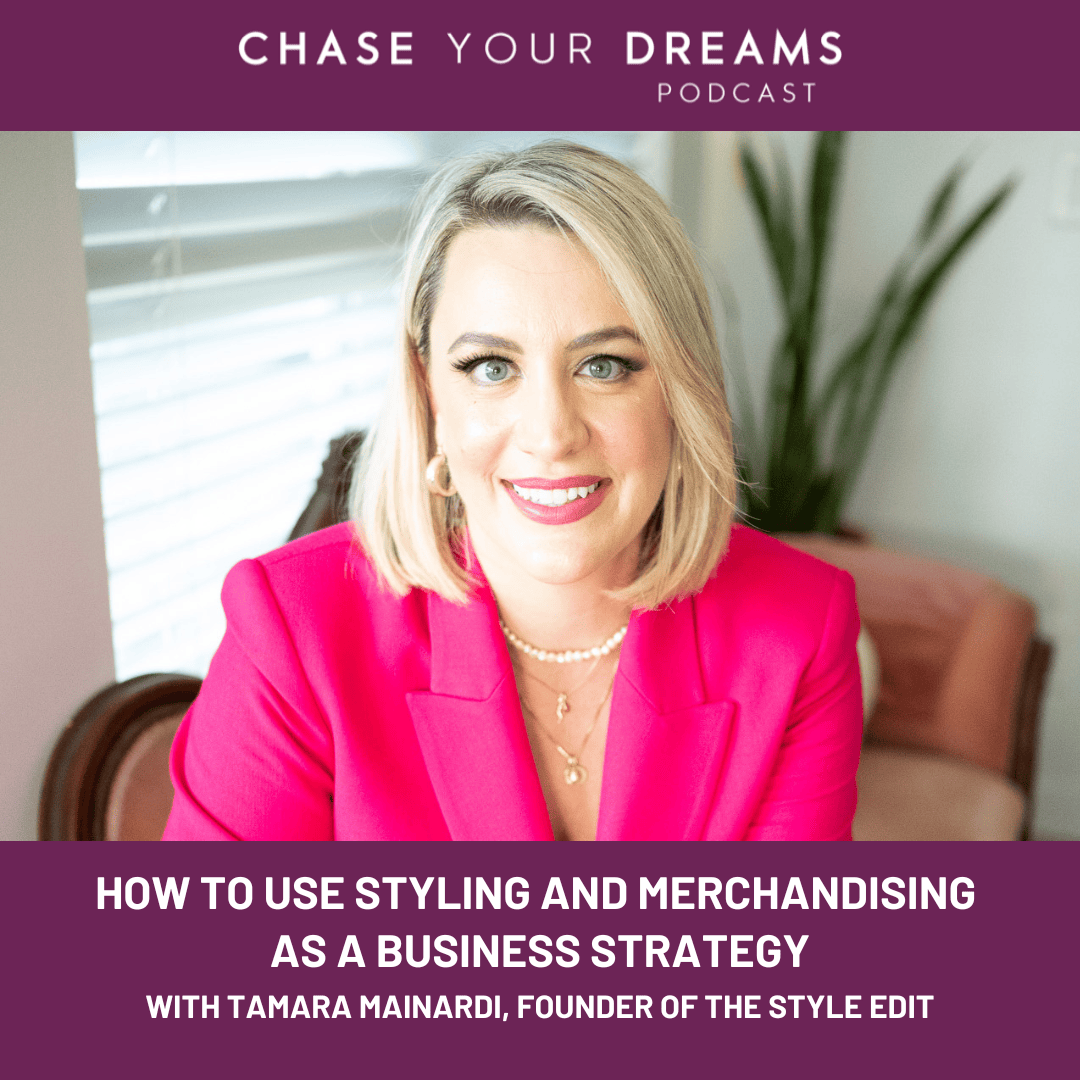
In this episode of Chase Your Dreams, Glynis Tao and Tamara Mainardi explore how style can serve as a strategic business asset. They discuss how personal styling, branding, and sales strategies intersect to create a compelling customer experience. Tamara highlights the importance of a strategy-first approach, the challenges designers and business owners face, and the missed opportunities in fashion sales. They also cover building trust through style, the power of collaborations, inclusivity in fashion, and how taking the pressure off founders can unlock creativity and innovation while keeping fashion playful and personal.
About Tamara Mainardi
Tamara Mainardi is the founder and principal stylist at The Style Edit, a personal styling, branding, digital marketing and business development services company. She helps entrepreneurs show up with clarity and confidence while guiding fashion brands toward stronger sales, sharper positioning, and better customer experiences. With over a decade of experience working with brands like J. Crew, Aritzia, Park & Fifth, Indochino, and Burberry, Tamara brings a strategy-first approach that connects style, customer, psychology, and revenue.
Contact info
Website: https://www.thexstylexedit.com/
LinkedIn: @tamaram
Instagram: @thexstylexedit
Takeaways
- Styling and merchandising can be strategic assets that guide purchase decisions
- Trust, authority, and sales are built through thoughtful styling and storytelling
- Great products don’t sell themselves—context and connection matter
- Collaborations work best when aligned, small-scale, and tested for shared growth
- Expertise is communicated through presence, clarity, and authentic enthusiasm
Interview Themes
How can styling be a part of a business strategy?
Style isn’t just about aesthetics—it shapes how brands build trust, authority, and credibility. When styling is done strategically, it can lead to business growth by helping customers understand who the brand is for, what its values are, and why its products or services matter. With the proper styling, brands can influence purchase decisions and customer experiences.
I have a great product, so why isn’t it selling?
If a brand can’t communicate why a product exists or what problem it solves, people can’t form an emotional connection with it. For people to want a product, brands need to focus on crafting a clear and engaging story that paints a picture for how their products can integrate into customers’ lives.
Why do some brands struggle to convert even if they have strong visibility?
Being visible on Google doesn’t mean your brand is memorable. Brands that play it safe or blindly follow trends struggle to leave a lasting impression. Leaning into what makes your brand stand out and experimenting, testing, and having fun are what will make people want to invest in your brand.
How should brands think about collaborating to support growth?
Brand collaborations can be beneficial if the brands’ values are aligned. Starting small—testing one product, one idea—allows brands to learn how they work together without overcommitting resources. The most successful partnerships create shared value, strengthen positioning, and support sales, rather than functioning as one-off visibility plays.
Why do entrepreneurs struggle to be seen as experts?
Entrepreneurs that don’t appear excited or energized about their brand or ideas make it difficult for customers to care about their brand. Authority and trust is established when founders are confident, clear, and enthusiastic about their work.
What changes when founders take the pressure off?
Reducing pressure creates room for creativity, curiosity, and collaboration. Instead of trying to be everywhere and do everything, founders can focus on what truly matters, build community, and grow in a more sustainable way. Taking the pressure off doesn’t slow progress—it often accelerates it by restoring clarity and momentum.
Chapters
00:00 The Intersection of Style and Strategy
05:34 Bridging the Gap: Creatives and Business
06:45 Missed Opportunities in Fashion Sales
09:34 Selling with Authenticity: The Art of Connection
14:03 Styling as a Sales Tool
17:46 Building Trust Through Personal and Brand Style
20:22 Examples of Brands Doing It Right
22:58 The Cool Factor: Standing Out in a Saturated Market
25:24 The Importance of Creativity in Fashion
27:15 Collaborations: Strategic Partnerships for Growth
28:44 Strategic Collaborations: Starting Small
29:35 The Edit, Curate, and Reimagine Methodology
32:33 Finding Passion and Playfulness in Business
34:47 The Importance of Energy and Authenticity
39:05 Taking the Pressure Off in Fashion
40:52 Building a Supportive Fashion Community
Transcript
Tamara Mainardi
If there's anything I've learned, especially from digital marketing and paid ads, especially from a strategic point of view, it’s about constantly testing because you and I can be like, “Oh, that's going to work”, “Everyone's going to love it”, and it can completely bomb unless you actually have the data and the numbers to say, “Yes, this is going to work.” And even that sometimes isn't 100% foolproof.
You do have to have fun with it, try new things, see what happens, and take a moment to actually see what is working, and the things that aren't working. Spend the time to evaluate, and what can you pull from that to get new ideas?
Glynis Tao
Welcome to Chase Your Dreams, a podcast for fashion entrepreneurs who want to build a purposeful and profitable clothing business so they can make a living doing what they love. I'm your host, Glynis Tao, an apparel business consultant and SEO specialist with 20 years apparel industry experience. I'm also a mom to a wonderfully energetic little boy named Chase.
Glynis Tao
Today's episode is all about something that often gets overlooked in business conversations—style as a strategic asset. Not just how things look, but how style influences trust, authority, sales, and how people experience your brand.
I'm joined by Tamara, founder and principal stylist at the Style Edit. Tamara works at the intersection of personal styling, branding, digital marketing, and business development. She supports entrepreneurs who want to show up with clarity and confidence and fashion brands that want stronger sales and sharper positioning and better customer experiences. With over a decade of experience working with brands like J.Crew, Aritzia, Park & Fifth, Indochino, and Burberry, Tamara brings a strategy-first perspective that connects style, customer, psychology, and revenue.
In this conversation, we're diving into how brands can sell their collections more effectively, how to show up clearly online, and how to think about collaborations in a way that actually supports growth. So let's get into it.
Welcome Tamara. It's so nice to have you here today. Thanks for joining me on the podcast.
Tamara Mainardi
Yes, thank you so much for having me. I'm happy to be here.
Glynis Tao
So, you work across personal styling, branding, and fashion business consulting. How did those worlds come together for you?
Tamara Mainardi
I think it's always just been a very natural progression. I do have a background in business admin. It does fall under hospitality management, but when you look at the big picture, it is business development, business structure. I learned how to really communicate with people, but also listen to what it is that they’re saying in order to really bring things together. I also was an artist in high school, which seems like a million years ago, but I've always just generally been a very creative person and on the flip side, been very numbers focused. So I do have a certificate in bookkeeping and I always like to bring that up because as someone who is very creative and artistic, having something that's, you know, more of a finance or numbers focus, those two necessarily don't always jive. So I feel like work is like a bridge or translator between the two.
Glynis Tao
You describe your approach as strategy-first. What does that actually mean when it comes to style and branding, especially for business owners?
Tamara Mainardi
It's important to really have a foundation and I think be inspired. We spend so much time trying to get to the end result, but we don't actually take the necessary steps to get to the end result. Sometimes that does require trial and error. When I work with my styling clients one-on-one, I really focus on understanding who they are as a person. What are the things that you like? What are the things that you dislike? Focusing on the things that work for you, because if you spend so much time trying to go against the grain, in the end, it's just going to backfire. So for me to have a strategy, it's about really getting messy first because all artists, all creatives, are messy in some capacity because it allows you to find what you're looking for.
As an example, you throw everything on a table and then you can start to organize what is working, but also, go antique shopping or go to the thrift store. Start looking at different objects and different things to be inspired. If you can travel, travel because gaining inspiration will help to form your ideas and help to actually grow and build what you're wanting to achieve.
Glynis Tao
Yeah, being creative myself as well, I know sometimes the process can be a little bit messy before it starts to take shape and become something. Where do you see founders getting the most confused between the style and strategy? Are they really that different? Can you merge the two?
Tamara Mainardi
I may repeat myself a few times on this, but what I constantly see is that creatives create. They're designers, they are maybe business owners, but again, it's bridging that gap. There's a piece where it's like, “I'm just the designer”, but then when you're very small and starting out, you have to be everybody and not everyone is meant to be able to design, create, sell, production—do all the things that come with it because it's a lot of work. You're one human being. One human can only do so much.
So I think it's like giving yourself a little bit of grace and actually saying, “Okay, what are the things I'm good at? What can I really focus on?” And when you have a little bit more money to buffer with, then it's like, “Okay, how can I now outsource and get someone to help so that you can build and scale your brand?”
Glynis Tao
When you look at a fashion brand's collection, what are the biggest missed opportunities that you see in how they're selling it?
Tamara Mainardi
They don't sell it. I mean, I've gone to, I don't know how many markets, how many shows, whatever you want to call it, and I am missing the passion. And it's not me missing it—I'm missing it from them. I can look at something and I need a moment to process, but I can come up with ideas of how it works, where it goes, how it needs to be included in whatever it is you're styling or putting together, and not everybody can do that.
So I think it's really knowing your product, your what it is you have and you gotta get over that hump—you've got to talk to people. And sure, people are not always going to respond, but at least say “hello” because then you are catching someone. Just keep working on that because especially from a sales side, if you go to one person and they say no to you when you're trying to sell them something, and then you're like, nobody wants to buy my stuff. That's one person. If you go up to a thousand people and everybody says no, that's not very likely. You're probably going to get maybe, you know, 10 people or something of that extent, but you've got to really just keep pushing the boundary on yourself because you can't expect things to sell if you can't engage. People spend time thinking like, it's just going to sell itself. If someone's looking at a dress or shirt or whatever it is, they don't understand what it means, why you designed it, how it integrates into their wardrobe and that connection is very much lost.
Glynis Tao
Because you come from a retail background you were telling me about your sales experience, right? And you were like, I guess you built up the skill, perhaps you learned it. I always find it hard to sell and like, it requires you to sort of have thick skin and not feel offended by somebody if they criticize your product, especially if it's your product you designed and made. I found it really hard to be the face of the brand or sell my own product. So, what do you tell someone in terms of how to sell through either through style and service, but not with pressure? What does that look like in practice to you both online and offline?
Tamara Mainardi
Well, you know, not to toot my own horn, but I've been like this my entire life. This is just naturally who I am. I mean, I've been told I should be a realtor, sell homes. When our family was looking for another property, I did all the shopping around and there were a few times I would go back with my mom and they were like, “Oh, do you want us to come?” I was like, I already know what it is, so don't worry about it. If anyone's going to sell my mother, it's me because I know her very well. The rest of you will fail epically. So let's just like, just cut, cut you out altogether.
You know, when I was very young, I would sell parking spots in East Van because I lived close to the PNE. I took bottles back. I have no shame in selling, making money. And to come back to the styling part, more recently I'd worked at Park and Fifth and I thrived there because I was like, “Okay, you're getting ready for an event. Okay, what's the event?” And like having that conversation. I'm your best friend that you could only dream of who is going to be honest with you, but I'm also that person to be like… I can see when someone's like, I'm just not feeling this. I'm like, “Cool, that's cool. You're allowed to have that opinion. Nobody's forcing you to purchase this.” And that to me builds a lot of trust because I think it's well known that there's certain establishments in the city that are very much under pressure sales. Anything, everything looks good on you. And I know for a fact, if you hate something in the change room, when you wear it—or maybe you probably won't wear it—you're going to hate it a hundred times more when you have it at home. So listen to your gut. If you don't like it and you don't feel good in it, don't buy it.
And I think there is something about just being able to connect with people and there are, like you said, talking to people, that's not really my thing. That's fair. If you know for yourself, that's not your genius zone, then don't go there. Stick to where you know, you can really thrive.
And that's where collaboration comes in—to find the people that you know can really come together to help build your brand. I mean, I went to CircleCraft back in, what was it? Whenever it was in December of last year, November, can't remember, it all meshes together. And there are some designers that are very timid in selling. I mean, those are long hours and I get that, but you've got to show a little bit of excitement. These are my clothes! This is what it is! And yeah, people might not like it, but those aren't your people. So you just gotta keep promoting it because the more you promote it, the more that it will get out there, right? And if you're excited, then people will get excited. But if you're a little timid or you're just like, sure, that's one thing. And then there's also those who are seasoned veterans and they're just like, my people are coming. And that's a totally different group. You have to go for it and you have to be proud of what it is you do. I'm like, yeah, like, just do it. Nike's so fast. Right?
Glynis Tao
Just do it. Yes. Well, you seem like you're a natural at it and you sound like you were a really good salesperson that was trustworthy because I find that people can also sense that insincerity, right? Someone says, “Oh, that looks good on you” just to make that sale. Sales definitely can be a tricky one, I think, for a lot of brand owners out there.
So how can brands think about styling as a sales tool rather than just say a visual one?
Tamara Mainardi
I mean, if you look at merchandising, I know merchandising has shifted a lot, especially in the retail space, and to me, merchandising, I mean, I remember as a kid going back past so many stores. I have a thing for Louis Vuitton. I haven't quite figured out why, but I do. It's been a long, long relationship. I remember when I was 11, there was just like a Louis Vuitton suitcase in the display window. And I looked at my mom and I was like, “This is what I need to add to my collection.” And she's like, “My God.” She like just pulls me out. But I’m like, “Mom, I need to get the Louis Vuitton suitcase. We're traveling all the time. This is necessary.” And she's like, “Whose child are you?” because my mom is very down to earth and I live in La La Land. It was the lighting.
Glynis Tao
Just with that—the way it's merchandising really sells a lot. It can do a whole lot, like visually, but also with telling the story through really good merchandising, right? Can emotes, like emotions to people and convey some storytelling, I think behind it as well.
I think I've seen some of their collabs as well and the way they merchandise those and maybe different artists and stuff like that and how they put the product together with the art and the two together. It's like, wow. It's just so visually appealing. They're just amazing at what they do.
Tamara Mainardi
Yeah, it's having fun. I had a conversation yesterday with someone and it was like, have fun with fashion. I was like, yeah, I don't know where we lost that. We were so caught up in these labels, these trends, these stereotypes. I don't know how this is going to come across, but when they were doing the whole mob wife aesthetic, that was a thing. They're like, oh, know, Tamara, you're Italian, blah, blah. And I was like, how do you associate because I'm Italian that now I'm associated with a mob and that's how we dress? Did my Nonna have fur coats? Yes, but she was not. That was a part of her style and not because it was associated or whatever with something. I don't know why we need to have all these labels. We should be having fun with fashion, being creative with it. We should be innovative, trying new things, testing the waters.
If there's anything I've learned, especially from digital marketing and paid ads, especially from a strategic point of view, it’s about constantly testing because you and I can be like, “Oh, that's going to work”, “Everyone's going to love it”, and it can completely bomb unless you actually have the data and the numbers to say, “Yes, this is going to work.” And even that sometimes isn't 100% foolproof.
You do have to have fun with it, try new things, see what happens, and take a moment to actually see what is working, and the things that aren't working. Spend the time to evaluate, and what can you pull from that to get new ideas?
Glynis Tao
From your perspective, how does personal or brand style impact whether people trust you online before they ever buy?
Tamara Mainardi
Gosh, that's such a loaded question. It's really about the user experience, right? People need to come back to you a few times. So first impressions still matter as much as we speak to it's not as important or even just from a branding perspective, as like a human being, how you show up. Are people looking at you like you're an actual authority in your space or do you just look like you don't care? Because if people are putting money into and investing, they want to see at least a pretty picture of something, but that the picture is telling a story that makes sense. So I think, especially when it comes to online, it doesn't need to be easy. It needs to be accessible, but it also has to be that people want to stay on your website. What value, I know people talk about that a lot in business, like what value or what problem are you solving? But generally, do you know the problem you're solving when it comes to style? What is that motion you're trying to provoke or what are you trying to do to help people through clothes?
Glynis Tao
I want to ask you if you can give some examples of some brands you think who are doing this really well. For me on social, I've seen a few brands that stand out. I don't know if you've heard of POPFLEX. It's like a yoga athleisure brand. The person behind the brand, her name is Cassie Ho, who is a Pilates instructor. She has a pretty big following personally as well. She's built up pretty good personal brand, as well as her clothing brand, this POPFLEX brand, and she does all her own Instagram, Reels, it's all her, right? So there's kind of like this merge between her and the brand. I don't know where the separation between her and the brand itself is. It is very merged together. So I think if she has a following of people who really just love her personal brand, I think they'll just buy her anything that she comes out with, right? Like she does all these new launches and drops and new products and stuff, and she's always showing it on Instagram, but I'm wondering, that would probably be a good example of how she built up that trust with her followers.
Tamara Mainardi
I mean, that's a lot. Ultimately, as much as that sounds like an influencer and her brand, she's a saleswoman. It doesn't matter what she sells, people are going to buy because that trust is built between her and her community. So anything she comes out with, they're going to buy from her.
There's an Australian brand called Fayt the Label and the owner, Brittany, she was a YouTuber influencer and she does her own things as her own personal brand, but then she has Fayt the Label. But what's also, I think, really unique about Fayt is the fact that it's inclusive. They have a very wide range of sizing for women. It's not just your straight sizes. It goes, I believe, up to 4X. I'm not 100% sure of the sizing, but it's about having accessibility to those who feel excluded. And that's what's always really perplexed me about fashion. Fashion is supposed to be fun, creative, innovative, but somehow it's also become a very like you're excluded because you don't look like X. Which I don't think is very fair because it shouldn't matter how tall you are, how short you are, if you're straight size, plus size—hat doesn't matter because we're all human and clothing is meant to fit on our bodies. So why are we now, because you're a certain body type, you're not included. I really struggle with this because I know what it's like to be excluded and for me it's like I don't ever want anyone to feel that they don't belong because life throws us all sorts of curveballs and when you're being excluded, it's not a great feeling. So I think that brands that think of who their ideal client is but it's showing that there's openness as well.
Glynis Tao
Yeah, a lot of brands are active on social, but still struggle to be found or remembered. What do you think is usually missing?
Tamara Mainardi
I think it's that cool factor. I know that sounds so simple, but how are you cool? Because at the end of the day, you are cool. You are who you are and sometimes you've got to get out of your shell. Like A Bronze Age is a Vancouver brand and they started with something very small—just their handbags—and now they've evolved to apparel. They've gone back into sort of like 80s, 90s archives of photography, and it's just so cool. You're like, “Oh my god, I want that.”
There’s another designer, I don't know what her name is, but the piece spoke on its own. She takes men's dress shirts and she cuts holes and then puts elastic drawstrings so you can make the hole a little bigger or smaller so it creates more of an hourglass shape. And I was like, this is really cool because now we're repurposing, we're being innovative and just again also having fun with it. Those are things that stick out. How are you different? How are you unique? we as people are all unique and different. Why not be proud of what that is and tap into it more?
Glynis Tao
Mm-hmm. Yeah, without opening a can of worms here, but I was just following the latest on Lululemon and their recall that happened on these sheer leggings. Chip Wilson had chimed in on it and I was reading this thread on LinkedIn. He was just kind of saying how Lululemon has really just lost its cool. I think they've gotten too big and maybe kind of reached that level of mass appeal that people don't want it anymore, right? So yeah, I guess you can sort of reach that level of saturation where it's just like brands are cool and then like, which kind of, I think, creates this opportunity for smaller brands to show up and be different and be unique there, right?
Tamara Mainardi
Absolutely. I mean, this is, I'm going to be known for this and people who personally know me know this. I actually dislike a great deal of the whole black leggings with clothing that's not styled. I don't think that that's a way to dress yourself. Again, I also lived in Italy. I am very much Italian in my upbringing. So that is a huge faux pas. There is, look, there is a way to wear leggings, but stop wearing your Lulus because that is for workouts. I have Lululemon, I'm not going to sit here and tell you I don't, but I wear them to the gym and that is where they stay. You can be comfortable in anything you wear, it needs to fit you, and this works if you're a business owner, if you're a customer shopping. If your clothes don't fit you properly, it's just not going to work and I mean I shopped at Lululemon when it first came out. I remember I went with my Nonna and she just let me go ham on whatever I could buy. And yeah, it did have a cool factor, but I think that we have to be creative. There's so much out there to choose from. You're not subjected only to one brand.
Glynis Tao
Yeah, you had just mentioned briefly about collaborations. I just want to touch on this briefly. So you have collaborated with many different brands, major brands, smaller ones. How should brands think about partnerships in terms of sales and positioning?
Tamara Mainardi
I think it's such a great opportunity. Every opportunity is an opportunity, if that makes sense. I hear a lot of fear and I don't think I can do that or I can't do this. If we keep getting in our own way, then nothing is going to happen. I don't love referencing Kim K, but she has collaborated with so many brands because she has something that she offers and the brands that she works with also offer something. So now you're coming together and building something even bigger.
I mean it would be really cool to see especially here in Vancouver where we have so many different types of fashion brands to choose from. It's astounding. Some of these fashion brands I have seen work with influencers and I think that's great. But I think we need to take a step back and actually learn to work together. There seems to be a really big divide of, “This is my company, that's your company” and we kind of leave it at that. I find it kind of bizarre that people don't actually want to work together in a sense that could be I think pretty explosive in a very positive way.
Glynis Tao
How can fashion brands approach collaborations in a way that supports sales and positioning, not just visibility?
Tamara Mainardi
You have to start small. Sometimes we just want to bite off more than we can chew. Focus on one item, run a test because you do have to ultimately run a test and you have to see how it's going to play out because everybody has their own logistics and their own operations and how they function. So it's finding something, one item, whatever that may be, work on it together and see how it played out. And if that doesn't work, then maybe it's just not a fit in the end, but you don't have to do, for example, like a whole line or these massive campaigns. You can start really small because that's a great way to learn.
Glynis Tao
I just wanted to ask you to just walk us through your methodology. You call it the “Edit, Curate, and Reimagine methodology.” How is it applied to both individuals and fashion brands?
Tamara Mainardi
I don't know, I was thinking about this—if it actually goes in that order anymore—but I think editing is so important. It's taking a moment to really look at the big picture, seeing everything you have. This is both like if you're a store, a brand, or even as an individual, because when you take a moment to really look at everything, I think it helps to provide a lot of clarity. I can be like, “Okay, this is working, this isn't working.” And I say that a lot because at the end of the day, we have to keep testing things. You can't just live in this cycle that just keeps going and going because sure, if it's not broken, don't fix it, but if you want to challenge yourself, you're just going to be in that same loop.
Curation is really about getting curious and finding things that are interesting or odd. There's a lot out there on the internet. If you travel, that shows and exposes you to things that you probably couldn't even imagine. Find the pieces that you really gravitate to and pull that in.
And then I think reimagining is pushing the boundaries on yourself. I think we're all really good at wearing our uniform or the same thing over and over again, but make that one small move to think differently or just try to give it three months, six months and see what happens and then go back and be like, “Okay, this is what I liked about it. This is really cool. This felt really good. We're seeing a lot of progress over here.” It’s just pushing yourself and as someone who's been through a lot—I'm sure everybody says that—but especially having sustained a concussion, you really have to slow down and you have to take a moment to evaluate because you can't do the same thing that you did prior to the accident, right? I learned a lot from that and taking that as a turning point of like, “Okay, where and what do I need to do?” And I think that Edit, Curate, and Reimagine really come together. They all play into each other.
Glynis Tao
Is that methodology, did that come about when you started your business and did you go through this yourself? Is that how this sort of came about?
Tamara Mainardi
I love the word edit for some reason. I don't know why, I'm like edit, just edit everything. I’ve gravitated to it for some reason. Curation has been something I've always just done naturally. I've curated my apartment, I curate myself and how I dress and how I show up. And reimagining is something that's a little bit newer and something I came up with AI because I was just dumping ideas and I needed something, another word to kind of pull it all together.
I use words also as a place to kind of set the tone. I talk a lot about intention and also being disruptive. Disruptive, I know, doesn't always align with people in general, but I'm here to disrupt in a way that really challenges you and again, to reimagine what's happening and to look at it as a positive versus a negative.
Glynis Tao
Amazing. I really love that. Thank you for your explanation. I feel so inspired after talking to you right now and just rethinking about certain things where I feel like, wow. Sometimes as a business owner, you get so deep into it that things become so serious that it no longer becomes fun anymore, right? I'm just like, holy smokes, when did all that disappear? Where did all the playfulness and the fun part of it all go? And I think this conversation has really helped inspire me to think things differently.
So what advice would you give to founders who feel like they're doing all the things, but they're still not being recognized as the expert?
Tamara Mainardi
You know, this is such an interesting question because there's a smaller brand name and she was talking about like, “Hey, support small” and like, “Hey, like me” and not in a negative way. It was very sweet and very endearing, but from my point of view, as a stylist, as someone who's very creative, I'm like, “Where is your energy?” I want your energy. And I think this is sometimes what's missing. You've put so much energy into your work, into your designs, and now you have to talk to people. That's a whole nother ball game. You have to be in front of people and it is not easy. Like I know I can be on, but I tire myself out sometimes too. That might be hard to believe, but then there's moments I'm like, “Okay, now I just need to stop talking to everybody and just shut out for a minute to recalibrate.”
Get excited. To see excitement from brands, and I know not everybody has that and that is okay too, but come in with that and be genuine. Have a conversation because when we start to be like “Support us, support local”, sadly, it just doesn't translate because a lot of brands talk about that. Why do we have to support local? At the end of the day, people are so quick to buy their luxury brands or go to the mall or whatever it is and they're so quick to do that because it's like a knee jerk reaction, right? We know the brands because they've been around for a long time. So now if we're going to support local, why are we supporting local? I know this is gonna ruffle some feathers, but it's true. I support local because I have friends who sell and I myself resell clothes here and there. I do it as a way to also put myself out there—to be able to connect and hear what people are doing. How are they shopping? Why are they shopping? What are they looking for? It really is about being curious.
Glynis Tao
Yeah, sometimes you just have to really dig deep there. It may not always be comfortable either, I think.
Tamara Mainardi
No, it's never comfortable
Glynis Tao
Okay. It's not just me.
Tamara Mainardi
I mean, I worked with a client just a couple days ago and she herself is a creative person and she alluded to some things that are going on in her life and I was like, “Okay, let's really focus on you as a person.” And by the end of the call, once we have gone through the entire process—I have a style strategy call that I go through with clients and it's really from mindset to understanding your shape and colors and patterns and really doing this. You have homework after because they have to process everything. And in the end, she was telling me about this one French brand that she just loves and she got so excited. I was like there we got to it. I was able to burst the bubble of that passion and she's like, “I used to love clothes but now not so much” and she's gone through changes in her life and sometimes you just need someone to talk to just to like get it out and to provoke those ideas—push the boundaries. What is it that you do like? Where do you source your creativity from? And if there's one thing, like I said, that I'm very good at, it's disruption and constantly challenging the way you're thinking because you're doing your thing your way. And it's doing something, sure, but let's try something else and see what happens.
Glynis Tao
If you could give fashion founders one principle to guide how they sell, show up and collaborate, what would it be?
Tamara Mainardi
Take the pressure off.
Glynis Tao
That's a good one.
Tamara Mainardi
Take the pressure off. We live in such a wild, wild world these days. There is so much happening. The left doesn't know what the right's doing and the right doesn't know what the left's doing. It's a wild world. Someone once said to me, “I know there's a lot and you're passionate about, but just pick a spot that you know you can really advocate for.” And I was like, “That's a good piece of advice”, because yes, you want to do everything. You want to be the biggest thing, the grandest thing or whatever and there are certain issues that come along the way, as much as we want all this perfectionism and everything to work out. I think taking a moment of taking the pressure off yourself, having a community you can really build. And I think that would be something really nice in Vancouver and something I'd really like to build as well as having like a fashion community that are supportive of each other because we have a lot of people in this city who are incredible at what they do, but everybody kind of just sticks in their bubbles. It would be so amazing to really come together, share our ideas. I think it would really open the room to collaboration.
Glynis Tao
I love that idea. I am open to this if you want to really explore this idea or something. Bringing people together because I feel like everybody's just working in their own bubble, but then we hardly ever all come together and share ideas and talk and stuff like that. So I'm just so glad that you're here today and we're able to have this conversation. Hopefully, some more ideas for people and who knows, right? I'd love to get together cause I've had a few Vancouver fashion professionals and PR, branding, yeah, styling, different things, designers. It'd be nice to have one place or event that we can go and be able to all meet together and talk about ideas and stuff like that. So that could be a possibility.
Where can people find you if they want to get in touch with you?
Tamara Mainardi
Well, the good old internet. You can find me at thexstylexedit.com. And then on Instagram and on TikTok, you can find us @thexstylexedit. It's the style edit, but there's Xs in there cause I wanted the style edit to look clean. I was like, Xs are going to be my connector.
Glynis Tao
Yeah, I will make sure to have all your links and contact information in the show notes as well. Tamara, thank you so much for joining me today. I really appreciate that clarity perspective that you bring to the conversation around style, branding and sales.
Tamara Mainardi
Thank you. Thank you for having me and I'm happy to share and chat all the time.