
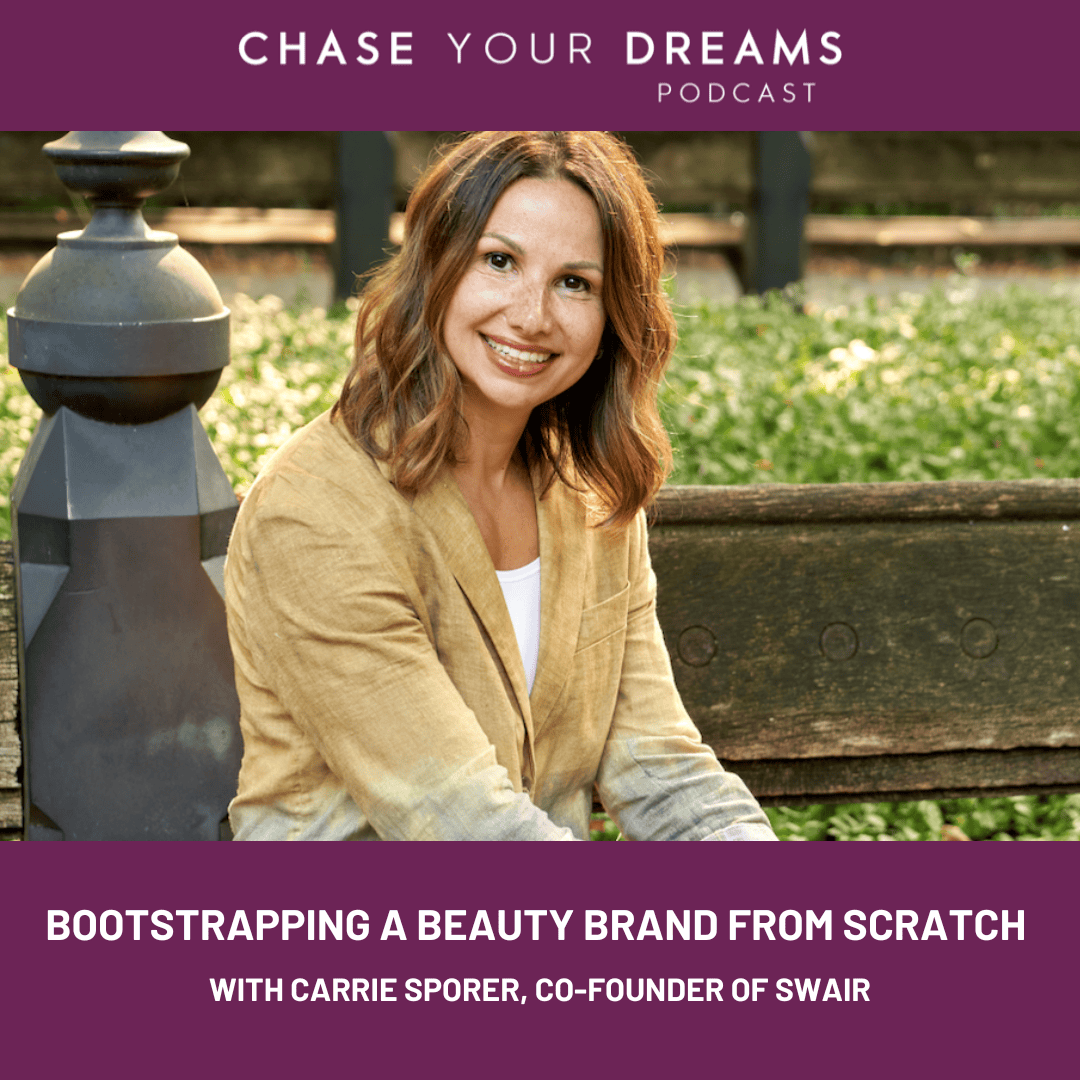
In this episode, Carrie Sporer, co-founder of SWAIR, shares how her frustration with constantly washing sweaty hair during marathon training led her to create showerless shampoo, a new category in haircare. She discusses her transition from a luxury fashion career into entrepreneurship, the importance of choosing the right co-founder, and how building a brand on a bootstrap budget requires focus, scrappiness, and resilience. Carrie emphasizes the challenges of educating consumers when introducing a new product, and how visual storytelling, community-driven marketing, and in-person demos have been key to growth. She also opens up about balancing motherhood and business, redefining “balance” over the long term, and why a founder’s personal story can be a powerful tool for connecting with customers. This episode is the perfect encouragement for aspiring entrepreneurs to take that first step toward pursuing their business venture.
About Carrie Sporer
Carrie Sporer is the co-founder of SWAIR, the beauty brand behind Showerless Shampoo, created to help people go from sweaty to ready without a full wash. She brings a strong background in luxury, having served as vice president of sales and operations at Edie Parker and director of sales at Judith Leiber. The idea for SWAIR came during marathon training runs in New York City, where she and co-founder Meredith Krill grew frustrated with the need to constantly wash sweaty hair. After more than a year of searching for a better solution, they decided to create their own. Today, Carrie channels her entrepreneurial drive into building a brand from the ground up while balancing the realities of motherhood and resilience in business.
Contact info
Website: swairhair.com
Instagram: @swairhair
Linkedin: linkedin.com/in/carriesporer
Takeaways
- Build your business around a real problem to ensure genuine demand.
- Start small and focused rather than launching with too many products at once.
- Educating your customer is just as important as selling your product.
- Show your product in action to build trust and drive conversions.
- Leverage your personal story to create authentic connections with your audience.
- Embrace flexibility and think about balance over the long term, not day to day.
Interview Themes
What does it really take to build a brand on a bootstrap budget?
Instead of relying on major funding, Carrie built SWAIR with limited resources by staying focused and making intentional decisions. For instance, she started SWAIR with just one hero product and outsourced logistics in the early phases of the company. Carrie emphasizes that businesses do not need a full product line or a large capital to begin with.
What are the challenges of creating a completely new product category?
Launching a “showerless shampoo” meant not only selling a product, but educating consumers on why it matters and how it works. While differentiation can spark interest, it also requires consistent, clear messaging to help people understand the value. Building awareness becomes just as important as building the product itself.
Why is showing your product more powerful than explaining it?
Since SWAIR is a haircare product that visibly transforms the appearance of customers’ hair, Carrie leans heavily on before-and-after demonstrations across social media and in-person activations for marketing. Seeing the product in action builds trust and drives conversion far more effectively than words alone, reinforcing the idea that visual proof can be a brand’s strongest marketing tool.
What does balance look like as a founder and a parent?
Carrie reframes balance as an entrepreneur and a parent as something that happens over time rather than day-to-day. Some weeks demand intense focus on work, while others require being fully present for family. Accepting this ebb and flow allows her to manage both roles more realistically without striving for perfect equilibrium.
Why is your personal story your greatest marketing asset?
Carrie believes that a founder’s “why” is often the strongest differentiator in a crowded market. By openly sharing her own frustrations and experiences, she creates a relatable connection with customers. In a world saturated with ads and polished content, authenticity and real stories help brands stand out and build lasting trust.
Chapters
04:47 The Birth of SWAIR
08:57 Creating a New Category in Hair Care
11:58 Building Awareness and Community Engagement
14:31 Bootstrapping a Beauty Brand
16:17 The Myth of Needing Huge Capital
20:21 Resilience in Entrepreneurship
24:15 Navigating Work-Life Balance as a Mompreneur
28:02 The Power of Personal Narratives
31:02 Using AI in Business
36:30 Encouragement for Aspiring Entrepreneurs
Transcript
Carrie Sporer
So it's finding your why and putting that problem out there in the world for other people to relate. I think when you can crystallize it to one pain point, phrase, or sentence about why you started your business, it really does become like this beacon that other people can see relate to. And then that's what turns people into customers and fans.
Glynis Tao
Welcome to Chase Your Dreams, a podcast for fashion entrepreneurs who want to build a purposeful and profitable clothing business so they can make a living doing what they love. I'm your host, Glynis Tao, an apparel business consultant and SEO specialist with 20 years apparel industry experience. I'm also a mom to a wonderfully energetic little boy named Chase.
Today's guest is Carrie Sporer, co-founder of SWAIR, the brand behind Showerless Shampoo, a product designed to help people go from sweaty to ready without needing a full wash. Carrie brings a powerful mix of corporate leadership and entrepreneurial grit to the beauty industry. Before launching SWAIR, she built an impressive career in luxury accessories, serving as vice president of sales and operations at Edie Parker and director of sales at Judith Leiber, two iconic brands known for their craftsmanship and global presence. But the idea for SWAIR didn't come from a boardroom. It came during the long marathon training runs in New York City when Carrie and her co-founder, Meredith Krill, kept running into the same frustrating problem: sweaty hair meant another full wash. After more than a decade of searching for a better solution and finding none, they decided to create the product they wished existed.
In today's conversation, we talk about what it takes to build a beauty brand on a bootstrap budget, the realities of being a mom and a founder, the resilience required to navigate professional setbacks, and why your personal story might be the most powerful asset you have as an entrepreneur.
Welcome, Carrie. It's so nice to have you here today. Thanks for joining me on the podcast.
Carrie Sporer
Thank you so much for having me and I'm glad to finally have a conversation with you. I feel like I've been following along your journey and the podcast and the content you put out into the world. So it's fun to be on the other side of it.
Glynis Tao
That's amazing. So glad to have you here. Carrie, let's start at the beginning. You built a successful career in luxury accessories at brands like Edie Parker and Judith Leiber. What inspired you to leave that world and start a beauty company?
Carrie Sporer
So when you look back, everything feels like it happened for a reason and you were on a certain path, but at the time it definitely felt much more haphazard. And when I was working for Edie Parker, which was my last sort of in-house job, I was traveling a lot. And with my first son, my first day back after a three month maternity leave involved a plane to Paris. So I just felt like the obligations of that job at the time did not match my capacities and wants and needs. So I decided that I was going to start consulting. I feel like it was the beginning of the gig economy back around… I want to say 2016 was when I started consulting. So about exactly a decade ago, we were having a lot of consultants come in and work with the brand and I was always really jealous being like, I want to be that person that kind of comes in, in charge of their own schedule, gets to work on with a lot of amazing brands. So I was consulting for a few years and learning a lot from other female founders that you don't necessarily have to have school expertise in the company that you end up founding. And I had this idea with my co-founder, Meredith, or at the time it was a frustration of having sweaty hair after every marathon training run. We wished that there was a magic product that could end that frustration and kind of put together what I had learned from these female founders that were starting small businesses and my own frustration figuring out how maybe I could be a founder as well and started contacting labs to see if anybody could help me.
Glynis Tao
So the idea for SWAIR came from a very real problem you experienced while training for the New York City Marathon. Can you tell us about that moment when you realized why doesn't this product exist yet?
Carrie Sporer
Yeah, that was definitely a journey. I was running most days of the week, and when I was running, I was getting sweaty enough, especially training for a fall marathon. You do a lot of your longest runs through the summer. So doing a 15, 18, 20 mile run in New York City with the heat and humidity in August, definitely left me having to wash my hair every time I ran and one just wreaking havoc on my hair and scalp, but it was just so time consuming. If you really wanted to quote unquote do your hair afterwards, you know, it may take five minutes to wash in the shower, but then it's like a 30 minute process after that to dry it and style it. So I tried everything on the market. I tried quick dry products. They were never what they claimed to be. I tried every type of dry shampoo under the sun and they often left my hair looking worse than how I started. And many of them were very flawed in terms of the ingredient list and the buildup they're leaving on your hair and scalp causing you to break out. So it was really like nothing was working. And I knew that so many other women were having the same pain point, whether they were runners, whether they had other ways that they were working out, or if they were just busy women that sweat a lot and needed help getting on with their day. So yeah, I tried everything. It wasn't like I didn't try and solve the problem in other ways.
Glynis Tao
I'm sure you did. And I'd like to get more into the product later and you telling us about the product that you came up with. But you met your co-founder, Meredith Krill, while training for that marathon. What made you two decide that you were the right team to bring this idea to life?
Carrie Sporer
So I've had a lot of conversations with a lot of different people about co-founders. I think there's no special sauce. I hear people say, don't work with a friend, don't work with a stranger, don't work with a spouse. I've seen every iteration of it, not personally, but from other founders that I know. And sometimes it works and sometimes it doesn't. And I think you know, it is a marriage in a sense. I joke that I have a husband as well as a wife with Meredith because, you know, our relationship is that close. But I knew that we'd be able to work together because we were both just very honest people and we're both not easily affected. If she tells me to chill out on a decision that I want to make, I'm not offended and I'm more curious about how we can get to the right solution and she's the same. And then one thing that I recommend to people, whether you're getting into business with a stranger or a friend, was that we put together a partnership agreement with a very expensive lawyer, probably more expensive than we should have, but we wanted to make sure that we were doing it right. And it really forced us to answer a lot of difficult questions about what would happen if one of us wanted out of the business, if one of us, for whatever reason, was not capable of staying in the business, if one of us, you know, God forbid, medically was unable to continue with the business. So we have the framework for all of that. And before we turned on our Shopify site, you know, we had the answers to a lot of the most complicated things that founder teams face. And I think that takes a load off just knowing what the worst case scenarios are.
Glynis Tao
That's great actually that you have put all those agreements in place prior to jumping into the business because oftentimes I find, you know, even during the best of times, sometimes, you know, we have different ideas, point of views and we don't want that to affect the friendship. And for me, if I were to ever partner with a friend, I'd always put the friendship before the business. If it were to harm our relationship, I'd feel like it's better to go our separate ways at that time, but it's good that you had that already in place in case anything happens.
Let's talk about you creating a new category with your product. SWAIR is positioned as a showerless shampoo, which is different from traditional dry shampoo. How did you approach creating an entirely new category in the hair care market?
Carrie Sporer
Yeah, starting a new category is definitely a blessing and a curse. You have built-in product differentiation where you are unique and a lot of people get excited about it, but there's also a big hill to climb in terms of having people understand what you're doing, and then some of the really basic things, and this really falls into your world, Glynis, with SEO. We consider ourselves a dry shampoo alternative and dry shampoo, in terms of SEO, in terms of page strategies, is really expensive to go up against. So it's creating this category, being known for being different, and then how are you gonna fight against the incumbents where it can be really, really expensive. So we've just tried to be very organic in our approach and have genuine fans that have voices in the communities that our product tends to fit best, like fitness communities, and really relying on fitness influencers or adjacent brands to really, you know, sing our praises and let people know that we exist. Cause it is much more challenging than I thought. I felt like people would hear dry shampoo alternative and come flocking to it. But because it does require a bit of education, it's probably our number one struggle still five years later is how are we effectively and concisely communicating why we're different than everything else on the shelf.
Glynis Tao
Yeah, so this leads me to the next question. When you're introducing something new to that consumer that doesn't fully understand yet, how do you communicate the values of your product so that people instantly get it?
Carrie Sporer
So I think that we're very lucky at SWAIR that our product is about convenience and transforming your hair, so we are able to communicate very visually how our product works. I was participating in a pitch contest panel providing feedback to people that are newer at pitching than I am. I don't want to say I'm some sort of expert, but I'm a bit experienced in pitching and the feedback I kept giving people was any way you can show your product in action will put you head and shoulders above somebody else who's just talking about it. So I'm very grateful that our product does lend itself well to visual mediums. That is how so many people are getting information about new products, particularly on Instagram and TikTok. So every ad that we do and almost every piece of content we put out is just before and after, before and after. And we are just drumming that message in and showing it a little bit differently in different settings, different hair types, different ages of women, different ethnicities of women. But yeah, it's just show and repeat.
Glynis Tao
Yeah, I can imagine. So many founders worry about competition, but when you're creating a new category, the challenge is often education. What strategies have helped you build awareness around SWAIR?
Carrie Sporer
Yeah, I think we have a few different strategies that have worked really well. As I mentioned, it's really seeing the product in action that is so helpful. So we've done a lot of kind of boots on the ground being based here in New York City. There is no shortage of fitness studios. So we're often popping up and doing demonstrations after fitness classes where women can try the product themselves without doing a full commitment to purchasing it. So they can try it out and it has been really great for us. Where we're unable to do that in person, having other members of our community and tell. We're very lucky that our community does have a lot of fitness instructors, so they'll show and tell about the product after their classes or even just having other people show it online.
Glynis Tao
So your product is very much a need to try it out, you know, product. So, I mean, I'm sure you've tried this, maybe giving out samples or something or waiting at the finish line of the marathon, giving out some samples to people to try it there right on the spot.
Carrie Sporer
Mm-hmm. Yes, we've gone to more of a demo model than a giveaway model. It's really hard to track the ROI of just giving product away. And we've found, if I'm speaking freely, we found that when we give the product away, people don't appreciate it as much. And even our smallest size now, which is like a travel size two ounce, it lasts most customers about two to three months and it costs us several dollars to make that size. So unless we kind of scale down to something that's almost more like a perfume sprayer, there's still really an expense in us giving that away. And we find that when people try it and love it, just that one time experience, that gets them more to then immediately go on and purchase. The amount of times we've done demos and somebody in front of me is like checking out on our website or on Amazon. Like that's amazing. That is like the best conversion that can happen. So, we have tried it, but we found that demos are just one less expensive and two really creates that urge a little bit more. If they don't have it in their hand immediately, they're more incentivized to then go purchase it.
Glynis Tao
Yeah, okay. That’s great!
Carrie Sporer
But that was definitely trial and error. I've given away a fair share of products in my day.
Glynis Tao
I'm sure. So how long have you been in business now?
Carrie Sporer
We've been doing this for five years, which is crazy.
Glynis Tao
Okay, and when you started the business, it was on a bootstrap budget, is that correct?
Carrie Sporer
Yeah, we're still bootstrapped. We've had two small angel investments, but combined, they’re still only five figures. So I still consider us bootstrapped because we haven't had any major investments.
Glynis Tao
So you built SWAIR on a bootstrap budget. What are some of the smartest decisions you made early on that helped you grow without outside funding?
Carrie Sporer
So one decision that I made that is probably a little bit controversial is that we started with a third-party logistics warehouse from day one. And part of that is being in Manhattan where I just don't have the space in my apartment and Meredith does not have the space in her apartment to keep a lot of product. But I felt that if we don't have money to bring on people to work on other things, then I was gonna outsource the thing that did not require a ton of brain power, the packing and the shipping, so that I could really focus on building the brand and not have to take several hours a day out of that. So that was kind of one choice that we made immediately that I think some people might disagree with, but it's worked for us.
A lot of it was a lot of negotiating really good rates to get started with that, which we were very lucky, but I really wanted to focus on brand building activities since I couldn't pay anybody else to do those.
Glynis Tao
For founders listening who feel like they need huge capital to launch a beauty brand, what's one myth that you like to challenge?
Carrie Sporer
So I think that to start a beauty brand, a lot of people think about a full suite of products. We started with one product in two sizes. We could have even started with one product in one size if we wanted, but I think that there are so many benefits, especially if you're like myself and Meredith, where you're not coming from the beauty industry and you're learning as you're building. There's so many advantages to starting narrow. You have just a lot less costs in general, of course, involving manufacturing if you're just making one thing. But also you're only marketing one thing, you're only shipping one thing. There's a lot of savings in just starting with one product.
So I would definitely encourage people who wanted to start something, starting really, really focused. And you know, it may not be one product, but you certainly don't need a whole collection. I know that can be a little bit challenging with color cosmetics, because you do need a bit more of a range, but finding products that work for a wide variety of customers and being able to focus is definitely a really great cost savings.
Glynis Tao
So just like with SWAIR, you launched with one hero product, right? And have you expanded?
Carrie Sporer
Yeah, we have three products now, plus a really adorable shower cap as a cute little add-on. And for us, we do want to grow beyond the three products, but we never want to be the brand that's putting out a new collection every season and that's following trends with ingredients. Everything that we have now is really different than anything else a customer has in their bathroom and we really want to focus on differentiated products. So we would love to be like six to eight really focused, amazing groundbreaking products rather than having a bunch of things.
Glynis Tao
Would you be able to just tell us quickly about what's in the actual shampoo itself? Because you said it's made with natural ingredients as opposed to dry shampoos, which I've seen contain a lot of chemicals and that's why I stayed away from it. Maybe you could tell our audience what makes your shampoo different.
Carrie Sporer
Yeah, so the main difference is just how it works. So rather than a dry shampoo where you're spraying either alcohol or powder on your scalp, neither of which are great things to put on your scalp, ours is the consistency of water. So you spray it on and then you actually towel dry it out and that process removes the dirt and the sweat. So it's a different behavior and you're actually removing the dirt instead of just masking it with other ingredients.
We launched in 2020. We always said if it couldn't be a clean formula, like why bother at that point? Because I feel like most products within the last five to 10 years have really focused on clean ingredients. So we made sure that we omitted any endocrine disruptors. So there's no phthalates, there's no sulfates, which there's a little bit of controversy if those are too harsh for the hair. It's gluten-free, it's formaldehyde-free, it's silicone-free. So really a lot of the biggest problematic ingredients we've omitted.
Glynis Tao
Looking back, were there any scrappy or unconventional marketing strategies that ended up working surprisingly well?
Carrie Sporer
Goodness, that's a great question. I think, you know, we've done quite a bit of like man on the street style demoing, or we'll just kind of know where, like in Central Park or Riverside Park where a lot of people tend to be running or there's often like outdoor fitness classes happening. You know, making sure that we're just kind of in the right place at the right time or knowing where a certain run club ends their runs. So we did kind of a lot of show up and ask forgiveness not permission type stuff
Glynis Tao
Guerilla marketing. Love it. Entrepreneurship often comes with setbacks that no one sees in public. Can you share a moment in your journey that really tested your resilience?
Carrie Sporer
Oh my goodness, there are so many of those stories. I guess I'll just say before going into, like, my probably most painful example, like, having a co-founder when you go through those moments, I might have quit like 10 times by now if I didn't have somebody to kind of hold hands with through these situations. I feel like there's a good push and pull when one of us is like, my God, and the other one's like, this is not something we can't get through.
But our brand almost ended before it began because of our first production run, which happened during the end of COVID. We were supposed to ship everything to our warehouse and two days prior, and we had worked with a PR firm to make sure that we were getting launch day press. Two days prior to shipping to our warehouse, the lab called us and said that there was a contamination and they needed to dispose of 5,000 of our 6,000 bottles from our initial order. And I'm glad I can laugh at this now because at the time it was anything but laughter. It was really challenging because we already were more delayed than we wanted to be because our bottles and sprayers were delayed because of COVID because a lot of surface cleaners and other types of cleaning products were taking up the capacity of the bottle and sprayer manufacturers. And because we're a tiny customer placing our first order, going against companies that are placing hundreds of thousands of bottles, we kind of got pushed to the back of the line. So we ended up buying stock bottles, which we still use a version of those today with some modifications. So we had to kind of change our packaging, buy new labels. Luckily, the lab took financial responsibility for the contamination and reimbursed us for anything new that we had to buy. But it was really, really painful. And we had to push back our launch by about six weeks, even with everybody moving mountains to make things happen as quick as possible.
Glynis Tao
Yeah, that sounds stressful.
Carrie Sporer
Normally, you communicate with the lab via email, and then when your phone rings from them right before launch, like your heart drops.
Glynis Tao
Exactly.
Carrie Sporer
It's like my kids at school. Like the email is okay. When school calls…
Glynis Tao
That’s right, that’s right. How did your previous career in luxury retail prepare you for the realities of building your own brand?
Carrie Sporer
I think probably the most important thing that I brought with me is just the mindset that everything is figure outable. In working in luxury accessories with the top stores in the world. A lot of my clients were like Harrods and Bergdorf Goodman and Barney’s when it existed. And they would say, we love this product and we want to purchase thousands of units of it, but you're going to have to change this thing about it. You know, like we want all of the black leather to be this special brown leather to match our sofas in our handbag department. Like we would get the craziest requests and it was learning how to make those things happen and go the extra mile that, being now an entrepreneur and having to kind of figure out a lot of random things that are seemingly impossible at first glance, that mindset has probably been the best thing to bring with me. Of course, there's some retail basics and terminology that I understood from my past career, but beauty does really operate very differently than leather goods. So there was also some unlearning as well. But especially in terms of reading sale sheets and things like that, there were some things that transferred over, which was great.
Glynis Tao
Okay, so let's go and move over to talking about being a mompreneur. So you're building a business while raising two boys, is that right?
Carrie Sporer
Yeah.
Glynis Tao
How old are they?
Carrie Sporer
Seven and nine.
Glynis Tao
Seven and nine. How has becoming a founder changed your perspective on work and balance?
Carrie Sporer
So one thing that I tell people about being an entrepreneur and a mompreneur is you're either completely flexible or completely inflexible because if something is on your calendar and you are the only person that has the capability to do that for your company, you have to do it. But on the flip side, if your day is a little bit more flexible and a kid is homesick from school, there's things like that that you can have more flexibility.
So I just find myself living on two polar ends of the spectrum that things are either completely inflexible and if something in life happens, I'm calling my husband, calling a babysitter to help, or there are the times where I do have the flexibility to move things around. It's living between those two poles that I find sometimes a little dizzying, but I'm glad for the flexibility where I have it. And I think, you know, like most people that are parents and working, whether it's for themselves or for someone else, you know, down the road, you're never going to look back and say, I wish I worked more. So bringing that mindset as well that there's things that have to be done that I will not sleep until certain things are crossed off the list based on deadlines. But really just trying to prioritize my family. And I know that my boys think it's so cool that I have my own business and they're really cute about it, but making sure that it can be all-consuming, so making sure I take breaks.
Glynis Tao
Mm-hmm. Because I've had a lot of other mompreneurs on the podcast as well, and I'm also a mom as well to a 10-year-old boy, and yeah. Things can really get very hectic at times and having to juggle a lot of things. I feel it's more of a juggling act than a balancing act. It's hard to really balance things when there's just so much going on and what you do is you do the best you can. And so the term balance gets used a lot, it doesn't often reflect reality. What does balance actually look like in your life right now? Or do you use another word?
Carrie Sporer
Well, I think of balance more over the long term than the short term because I think, you know, we've all been up against work deadlines where you're working 12, 15 hour days, and then there's like two weeks ago, my son was sick all week and was home with me all week. And I had a lot of deep work that I wanted to get done and it just wasn't gonna happen. So I kind of think more rather than like the day to day or the week to week, almost looking at balance, like over the course of a year where I know that there's gonna be weeks at a time where I'm doing really focused on work and then weeks at a time that I'm really focused on family. And I think that that kind of helps get me through the ups and the downs and lets me really vacation or be present when my kids need me because I know, three, four weeks ahead, I'm going to be glued to my laptop, grinding something out, working on a big project. So I try to give it wider boundaries. And that's been really helpful for my mental health.
Glynis Tao
Mm-hmm. Yeah. And just having that longer range perspective on things, I find that helps as well. And also I think, you know, I can be a workaholic and keep working, but to set these more healthy boundaries… After my son was born, I was thinking in my head that, you know, he's only going to be this little. He's not going to stay this small forever. Right. So I really just wanted to enjoy this time with him as well to watch him grow up and not feel like I missed out on his childhood.
Carrie Sporer
I totally relate.
Glynis Tao
You said that personal narratives can be a founder's superpower. How did your own story shape the SWAIR brand?
Carrie Sporer
I'll take a step back first. Meredith and I actually met in 2007 training for the marathon that year. There's been a lot of marathons and races and other things that have happened fitness-wise and then of course just a bunch of life in the almost 20 years now since we've been friends. And then of course the business didn't start until much later in that friendship. But now, even that we're five years in, the question that we always get is why did you start? I know we talked about product categories and differentiation, but your why is your biggest differentiator. And with seven billion humans on this planet, you're not going to be the only one.
I'm sure we've both come across some really esoteric brands that are very, very niche. I was listening to something recently on how someone was talking about a very specific type of fishing a certain fish. It was like the narrowest scope that you can imagine, but the fact that that could still be a full-fledged business because there are so many people that have that very, seems to me, narrow hobby.
So it's finding your why and putting that problem out there in the world for other people to relate to. We're constantly updating our social media, updating copy on our website, on our Amazon site. And what really converts people from people just looking to being customers and then being fans of the brand is hearing our story about how we just hate it to wash our hair, which sounds kind of silly, but other women who get sweaty are like, I get it. And I have never once explained our product to someone that was like, I don't know what you're talking about, on some level. Anyone with hair can relate to the fact that it gets sweaty, that it feels inconvenient, that washing your hair can be too much of a good thing. So whatever your version is of sweaty hair that you didn't want to wash, I think when you can crystallize it to one pain point, phrase, or sentence about why you started your business, it really does become like this beacon that other people can see relate to. And then that's what turns people into customers and fans.
Glynis Tao
Many founders struggle with putting themselves out there publicly or they are afraid to show up on camera, myself included. Why do you think sharing your personal story can be such a powerful marketing tool? I mean, you touched upon it, but just more of like how it's worked for you and how you think that could work for others as well.
Carrie Sporer
Yeah, I think that seeing real people telling real stories in a world where now so much is like, forget even a model, it's like AI, it literally is not real. I think having a founder talk about their story really cuts through a lot of the BS that's out there. People are bombarded with, you probably know these statistics better than I do, but you know the thousands and thousands of ads in some way or form every day. And it really is a way to kind of cut through the rest of the noise out there.
I put all kinds of ads on Facebook and Instagram, and when it's me demoing the product or talking about the product, those are the ads that make money. Again, like I'm scrolling Instagram and I see my face pop up as part of an ad. Like it's not the greatest part of my day. I cringe, but people are definitely connecting with it and they like seeing a real woman. shoot them on an iPhone, often like in my kid's bathroom because that just tends to be the one with the best natural light. And it's made our brand like hundreds of thousands of dollars. So I mean, when there's sales behind it, we start believing, right?
Glynis Tao
Yeah. So just put yourself out there.
Carrie Sporer
I would say one thing that's been really helpful, and I'm sure like for most founders, AI and like particularly ChatGPT, Klaus, Gemini, like have been so transformative for small businesses in the last year in particular. Sometimes when you're the founder, it's hard to think about what you want to say and really just asking ChatGPT for some prompts, like this is roughly what I wanna talk about, or this is what I'm having trouble communicating. And when ChatGPT just spits it out, and it gives me the exact script and the exact captions to put on, whether it's YouTube or Instagram, any kind of media, having the directive makes it so much easier. Because sometimes we're just like, okay, what am I gonna post today? I can say this, I can say that. Letting AI do its AI thing about exactly what you should say. It's not going to get it right all the time, but it's really keeping us consistent because it's just popping out directions. And with decision fatigue, it's really nice for someone to tell me what to do, even if it's AI.
Glynis Tao
There's nothing wrong with using AI for your business. It sounds like you use it for yours in helping you generate social media captions. Anything else you use AI for?
Carrie Sporer
Yeah, so we definitely mostly, I would say, use it for helping with social media ideas. I will use it to help put individual product shots in different settings, but I don't feel comfortable using any videos or before-after images with an AI generated human. I'm not comfortable with that. Anything you see with a human from SWAIR is a real human, but we will use, you know, like put this on a pink bathroom vanity. Like I'll definitely use image generation tools for that.
I did walk away from having a third party run our Google Ads. So I'm doing that all by myself now, but I put in the analytics once a week to ChatGPT and I asked it to analyze and make suggestions and it's been really amazing and helping us scale and manage Google. So any data analytics or it's really, really great for, and then sometimes just checking things like on our website or on our Amazon and just saying, you know, read this webpage, pop in the link, and then whatever I'm looking for, like, are there any quick changes we can make to improve conversion? Or can you spell check this quickly? Like, I use it all the time.
Glynis Tao
It's really good at just fine tuning things and refining copy that if you're not a professional writer or copywriter, it can kind of help you if you feed in your own words, right? To begin with, or help me tweak this, you know, so that makes it sound more appealing to my audience or target market. I find that's great. Yeah.
Carrie Sporer
Yeah, and one thing that I do that's really specific to you, Glynis, is I feel like I mentioned it, that you were our inspiration for finally starting a blog five years into the business. I was listening to something on the podcast, and you always talk about the benefits of blogs for SEO. I don't want AI to write the entire blog. So what I do is I ask AI to ask me questions to make the blog post and that's really helpful as well. And then after I write the blog post, I put it back in and make sure that there's not any additional places that we can put keywords. I've written this blog now, you know, make it more SEO friendly.
Glynis Tao
So you've written it from your point of view with your own expertise, you know, and written in your voice and you just ask AI to sort of tighten it up and put in those relevant keywords in there just to polish it and yeah, make it ready. That's great and thank you so much. I really appreciate that. I remember you mentioning that, yeah, you started your blog because of the podcast or an episode you heard on the podcast. So I'm really glad that helped inspire you with it.
So before we wrap up, for someone listening today who has an idea but hasn't taken the leap yet, what would you say to encourage them to start?
Carrie Sporer
So I think a lot of people feel like starting a business is binary. Like they're either not starting the business or they're starting the business. And when we had the idea for SWAIR, we actually didn't even know if the idea of a showerless shampoo product was possible. And I was not going to start. It was about finding this problem solving product. And it wasn't about, I want to start a hair care brand. I wasn't going to start it if I couldn't find this product to work.
So I put together a brief about the product that I was hoping to make—what I wanted it to look like, what I wanted it to smell like, what I wanted the experience to be. It certainly was not completely flushed out. I don't have a chemistry background. A lot of it was just in layman's terms of like this is the product that's missing for a lot of women and I just started calling different labs and shopping around my brief to see if anybody even reacted or thought that it was something that they could do. And we got very mixed reactions depending on who we spoke to.
So I think just taking that first step of figuring out how are you going to make your product? Can you make your product? It doesn't have to be, tomorrow I'm starting my business. There's a lot of gray area that you can live in and gather information and start to think about your plan. So I think just baby steps is all that you really need and that will kind of help push you in one way or the other, but just do it. Like if you're thinking about it, just take that first baby step. There's literally no harm. If you find out you can't make what you want to make, you can't do what you want to do, you haven't failed. You've just dipped your toe in the water and you'll be glad you did.
Glynis Tao
Where can people find you if they want to get in touch with you?
Carrie Sporer
carrie@swairhair.com. Very easy to email. We're swairhair.com and @swairhair on all of the socials. So we are not hiding, we're easy to find. Myself or my co-founder still look at all of the DMs, so if that's easier than email, you can slide on in.
Glynis Tao
Carrie, thank you so much for sharing your story and the journey behind building SWAIR with us today.
Carrie Sporer
Thank you, this was really fun!
Glynis Tao
Yes, it really was. I always love hearing founder stories and that's one of the biggest reasons why I do this podcast is for people to just share their stories with others. It sort of feels like, you know, they're perhaps alone out there and thing is there's other founders who are right in the same boat.
Carrie Sporer
Yeah.
Glynis Tao
And that's the reason why I love doing this. So thank you so much.
Carrie Sporer
Yeah, thank you.