
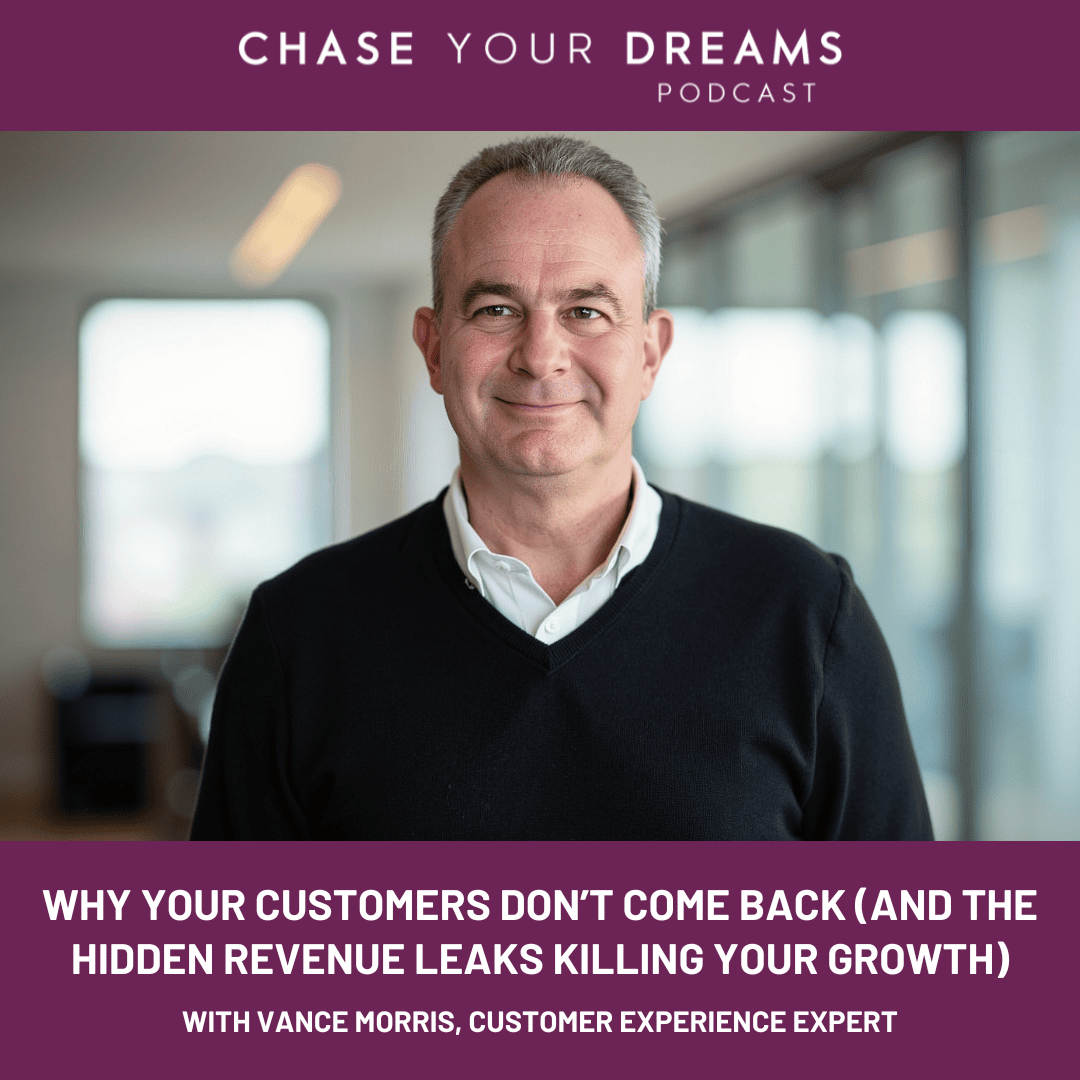
Vance Morris, business consultant and former Disney leader, shares expert insights on how brands can improve customer retention, form emotional connections with their audience, and sustainably grow through exceptional customer experience and loyalty strategies. Drawing from his unconventional journey and hands-on experience building businesses, he explains why many companies have a retention problem and are losing revenue after the first purchase due to weak or nonexistent post-purchase systems. He breaks down how Disney’s focus on emotional connection and repeat customers can be applied to businesses of any size. This episode highlights why discounts create false loyalty, how retention directly impacts profitability, and simple but powerful shifts that can turn one-time buyers into long-term advocates.
About Vance Morris
Vance Morris is a business consultant and customer experience expert who helps businesses stop losing revenue after the first sale by focusing on customer retention and loyalty. Vance comes from an unconventional background. From working as a security guard to becoming a leader at Disney and then rebuilding after bankruptcy, he brings a practical, experience-driven perspective to brand growth. He specializes in direct response marketing and engineered customer loyalty systems to turn one-time buyers into repeat, loyal customers, helping brands drive long-term profitability.
Contact Info
Website: vancemorris.com
LinkedIn: www.linkedin.com/in/vancemorris/
YouTube: www.youtube.com/@Deliverservicenow
Email: vance@chesapeakeservicesolutions.com
Resource:52 Ways to Wow your Customer
Takeaways
-
Most brands don’t have a traffic problem—they have a retention problem
-
Emotional connection is the key driver of repeat purchases and long-term loyalty
-
The post-purchase experience is where loyalty is either built or lost
-
Regular, non-salesy communication helps maintain valuable customer relationships
-
Retention is more cost-effective than acquisition and has a direct impact on profitability
-
Discounts create fake loyalty, while real loyalty comes from experience and consistent value over time
Interview Themes
How can I develop an emotional connection with my customers?
Emotional connections are created by showing the human side of your brand. Share your personality and your story through regular, non-salesy communication with your customers. The goal is to make customers feel like they know you personally instead of just perceiving you as a conventional ecommerce brand.
What are some practical ways to nurture relationships with existing customers?
After making a sale, stay in touch with your customers. The post-purchase experience is the perfect opportunity to leave a lasting impression on customers to make them want to come back for more. Follow up with helpful tips, how-to tutorials, testimonials, and other valuable content through email or even physical mail. Small, thoughtful touchpoints are what keeps your brand top of mind.
Why can discount offers be a harmful retention strategy?
Offering discounts is not a loyalty strategy—it’s bribery. If you train your customers to get used to regular promotions and discounted prices, they aren’t going to buy your products at a regular price. They’re going to wait until the next sale because they don’t associate your products with the full prices that you value them at. Although it may boost your short-term sales, discounts can hurt your profits in the long run.
What key metrics should I track to measure customer retention?
Focus on customer retention costs, customer acquisition costs, net promoter scores, and repeat purchase rates. These metrics will give you a good picture of how much it costs to attract customers and maintain strong relationships with them.
What are the benefits of having brand ambassadors?
Brand ambassadors help build trust between the brand and its customers because they are real users of your product. When customers see real people sharing their experiences with your product, it strengthens your brand’s credibility because it feels authentic and relatable. It builds social proof and pushes word-of-mouth growth. Overtime, brand ambassadors help expand a brand’s reach and drive growth.
Chapters
00:00 Understanding Customer Experience and Retention
06:34 The Disconnect in Customer Experience
11:41 The Importance of Emotional Connection
16:40 Retention as a Revenue Strategy
22:03 Building a Strong Response System
25:36 The Dangers of Discounting for Loyalty
27:46 Moment Zero: First Impressions Matter
29:52 Practical Steps for Improving Retention
31:47 Key Metrics for Tracking Retention
Transcript
Vance Morris
It’s the emotional connection and that's really what drives Disney. If you went to the park today, you went to Magic Kingdom, 80% of the people in the park right now have been there before. It's only 20% new. So I figure, if that ratio is good enough for Disney, it's good enough for me and for my clients. So that's the goal we're trying to hit is 80% customers.
You know, I mentioned this emotional connection thing and Disney does it very well. I mean, they have movies, they have characters, they have theme parks. I mean, when you drive into Disney World down in Orlando, there's the big arch over top and “Welcome to Walt Disney World”. And you know you've arrived and you start to get goosebumps and the kids get excited and all that stuff. That's the feeling we want people to have about our business. But we don't have Cinderella castles, we don't have characters and all that stuff. So how do small businesses create that emotional connection?
You really have to let your personality come out in this. Use stuff from your background, use stuff from your personality that is going to help create an emotional connection with your customers, not just a transactional one, because if the only time your customers ever hear from you is when you want money, that's not a relationship. You've got to have non-salesy communication going on with your customers. That’s where a lot of businesses miss.
Glynis Tao
Welcome to Chase Your Dreams. I'm your host, Glynis Tao. With more than 20 years in the apparel industry and deep expertise in e-commerce SEO, I help fashion, beauty, and lifestyle brands build visibility strategies that drive long-term growth.
Now, most brands think they have a traffic problem. They think if they just get more people to their website, more clicks, more sessions, more reach, everything else will take care of itself. But what I've seen again and again is that it's not where the real problem is because you can have traffic coming in every single day and still not grow. And the reason is what happens after the first purchase. That's where most brands are quietly losing money. Customers buy once and then disappear. No second purchase, no loyalty, no referrals. Most brands don't even realize it. So today, we're breaking down what's actually happening and how to fix it.
I'm joined by Vance Morris. Vance has had one of the most unconventional journeys from working as a security guard to becoming a leader at Disney, to going through bankruptcy and then rebuilding into a successful entrepreneur. Today, he's the person businesses call when they're bleeding profit and can't figure out why. He specializes in customer experience and retention. What makes his approach different is that he blends direct response marketing with engineered customer loyalty systems. In simple terms, he helps businesses stop customers from quietly disappearing and stop money from leaking out the back door. Vance, welcome to the show.
Vance Morris
Thank you so much. I appreciate you having me. Hopefully we'll drop a few gold nuggets for everybody today.
Glynis Tao
Amazing. Let's start here. You work with a lot of businesses that feel like something is off. They're getting customers, they're making sales, but growth isn't consistent. When you come in and look at businesses like that, what's usually actually happening?
Vance Morris
They're focused a lot on their widget—whatever the thing is that they're selling. So they worry about the packaging. I work with a luxury shampoo manufacturer and he's more worried about the bottle the stuff goes in than he is about the method of delivery, how it's delivered, what it’s delivered in. There's really no experience around receiving his product. And so really a lot what we look at is where do we start with kind of an unboxing experience? The only thing that separates you from every other commodity in your niche or in your industry is your personality and the experience you deliver. I mean, there's 10,000 shampoo companies out there. You know, he has a specific way that he can separate himself. We just need to be able to lean into that. And if you want to retain customers, you have to start with an incredible customer experience. Otherwise, you don't have a prayer of keeping customers around. What I see in most companies is that there is no system, no process for customer retention.
Glynis Tao
And so one thing that stood out to me when you reached out that you mentioned is that most brands are losing customers after the first purchase and they don't even know it yet. So why does that happen?
Vance Morris
There is no system, backend system for after the purchase or the experience of the purchase was not memorable. Because you got to remember it is not the customer's job to remember you. It's your job to remind the customer that you exist. And so having a customer existence system in place, you've got to be able to create this emotional connection with your customer when they first either visit your website or they open the box when they get it at home. I’ll give you a quick example. So when you order my book—this is not a shameless plug, don't worry—you can order my book on Amazon and it's going to show up in an Amazon box or a little baggy. Nothing exciting about that. We get those all the time. But if you order the book from my office and we are the ones that fulfill it, you get an unboxing experience. My book comes in a custom box, and then there's a nice bookmark in there with a little tassel on it. It's more of a workbook, so we've got a pen in there. I've included a nice thank you note. And there's other little gifts in the box so that when you open it and then that box is inside of another box. So it's like a little Christmas party. You know, when that box arrives, you're like, oh my God, one, somebody cared enough to look at the packaging, and two, somebody cared enough to create an experience out of opening up a box and inside was a book. So you can do that with really any product. That experience is really where you need to start.
Glynis Tao
That's a great example that you just mentioned with your book, which I love for you to tell us more about that at the end and where people can purchase it. So you gave an example of your book in terms of like, the previous question in terms of, where people are losing their customers after their first purchase. Where do you see the biggest disconnect between the experience brands think they're delivering and what customers are actually experiencing?
Vance Morris
Yeah, I mean, there's been studies on this. Right now, the last time I looked, which was at the end of last year, 80% of businesses think they're delivering a great experience. When they surveyed the customers of those businesses, only 8% say those companies are delivering a great experience. So there is a huge disconnect. You have to get into the mind of your customer and figure this out.
One of the unsexy things, and here's a tactic that everybody can use, and it's not, like I said, not very sexy, but you map out your customer journey. You do it from the point of view of your client. So every time your business interacts with a client, whether it's a phone call, a website, a box gets delivered, whatever it is, you map that out on your customer journey. More importantly is mapping out what happens after the purchase. What are the mailings? What are the emails? What are the videos, the postcards? What's happening after the purchase so that you stay in that person's life? And like I said, you do it from the point of view of the customer.
So let's say the customer goes to your website and buys your product. At this point, they are excited, right? Because they just spent money, the endorphins and dopamine and everything's flowing. And, okay, cool, I just bought something. Can't wait for it to get here. And then what's the next thing the customer does? It's not open the box. That's what everybody thinks. They now wait. So there's a period of time between the order and the package arriving. Now, your company's doing work, okay? This is why we do it from the client's point of view. You guys are packaging and getting stuff together, you know, postal service, UPS, whatever, getting ready to get the box to go out, but your customer is sitting there waiting. So you have to address that wait period. Okay, what can you do to entertain them while they're waiting? Because when they wait, they can second guess their purchase. They could have some buyer's remorse. Maybe they're thinking, okay, I'll find something else. Another competitor comes in.
So if you think of Disney, right, when you go to Disney, you wait, right? You wait for the rides, you wait for food, you wait for transportation. Disney's just figured out a way of making that wait not feel so bad. So they call it “linertainment”, where they entertain you in line and they have, you know, characters and interactive stuff and, you know, they might be selling food in line. So it doesn't feel that bad.
We need to do the same thing. So as soon as that order is placed, what can you send immediately before the package, which is probably going to have to be digital, but can you send a how-to video? Can you send a testimonial video? Can you, you know, all sorts of things you can do to keep them excited about their purchase until the box arrives. So I think that's really one of the first places you can plug the holes in keeping them excited and getting them ready to make a second purchase.
Glynis Tao
You mentioned businesses call you when they're bleeding profit but don't know why. What are the first one or two things that you typically look at?
Vance Morris
Sure. Well, the first number and every business should know this is how much does it cost to get a new customer or your client acquisition cost? Typically, that is the biggest number when it comes to your business as far as marketing. So in my business, I have some businesses here in Maryland and it cost me $136 to get a new customer in the front door. That's the pay-per-click ad. That's the guy answering the telephone and dispatching. One of our technicians. So when I go out and serve a new client, I had to buy them. It costs me $136. It only cost me $23 a year to retain a customer. So my marketing efforts that I do after our first sale are a heck of a lot less than the initial acquisition. So the second purchase that I get from one of my clients, I'm already $100 more profitable because they didn't have to go out and get that client again. So you can be really busy, I mean, getting new clients, new clients, new clients, new clients all the time, but if they're only doing a one-time purchase, you're not profiting. You're going broke very slowly. You just don't notice it because you feel busy. But at the end of the week, there's no money in the bank account.
When I work with folks, one of the questions I always ask is, you know, do you have a marketing budget? And most people will say yes. The ones that don't make me nervous. Then I asked the question, okay, how much of your marketing budget is for customer retention? And they all look at me like I got three heads, right? 99% of companies don't have a budget set aside for customer retention. And that's where all of the money is made at the lowest cost. I don't know if that example painted a bleak enough picture, but that’s the first thing I look at is customer acquisition costs versus cost of keeping a customer.
Glynis Tao
I just kind of wanted to go back to your experience working at Disney. You mentioned, you know, how they've thought of everything and entertaining people in line and stuff. So what do they understand about customer loyalty that most brands still completely miss?
Vance Morris
It’s the emotional connection and that's really what drives Disney. If you went to the park today, you went to Magic Kingdom, 80% of the people in the park right now have been there before. It's only 20% new. So I figure, if that ratio is good enough for Disney, it's good enough for me and for my clients. So that's the goal we're trying to hit is 80% customers.
You know, I mentioned this emotional connection thing and Disney does it very well. I mean, they have movies, they have characters, they have theme parks. I mean, when you drive into Disney World down in Orlando, there's the big arch over top and “Welcome to Walt Disney World”. And you know you've arrived and you start to get goosebumps and the kids get excited and all that stuff. That's the feeling we want people to have about our business. But we don't have Cinderella castles, we don't have characters and all that stuff. So how do small businesses create that emotional connection?
You really have to let your personality come out in this. So one of the things that I do is I shamelessly use my children in my marketing. I have no problem with it. And so my daughter, she's 18 now, but when she was younger, she did ballet. And at the recital every year, I would take a picture of her and her little tutu and I would put it in my print newsletter that I sent to all of my clients. So every year, there's little Emma growing up and her picture’s in the newsletter. She was probably about 10 or 11 years old. We're in the grocery store and this lady comes running up to us and asks my daughter, doesn't even talk to me, talks to my daughter. She goes, oh my God, Emma, how was your recital? We're looking at each other like, you know, should we go hide in the frozen food section? Who's this nutty lady? And then I had to think, she's one of my customers. She has watched my children grow up. This lady is never leaving me. She has to either move or die before she'll stop doing business with me because of that emotional connection. My kids have thousands of aunts and uncles that they'll never meet. They're all my customers, but they know exactly who my children are.
Do you have to use your children? No. Maybe you're into knitting or bowling or something along those lines. Use stuff from your background, use stuff from your personality that is going to help create an emotional connection with your customers, not just a transactional one, because if the only time your customers ever hear from you is when you want money, that's not a relationship. You've got to have non-salesy communication going on with your customers because it's a rotten feeling. I mean, you know, we all know when the mattress sales are coming out because the only time the mattress company sends it is on Labor Day and Memorial Day. And it's the only time you ever hear from a mattress company is when they want money. Well, where were you back in November when I could have used a nice little postcard on how to get a good night's sleep or something like that, adding value? That’s where a lot of businesses miss.
Glynis Tao
Yeah, because whenever we look at the marketing funnel, you know, we see this top of funnel, middle funnel, bottom conversion, then what happens after that?
Vance Morris
It's empty!
Glynis Tao
So for founders listening right now, how can they quickly audit their post-purchase experience without over complicating it?
Vance Morris
Well, first, are you doing anything? And so you want to really look at, what is the follow-up? Do you have somebody or a VA calling and doing a quality assurance check on the product? Hey, did it arrive well? Is it safe? I mean, today, you know, VA's are so inexpensive and nobody's using the telephone. Can you imagine if you sold somebody a bottle of shampoo, it got delivered and two days later you had somebody from that company calling you saying, hey, we saw that the shampoo was delivered. Did it arrive okay? Have you had a chance to use it? What do you think? People will be blown away by that. Otherwise, most companies they'll send you an email, and please rate us here, or they'll send you a text message. Pick up the phone and make a phone call. It's easy to do.
And then look at your communication. Like I said, if the only time you're communicating is when you want money, like you're doing a promotion, sending out a kind of coupon, you're not creating relationships that way. So you've got to be able to add value. So in your monthly marketing mix, what are the value messages that you're sending?
Just take the shampoo example. My guy now sends out a postcard once a month with haircare tips in it. Nothing to buy, no promotion, no sale, no coupon, just a postcard to his buyers saying, here's how to best use our product. And here are three other, you know, haircare tips that will help, you know, help you keep your hair, something like that. I don't have much hair, so this is not really my best subject. But yeah, it's how do you deliver value after the sale is where the repeat customers come in.
Glynis Tao
So let's shift into how to think about this strategically and how retention can be used as a revenue strategy, not just marketing tactic. So a lot of brands are still very focused on acquisition, as you said, ads, SEO, traffic, getting more people in the door. At what point does retention need to become the priority?
Vance Morris
Yesterday. It really does. Think about customers that are your raving fans. They’re like evangelists. They’ll scream from the rooftops how great you are. That's word of mouth marketing, right? That's viral marketing. While yes, I mean, don't get me wrong, you need a top of funnel. No doubt about it, okay?Whether you're doing online, offline, doesn't matter, pay-per-click ads, flakebook, I get it, you need it. But once you have this army of raving fans, now you start to have a referral source. Think about how easy it is to close somebody who's referred to you versus somebody cold off the street, right? A referral coming to you is about as hot a prospect as you can get. I mean, you got to work hard to screw that up and not get the sale because one of your customers has gone out and said, yep, Vance is the guy for you. You really need to use Vance. He's amazing. Yada, yada, yada. And then they come to you and they are ready to buy. Their wallet is out. But a new client coming in cold, cold traffic off the street who's never given you money, never experienced your service, never used your product, they're very skeptical, right? They haven't had the opportunity to meet you, to try your stuff and do it. So they're a much more difficult sell than somebody who's coming in as a referral. So that's also part of your retention plan is your referral strategy.
Glynis Tao
So can you actually break down and give us an example of how improving retention actually impacts revenue compared to just getting more traffic in the door?
Vance Morris
So I own some home service businesses here in Maryland. One of them is a carpet cleaning business. So I'm not one of those consultants or coaches that has never done anything else. I actually own real businesses. You know, when we were first starting out, we were spending so much money on getting new customers because we didn't have any. But what we did smartly, was as we got a customer, they immediately went into our CRM so that they would go into a reminder sequence or just a general mail sequence so that we would stay in touch with them. We would stay top of mind. When I first started, my customer acquisition cost was probably closer to $200. And now, thanks to a raving fanbase and the people that get referred to us, our acquisition cost is, as I said, is now about $136. So all of that money goes to our bottom line.
Between today and say 10 years ago, we're probably looking at somewhere between 75 and $100,000 in profit. Not sales, but profit because I'm not spending that money going out and getting new clients. I'm spending that money, a lot less money, on keeping existing ones who then refer.
Glynis Tao
You had talked about something that I think has been really overlooked and that's like missed messages, slow replies, broken communication. These feel like small things, but they're actually big revenue leaks. So where do you see this happening the most and how much of an impact does something like response time actually have on conversion and retention?
Vance Morris
It's huge. Take this kind of in two parts. The first part is really that attention to detail, right? Okay, well, maybe we had a coupon code that didn't work. No big deal. Or maybe we answered the phone in five rings instead of three rings. Okay, no big deal. And each one of those in a silo by itself, it's not the end of the world. But if you add up five or six of these little details that are missed, you know, okay, the coupon code didn't work. You're out of stock on the product. You know, I had to leave a voicemail. The chatty bot thing on online said people were out for the next two hours. These are all little things that just add up and you're like, forget it. I'll go buy my stuff from somebody else because those little things added up.
And yes, these days, sadly, we are in the “I want it now” kind of environment. It always reminds me of that Charlie and the Chocolate Factory, Veruca Salt, the little obnoxious girl. I want it now! And she ends up turning into a big blueberry. But that's what people want. I mean, and we've been brainwashed with this. I mean, Amazon now delivers in two hours or less in some places. You know, we want stuff delivered in our hands immediately. So we have to do that. We have to meet those expectations. Now, I get it. We don't have the purchasing power and the shipping power of an Amazon. But setting expectations and then exceeding them, say, okay, yep, we're typically, you know, four to five days in shipping when you know that it's three. Right. So now, they got the box a day early. Now they're excited. Those are some of the holes that you have to plug. And again, if you do that entertainment piece while they're waiting, you again, you captured them in that period and they're going to feel a lot better when the product actually shows up.
Glynis Tao
And my follow-up question to that would be then, what does a strong response system look like for a growing e-commerce brand, especially one that doesn't have a huge team?
Vance Morris
Well, certainly one, if you can afford it, get a virtual assistant. There are some phenomenal ones out there that are English speaking that are very low cost. So if you have a telephone number that's advertised, well, don't have it go to voicemail. Have somebody actually answer the phone. Usually, if they answer the phone, two or three times and get a sale, they pretty much paid for themselves. So you're ahead there. Certainly having immediate access to a real human. So if you have to have a bot doing your answering, answering, you know, having access to a human needs to be like the first option. You know, don't make me go to option like 16 and I got to listen to the first 15 before I get to a real human. Real human needs to be number one. And that's really the big separator with all these companies is they're all relying on AI, they're all relying on a bot or a something because, well, that's the way we do it. Well, no. Sometimes, most times, it's best to actually talk to a live person because you start that emotional connection. If you want to have a repeat sale, oh my God, actually talking to somebody almost guarantees it.
Glynis Tao
And so speaking of AI, I have a personal story of something that I had experienced recently with trying to book a massage appointment and the booking system. They used to have a person who answers the phone, but now it directs you straight to an AI Chatbot. They'll do the booking for you. And I ran into issue because I had a gift card that I wanted to use, but they kept asking me for my credit card and if I have a credit card on file. I was like, wait a second, I just want to give you my gift card number because that's how they used to handle it when I was talking to a real person. They would just take my gift and that was enough to hold the appointment. So then they followed up with a text message saying, please reply back with your credit card number. And I was like, this is ridiculous. Can I just talk to a real person here? So then I ended up calling them and luckily they had somebody answer the phone, but you know, they could have lost me there, right?
Vance Morris
Yeah. And you know, and if you didn't have a gift card, they probably would because you had the card. You wanted to redeem this thing.
Glynis Tao
I just wanted to use the card.
Vance Morris
Yeah, I get it. I get it completely. And you know, and that's where, you know, again, that's where a lot of businesses are going to fall down. Let me give you a quick example of this is for communication and how looking at what other people do and doing something different. In the fast food world, you have the drive thrus, right? And if you go to McDonald's, you’ve got the little squawk boxy thing that you order your food in. And sometimes you can understand what they're saying back to you. Sometimes not. You don't know if they got the order right or anything like that. But if you go to Chick-fil-A right across the street, they have people standing outside. So you don't actually have to talk to the box, you can actually talk to a real human. And people say, that's expensive, that's expensive. I said, no, that's an investment in the longevity of your company. If you look at the average sales for a McDonald's, it's like $4.5 million a year. Your average Chick-fil-A is doing $9 million a year, and they're closed one day a week. So there is a huge correlation between the customer service that you're giving and your revenue and profitability.
Glynis Tao
Let's talk about loyalty. A lot of brands rely on discounts to drive repeat purchases. Why is this such a dangerous path to go down?
Vance Morris
Well, I actually just wrote an article on why business owners should be charging full price and not discounting. One thing with discounts is that's not loyalty. That's bribery to continue to use your company. And the minute you try to sell them something full price, they're gone. They'll go find a coupon from your competitor and buy from them. So it's fake loyalty. Yes, they may have bought from you a couple of times, but they did it with a coupon. The minute you stop running coupons, poof, they're gone. You need to do more than just coupons, and actually, probably, I know this might be heresy, but you know, coupons are not always great. I mean, yes, I like them. I like to use them, but I don't want to give them. And so we charge my home services business and my consulting business. Here's the price. But that's it. There is no arguing over it. There's no negotiation.
You know, now I will offer my existing clients a better price than my new clients. So I'm like the opposite of the phone company, you know, like Verizon and AT &T, they're all like, hey, we'll give you a free Apple this and an iPhone and an iPad and then just change and come to us. Well, what about their existing customers? If I stay with you, will you give me all that stuff? No, they don't. So that's where you have to flip the script and do the opposite. Your new customers need to be trained to pay full price. Once they are used to paying full price, they'll continue to do it. And their loyalty comes from the service that you're providing, the incredible product that you've developed and you're selling. And they won't even think of going anywhere else because of the experience, not because of the 5% coupon. Getting people, starting them off paying full price is the best way to ensure loyalty.
Glynis Tao
Yeah, I just love that. I wrote it down. Discounts? It's not loyalty, it's bribery.
Vance Morris
It is.
Glynis Tao
So what is moment zero and why is it so important in shaping customer perception?
Vance Morris
Sure. So moment zero is that first two or three seconds that a prospect has with your company. And what is it saying about it? It's the whole first impressions thing. You only get one chance to make a first impression. So how do you arrive in their world? I'm sure a lot of it is probably via a website. Great. What is the experience of that website? Is it easy to navigate? Do all of the buttons work? Do the promo codes work? That says a lot about the kind of company you are. If it's easy to navigate, the colors, colorblind people can read them. It's not a mishmash of stuff that makes sense. It's intuitive. That all adds up to moment zero, which is that first point that somebody says, you know what? I like these guys. I think I'm going to give them a chance and continue down the pipeline of going from a prospect to a customer.
Glynis Tao
Hey, this is Glynis from Chase Your Dreams Consulting. If you’re a fashion, beauty, or lifestyle ecommerce brand doing over $2,000,000 and you’re not seeing consistent growth from organic traffic, this is for you. The Fashion SEO Visibility Accelerator is designed to help you turn your website into a revenue-driving asset. You’ll get a clear, business-first SEO framework aligned with your products, your customers, and how people actually search today, including AI. No fluff, no generic audits. Just actionable insights you can implement immediately to increase visibility, traffic, and sales. If you’re ready to stop guessing and start scaling with clarity, join the five-day visibility accelerator today.
Glynis Tao
So let's make this really practical. If you were stepping into a $10,000,000 fashion brand what would be the first three things that you'd fix immediately?
Vance Morris
Oh my, first three things. I would institute a print newsletter. Number one, newsletter and in the mail. I mean, you can email it as well, but you have to get stuff in the mail because the mailboxes are empty these days. There’s not a lot of stuff in there. So if you are a fashion brand, you should have a newsletter and it's not designed to sell your stuff. The newsletter is designed to continue that emotional connection. You know, I mentioned my daughter, but you can have, you know, different stories. It's kind of like a reader's digest lite. You want to be entertaining. You can certainly talk about fashion if you like. You may want to put, you know, here’s six colors that go with anything. Don't mix these colors, things like that. And then you want to make sure that you're also in the mail, physical mail, postal service, with your promotion. So we do a monthly postcard and that is the promotion piece. So newsletter, emotional connection, relationship, postcard is the promotion. And then we do a weekly email. Not daily and not always, and certainly not like some of these companies that, okay, 16% off today, 17% off tomorrow, yada—that's not adding value. Do a weekly one and take an article from the newsletter and your promotion from your postcard and turn it into an email. So you're adding value and you're making an offer at the same time. Now you have hit your customer six times in one month and it's a great mix of adding value and asking for the sale or having a promotion. So those are three things that I would put in place immediately.
Glynis Tao
Yeah, having those touch points, I think, and staying top of mind for people. Email marketing, definitely. I think everyone should have some sort of an email marketing strategy just to keep nurturing their current customer base, right? And not just like end the relationship after the sale because it just becomes more transactional that way than relational.
So what metrics should brands actually be tracking if they want to improve retention? Because I think a lot of people are tracking the wrong metrics.
Vance Morris
Certainly, tracking, ads, spending, especially if you have repeat customers, you know, and maybe they're on a monthly subscription or maybe their, their monthly purchase is, let's just say $50. Every month for eight months, they purchase something for $50 and then the ninth month, they do something for $25. Somewhere in your CRM or in your purchasing system, there should be an alarm going off saying, whoa, you know, Suzy Q didn't buy what she normally buys. Let's go see if there's a problem. And maybe Suzy Q, has an issue and she just bought less. Maybe Suzy Q just didn't need it. But to be able to reach out to someone before they're a lost customer is imperative. So looking at sales over time.
As far as customer experience, customer service, doing a net promoter score of survey is definitely, once a year doing that, and measuring where you, well, more than once a year, but looking at those numbers all the time. Net promoter scores, there's no guesswork to it. It's a very, standard number and it's easily measurable. You can see where you land and see where you need to improve. Those are the two big ones I would do, especially around customer retention.
Glynis Tao
Can you just define net promoter score, what that is and how to calculate it?
Vance Morris
Sure, on a scale of one to five, how much are you willing to refer our company? That's the only question that's on there—one question. Anything less than a four or five, you're in trouble. And so if you're at 4.1 or above, you're doing okay, but you still got a lot of work to do. If you're at a 3.9, you're in deep doo doo, and you've got a lot of work to do. They consider those at the bottom detractors and they are not going to help your business. They're not going to go out and talk about you and they're not going to refer.
Glynis Tao
What about brand ambassadors and like having some sort of a reward program or something?
Vance Morris
Yeah, no, 100%. I firmly believe whether it be influencers or your brand ambassadors can just be any user of your product or service, especially if they're photogenic or they've got a great voice. Capturing that on video and having them featured on your website or featured on your YouTube channel or Facebook feed, 100%. Paying somebody to say something seems a little disingenuous, but if you have brand ambassadors that are users of your product that are willing to say, oh my God, yes, you know, all my hair grew back when I started using this shampoo, et cetera, that’s the kind of brand ambassador you want. Not, you know, going and renting a soap opera star from a B soap opera and having and painting them to be your ambassador. It's just disingenuous to me.
Glynis Tao
Yeah, I feel like this conversation with you kind of brings me full circle because together with a couple of conversations that I've had just recently with past guests. I had an actual dry shampoo founder of a dry shampoo company or no, showerless shampoo is not a dry shampoo shower, showerless shampoo that you can just put on without having to do a full wash.
Vance Morris
Oh my goodness.
Glynis Tao
So she invented this product.
Vance Morris
Okay.
Glynis Tao
Yeah, yeah. And somebody else who I just recently talked to right before you was about retention as well. And she's building a tech company that is all around relational relational retailing, which retailers can use. It's like a data platform that has all the customer data and past history as well as, not just purchases, but in terms of like, size are they, you know, or what colors do they prefer or what styles and different things like that. So they have this profile where their sales associate would then have this data and will know as soon as the person walks in the door that they will immediately recognize this person.
Vance Morris
Yep. Yeah, no, having that customized data is priceless. In our business, we go to people's homes. Some people have dogs. Some people have cats. Well, we note that in their file in our CRM, because I don't want to send a cat person a dog promotion and I don't want to send the dog people a cat promotion. So, yes, having that information is invaluable.
Glynis Tao
Yeah, so I think this talk will really just strengthen all of that past conversations that we have on customer service and retention. So before we wrap up, if you had to summarize it simply, what separates brands that scale sustainably from those that constantly struggle?
Vance Morris
Definitely the brands that are scaling and scaling profitably are the ones that are paying attention to the experience, not just the quality of their product, but the user experience of the product. And then the others have a robust customer retention system in place. Those are the two must haves to scale profitably.
Glynis Tao
Wonderful. So I think this is such an important thing to look at because visibility helps you get found, but experiences are what gets you chosen and recommended and also remembered, right?
So where can people find you if they want to get in touch with you?
Vance Morris
Sure. Well, I've got a gift for everybody if it's okay. It's called 52 Ways to Wow Your Customer. So it's one wow for every week of the year in case you're not feeling overly creative. You can get that at wow52ways.com.
Glynis Tao
Do you have a website for your business?
Vance Morris
Yep, VanceMorris.com. That's the easy one.
Glynis Tao
Amazing. Well, Vance, thank you so much for being here today and it's been great talking to you.
Vance Morris
Thank you so much for having me.
Glynis Tao
Thank you so much for tuning in. You can find me on Instagram, @glynistao, and my website, glynistao.com. Please subscribe to Chase Your Dreams podcast if you haven't already. If you enjoyed this episode, please share it with others who you think this may help. Lastly, it would be great if you left a rating and review for our podcast. See you next time!