
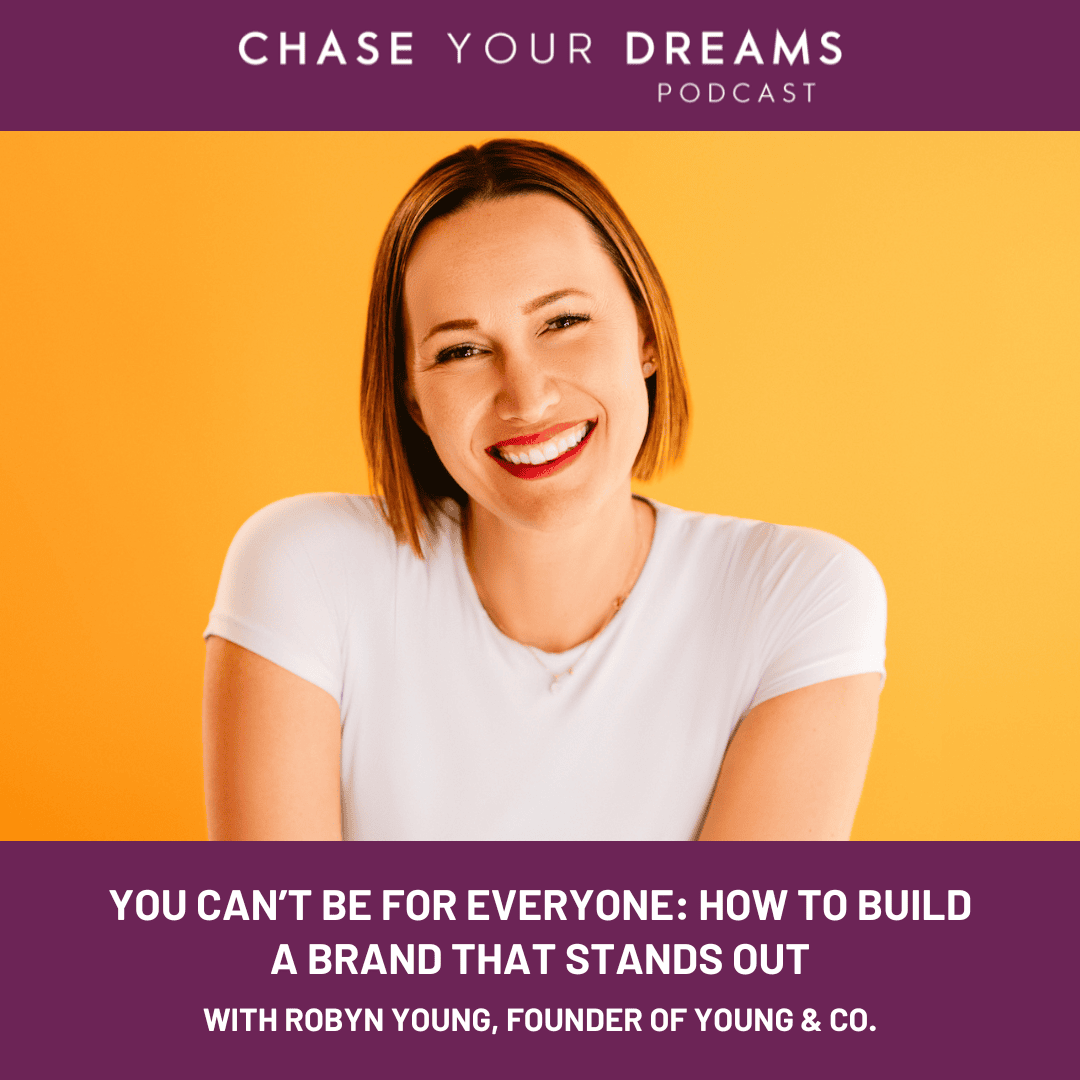
Discover what it truly takes to build a meaningful, lasting brand beyond surface-level marketing. Robyn Young explains that strong brands are rooted in a clear point of view and a deep understanding of their audience’s mindset, not just demographics or aesthetics. She introduces the concept of a “brand universe,” where every touchpoint works together to create a cohesive and memorable experience, and emphasizes that differentiation comes from ideas, not just visuals. The conversation also highlights the dangers of chasing short-term growth and vanity metrics, encouraging founders to focus instead on long-term brand resilience, loyalty, and trust. Ultimately, the episode reinforces that successful brands are built with clarity, conviction, and the discipline to stay focused on a distinct vision, even when it means not appealing to everyone.
About Robyn Young
Robyn Young is a brand strategist, author, and founder of Young & Co., a strategy studio dedicated to helping independent brands move beyond surface-level marketing to build what she calls “brand universes”: layered, immersive brand identities that foster recognition, trust, and long-term loyalty. Over the past decade, she has launched or relaunched more than a hundred brands, working with companies across all stages of growth, from emerging category leaders to established businesses undergoing major reinvention. Robyn’s work centers on helping founders articulate a clear point of view, strengthen brand resilience, and create businesses designed for lasting relevance rather than short-term hype. She is also the author of Build Your Brand Universe, a number one Amazon hot new release, and a sought-after speaker on brand strategy, positioning, and standing out in competitive markets.
Contact Info
Website: http://thisisyoung.co
Instagram: @robynyoung.co
TikTok: @robynyoung.co
Linkedin: https://www.linkedin.com/in/robyn-young/
Takeaways
- Build your brand around a clear point of view, not just a visually-polished aesthetic.
- Don’t try to appeal to everyone since specificity is what makes a brand memorable in crowded markets.
- Speak to your audience’s mindset and beliefs, not just their demographics.
- Create a cohesive brand universe where every touchpoint reinforces the same core idea.
- Avoid chasing vanity metrics and prioritize trust, loyalty, and word of mouth instead.
- Use brand strategy as a compass to guide decisions even in the early stages.
- Think long term and build for relevance rather than short term hype or quick wins.
Interview Themes
What is a brand and why does it matter?
A brand is not your logo, colors, or social media feed. It’s the perception people form when they interact with your business. While branding elements help shape that perception, the brand itself lives in the mind of your audience. This means founders must think beyond visuals and focus on the impression they want to leave behind.
Why shouldn’t brands rely on aesthetics to stand out?
A strong visual identity can attract attention, but it’s not enough to stay competitive against market competitors. Aesthetics are easy to replicate, making it difficult for brands to stand out long-term. To actually differentiate your business from others, focus on identifying a deep idea or point of view, with visuals serving as a reflection of that idea.
Why should founders focus on mindset instead of demographics?
Demographics tell you who your audience is on paper, but psychographics reveal how they think, what they value, and what they believe. Brands that connect on this deeper level with their audience are more likely to develop customer loyalty because they resonate with how people see themselves.
What is a “brand universe” and why does it matter?
A brand universe is a cohesive ecosystem where every touchpoint—content, messaging, visuals, partnerships—works together under one central idea. Instead of disjointed marketing efforts, everything reinforces the same core belief, creating a more immersive and recognizable experience for the audience.
What is “shallow growth” and why should you avoid it?
Shallow growth focuses on vanity metrics like follower count, quick wins, or viral moments that don’t translate into real loyalty. While these can create temporary spikes, they don’t build lasting brand equity. Sustainable brands prioritize trust, repeat customers, and word-of-mouth over short-term attention.
When should you start thinking about brand strategy?
Brand strategy isn’t just for later stages. It can act as a compass from the very beginning. Even if you’re still testing your product, having a clear direction helps guide decisions, align your messaging, and ensure consistency as you grow.
What does it take to build a brand people trust and return to?
It comes down to clarity and conviction. You need to clearly understand and articulate your point of view, and you need the conviction to stand by it over time. When your internal beliefs align with your external actions, you create a brand that feels authentic, consistent, and worth coming back to.
Transcript
Robyn Young
I think the key is really you cannot be for everyone. Like of all the things that I could say right now, I think that's the one that is the hardest for people to grasp. It's the one thing that I really hope that people can kind of get through their mind is that in the moment, when you start to lean into a psychographic mindset of a customer base that you want to attract, it can feel very uncomfortable because you know that you're dividing the room in a way. You're saying, okay, we're automatically not going to be for these people who relate to these things over here. But what it really does is if you can get past that discomfort, it opens up all of this potential for then how to treat your brand in a very distinct way that then makes it sticky, memorable, something that creates that loyalty that really speaks to people.
Glynis Tao
Welcome to Chase Your Dreams, a podcast for fashion entrepreneurs who want to build a purposeful and profitable clothing business so they can make a living doing what they love. I'm your host, Glynis Tao, an apparel business consultant and SEO specialist with 20 years apparel industry experience. I'm also a mom to a wonderfully energetic little boy named Chase.
Today's guest is Robyn Young, a brand strategist, author, and founder of Young & Co., a strategy studio that helps independent brands move beyond surface level marketing and build what she calls brand universes. These are layered brand worlds that people recognize, trust, and return to over time. Over the past decade, Robyn has helped launch or relaunch more than a hundred brands. She has worked with companies at every stage of growth from emerging category leaders to neutral and very sharp to establish enterprises navigating major reinvention. Her work focuses on helping founders clarify their point of view, build brand resilience and create businesses designed for long-term relevance rather than short-term hype. She's also the author of the book, Build Your Brand Universe, which became a number one Amazon hot new release. In addition, she is a frequent speaker on brand strategy, positioning, and what it really takes to stand out in crowded markets.
In today's conversation, we talk about why aesthetic alone is not a strategy, how founders can avoid what Robyn calls shallow scale, and why understanding your audience's mindset, not just the demographics, is one of the most powerful ways to build a brand people genuinely connect with. If you're building a fashion, lifestyle or impact brand and want to create something that lasts, this episode will give you a lot to think about.
Robyn, welcome to the Chase Your Dreams podcast.
Robyn Young
Thank you.
Glynis Tao
I'm so excited to have this conversation with you because so many founders listening are working hard to build brands that actually mean something, not just brands that chase the next trend, and your work around brand universes and long-term brand resilience speaks directly to that. So to start us off, I'd love to go back to the beginning of your journey.
Robyn Young
Yeah. I'm like, where to begin? I mean, it's hard to compartmentalize. I've been working in different facets of branding and marketing for much longer than I've had Young & Co. My business, Young & Co., I've had it for 10 years now. It'll be 10 years in October. Prior to that, we had worked with companies like UCLA and their branding and marketing department. I had worked in digital media, I had worked in fashion, I had worked in traditional media, so I have a lot of breadth in the development of brands at different facets—everything from market research to marketing campaigns to actual identity development. And it really gave me a very well-rounded knowledge of how to do this, not only in different size companies, but in different categories. What I found, and I really only became interested in brand strategy at the beginning of my business because I had already worked in sort of the creative execution and the production of brands, but I really only became interested in, you know, what actually makes an identity at the beginning of my business. And since then, you know, the more I learn, the more I realize there's more to know, which is why I feel like what I wanted to bring to my book is this deeper understanding. I feel like a lot of brand strategy books, they're very high on theory and not very suitable to somebody who's just starting out, who doesn't really know the terminology or the structure of building a brand identity. So I wanted to create something that made sense for them. So at the very beginning, it was a lot of like figuring it out as I went.
I left my very cushy tech job to start this business while I was two months pregnant, by the way. Not an ideal time, by the way, to be starting a business. And I certainly wouldn't necessarily recommend that for people. Like, don't start the way that I did, which was no clients, no money, no idea how to get either of those. It creates a very stressful environment for you. But it worked out for me because within four years I was already making multiple six figures. And I think the part that really resonated for me in a way was that when we approached the brand, we didn't just see it as creating matching luggage. What I like to call matching luggage is just like a shallow aesthetic. We really tried to get into the depths of what makes this interesting? What is the bigger idea that sits at the center of this that makes it something that people would feel loyal to? And as I started to shape that out and more importantly, developed a framework for building that, that's when I, in the last year, that's when I, well, to be fair, 2024 is when I started writing the book and then Build Your Brand Universe launched in January 2025. So that's really when I started to refine and create some ownership and IP around that process. So it's been a wild ride, to say the least.
Glynis Tao
I'm sure it has. And your book is called Build Your Brand Universe. What does a brand universe actually mean? And how is that different from simply having a brand identity?
Robyn Young
That’s such a good question. I love this. So a brand identity, let's start there. So I think a lot of people conflate brand with the things that we use to try and drive what a brand actually is. Okay. So a brand is an impression or a perception that someone has when they're interacting with your business or you or your product, whatever you're selling, right? What is it? What's that gut feeling that they get? That's what your brand actually is. Okay, so brand is the noun. It is something that theoretically isn't in your control because it's what they think it is, not what you say it is. So branding is then everything that you use to drive that perception, like your visual identity, like your vocal identity, your content, your marketing message, all of that. That's branding because you're using it as a vehicle to help you drive that perception.
Now, your point of view, what I talk about as brand strategist, your point of view is the thing that makes it distinct and memorable and ownable. So it's a bigger story that sits at the center. Okay. Once you have those things, you have an understanding of those things, then you can start to think about building your own brand world. That is, it doesn't even necessarily need to be a physical world. I see lots of brands that are actually building a sort of tangible world in the platforms that they have online or through different touch points. But it's a distinct vibe that you get, not just because of an aesthetic, but because of a bigger point of view or idea that makes it sticky, that makes it memorable, that allows people to recognize it. So, that's what your brand universe is. It's not just stringing together touch points that don't have anything to do with one another. It's something that has a very clear and different center of gravity to it. And then everything that you create from that is in service of that. The idea behind a brand universe is it's like a connected brand ecosystem, wherein everything kind of feeds each other because it all has that center of gravity in common. Does that make sense?
Glynis Tao
Yes. Now, could you give us an example of say, maybe someone you've worked with or a brand who is doing it really well, who has built a brand universe?
Robyn Young
Yes, absolutely. Oh my gosh, there's so many to imagine. I mean, in every category, you probably have somebody that is playing really well into brands. So like if I'm taking the water category, Liquid Death has a brand world. They have a rich textured world with multiple touch points that all come back to the same personality and point of view, which is death to plastic. Liquid Death was smart in that they recognized early on that their product wasn't innately different. It was water. Water in a can. This company's worth a billion dollars now, like genius, right? What made it different is that rather than spending their marketing dollars talking about how metal was infinitely recyclable, they put all of their investment and time and energy into building a brand that was a representation of heavy metal. So that's the personality trait, like why it's relevant to where they're actually positioned. And then yes, they were able to catch some early waves that really cultivated that difference, such as, you know, the non-alcoholic movement made it really useful for them to then have their products within bars, let's say. But they leveraged a visual language and a vocal identity to then shape wherever they showed up at any touch point, it created something that people were engaged with, that they could recognize and that they could interact with. So that's what I mean when I say there's this ecosystem there, right? And I think too often when people are just thinking about the aesthetic or a surface level vibe, it's much easier to copy. It's much easier for somebody to come in and create something that feels very similar, and then it's not as sticky. It doesn't create that same kind of traction. So when you're too focused on joining a platform and you're too in the weeds on just getting the traction on just that platform, what that does is it waters down your own brand and your own personality, your own identity. So it doesn't allow you to create the kind of, you know, traction that you want for your own brand.
Glynis Tao
From your perspective, what separates the brands that become truly memorable from those that struggle to stand out?
Robyn Young
Good question. I think that first of all, you cannot be a brand for everyone. And I think that people are starting to understand that because we're hearing a lot of like, you need to know your niche and know your audience. I feel like this is language that in theory people have heard, but what's funny is when they go to actually establish a content strategy, their marketing strategy, their marketing message, what they put forward is what I call a platitude. So it's all dialed into what their product features and benefits are or what their tech stack is. It dials up on the product. There's no point of view there because the very nature of a point of view is that people have to disagree with it. There needs to be somebody who would disagree with it. If it's not something that people disagree with, it's not a point of view. So it's not really something that is ownable for you. It's not really something you build an identity around. So starting with something that speaks to not a demographic, but speaks to a mindset, a psychographic, that's where you can really lay the foundation that then leads to brand loyalty. It's the more that you are willing to sacrifice one audience in service of another. That's what creates something that's more memorable. And it's very hard to do. It's not easy because you have to be willing to accept that you're not going to be for everyone. And that's not an easy route, especially for a brand that's just starting out. Knowing that you're going to alienate some people is very hard to do in practice.
Glynis Tao
Yeah, and speaking of just starting out, so many founders focus heavily on product development or marketing tactics early on. At which point should they start seriously about brand strategy?
Robyn Young
You know, that's a good question that has been asked so many times. And of course, the maddening answer I'm going to give is it depends. It depends because if you are, let's say, a solopreneur just starting out, you don't really know much about your audience, you don't really know much about your category, listen. A brand strategy is never going to be a bad thing to have because it aligns your ultimate goal with what you're saying in the moment, what you're trying to build in the moment. So you could see it as not exactly a plan. It's more of like a North star, a compass, right? So I find that even early on, it can be very helpful for figuring out what is in and out of bounds as you're laying that initial foundation for how your brand is showing up. Because here's the thing—you're never going to get a second chance at that first impression.
Now, that said, there's a lot to be said about getting an MVP, testing the market with your actual product and seeing if it's something that people even want. Learning the ropes a little bit, figuring out what's the cultural cadence when it comes to my world? Like what are people really interested in? Sometimes, those things just take time. They take time for you to understand. So I do think that there's something to be said about, you know, making sure that you have a solid business strategy first, because your business strategy and your brand strategy, they should align. So if you have no clue what your business is going to be, it makes it harder for you to then build a sound brand strategy. Even though your brand strategy is about the point of view beyond what you're selling, it should still align with what you're offering. You should see the offer as basically being like the punchline rather than the headline because if you go out there leading with, we've got a sustainable fashion brand, first of all, you're going to fall on deaf ears. There's nothing about that that gives you any competitive edge. But it's also just like you're only capturing somebody who might be looking for that specific thing at that time. The data tells us that's about 2% of the market in any category. People who are looking for what you're doing right now, it's 2 to 5%. So everybody that's product-first, you're squabbling over 2 to 5%. Rather than there's a fraction of the market that isn't looking right now, but they might be in the next 12 to 18 months or shorter.
So the name of the game is, how do you create an ecosystem in which you can engage these people until they're ready to buy from you? So it's that same idea of staying top of mind, but rather than trying to do it by constantly demanding their attention, which as we know, gets very noisy, it's instead creating these thoughtful platforms and touch points that double down on that point of view so that that way they can engage with you and then eventually buy from you. Or in some cases, it might be referring people to you. It just sort of changes the way in which we think about shaping that part, if that makes sense.
Glynis Tao
And so I think this moves us into the conversation about why aesthetic isn't a strategy. One of the ideas you talk about is that vibes and brand aesthetic are not the same thing as strategy. I think this is something a lot of founders struggle with, especially in fashion and lifestyle, where visual identity is so important. Can you explain what you mean by that?
Robyn Young
Yes. And listen, I spent many years as a fashion stylist. In fact, when I first moved to LA, that's where I started. I wanted to be a stylist and I worked within the commercial and editorial space and nobody loves a great aesthetic vibe like me. But that said, it's not going to give you a competitive edge. So it's not quite as simple as just, we need an original aesthetic or we need a vibe. That's all well and fine, but then somebody else could come in and mimic that and there's really nothing to say they're going to choose you versus this person. You're always going to get into that same trap. There's really no room for you to have conviction into something deeper. Plus, I think that the consumer base is becoming much more savvy. They care about more than just a vibe, right? That doesn't mean don't have a strong aesthetic. You're in fashion, of course, like this is something that's going to be pertinent, but the key is to establish what makes you interesting, what makes you different and then let the aesthetic be led by that. So it's kind of flipping it on its head. Whereas it used to be emphasized to create the visual identity and let the consumer base decide or tell you who you are in relation to other brands. Now that's just not, it's not sort of building strategically anymore. Instead, figure out what the category needs not just at a product or functional level, but figure out at an emotional level, at a highest order benefit level and then build your brand around that everything from the vibe that aesthetic the visual identity the name, you know. I mean down to your retail environment and you know your packaging. All of that should be in service of what is that impression that we want to give? What is that, you know, bigger reputation we want to build? So if you're thinking long term, if you want to build something that actually creates that loyalty, you have to be zooming out, see the bigger picture, not just be thinking about, how do I survive today?
Glynis Tao
I think what you're saying is to look deeper beyond surface level. Why do you think so many early stage brands rely heavily on the aesthetic instead of developing a clear brand point of view?
Robyn Young
Because this isn't information that is widely communicated, to be honest. It's funny because corporations, the Fortune 100 companies that I've worked with, they know this. They know this and they use this widely, right? But at an entrepreneurial level, a brand point of view is not a tangible thing. So everybody starts a company knowing you know, I need a logo, I need a website. Like, these are tangible assets that we know we need. And I think sometimes people, founders especially, can think, I have a clear idea of what my point of view is, and that might be true. In some cases, I work with founders and they do have a clear point of view, but the problem is that it isn't being articulated. It's either not being articulated in their message, it's not being articulated in their content, in their ads, in their website. So just having a point of view is only one side of the coin.
The other side of the coin is how well you amplify it so that it actually drives that perception. That's the hard part about brand is like, it's a complicated game of telephone. I have something I want to say. Starting at place A is you need to have something to say. You'd be surprised how many founders just want to create a business just to line their pockets and listen, like, I get it, but that's never going to motivate anybody but you. Not going to motivate your team, not going to motivate your customers, not going to create any kind of loyalty. So the idea is creating something interesting to say and then saying it, but saying it with your whole chest with everything that you do. That's the game.
Glynis Tao
All of it is ingrained in everything that you go beyond all the visual aesthetics. I mean, can you give us an example of apparel brands, a fashion brand that is doing really well? I'm sure the ones who have been around a long time, right?
Robyn Young
Yes.
Glynis Tao
Does it necessarily need to be? Those legacy brands?
Robyn Young
Yes and no. It doesn't necessarily need to be. I'm going to give you three examples because I want to show how this works regardless of vibe, the aesthetic, right? So probably the most familiar, Patagonia. Like, listen, I don't personally own anything Patagonia, but I could tell you everything about this brand. So it started very naturally, very organically, and the founder has such a compelling story about actually building within this climbing world. I think that that naturally lends itself to what was most important to Patagonia, but the point is it started as something that was such a small need, but a very established point of view about the world. So not just fashion, but about the world and what we should be focused on. And now today, many, many, many years later, they still put that at the forefront of decisions that they make, not just at a marketing level, not just at an aesthetic level, but at a business level. That's phenomenal. It's probably one of the best examples. Obviously, they have this social impact component to their point of view, but I think what's important is for people to understand you don't necessarily have to be a social impact brand in order to have a strong brand point of view.
So the other one that I use today in a talk that I gave is Jacquemus. Are you familiar with Jacquemus, that fashion brand? very, it's a very French name, but it's spelt like J-A-C-Q-U-E-M-U-S.
Glynis Tao
Okay, I think I've seen this around.
Robyn Young
Yep. It's Jacquemus.
Glynis Tao
Yeah, I thought it was Jackamoose or something. I wasn't seeing it. I was totally saying it wrong.
Robyn Young
I had been saying it wrong for but they only recently sort of appeared on my radar. And I found what was so interesting about this brand is they've captured this sort of almost ironic point of view about luxury fashion as a luxury brand. So a lot of times they're poking fun at luxury and the tropes of luxury fashion as a luxury fashion brand, which is kind of amazing when you think about it. And that whimsical dreamlike kind of aesthetic really lends itself to that point of view. So this is a brand where it's worked for them to have that different perspective. They've brought an element of humor and irony to a category that if you think about it, was relatively stuffy—a little too into itself. And what's interesting about that is it opened it up to engage with people who may not otherwise have cared much about luxury fashion.
So, we're now talking about a brand that leveraged that same point of view and baked it into even their events, their PR stunts. I'm sure you saw this, I talked about it today. It was an AI-generated video, these big purses driving through Paris. I don't know if you're on TikTok much, but in 2023, this was like a funny video that they released that, yeah, of course people knew this can't be real, but it went absolutely nutty viral—like 2 million views on TikTok. So what was interesting about this brand is that they actually created real reproductions of these huge bags and drove them through the streets of Paris as a PR stunt. Again, it’s a personality, but again, it's not just about a personality—it's a personality with some meaning behind it. It's capturing what is lacking within the category and it has nothing to do with social impact. So you can have a point of view that is still very distinctly you that gives you that competitive edge and then use your aesthetics, your content, your marketing, your stunts to be in service of that. Right. So that's another example.
And the one that I see that is somewhat emerging that I've been keeping my eye on is Late Checkout. Are you familiar with Late Checkout?
Glynis Tao
No.
Robyn Young
Okay, I'm fascinated obviously with this category having worked six years in fashion. So I always like to kind of keep my finger on the pulse of like, who's doing what. Late Checkout was created by these para founders who would travel around the world, but they always kind of felt a little like they had just missed the mark. So when they were staying at hotels, it was like they were always just a bit late for the breakfast buffet or just a little far behind in the happy hour. What they saw in that was this crossover between the mindset of somebody who feels like they're running on their own time. So what I like about that is that's a great representation noticing a mindset of a customer base and then shaping your brand around that. So in the very name, Late Checkout, they're speaking to this audience that does take a more relaxed approach to things. And they have, again, an aesthetic that lends itself to that. So they aren't led by trends really. I mean, they have their own sort of visual language and honestly, talk about a brand world, when you go to their site, you'll actually see that their collections are named after characters. Within the site itself, the way that the tone reads is as if you are visiting a hotel and the hotel is very uniquely their hotel. So they're using a story to create something that feels different than just your standard e-commerce shop.
So it's a perfect representation of like, how do you create something that feels distinct, that's enjoyable for somebody to engage with, that actually makes them feel like I'm entering into a world rather than just I'm visiting their site, right? And I will tell you, they are technologically savvy about their site. They're really using very, you know, simple things to do this. I mean, you'd be surprised how much just a great tone of voice of your copy and some original photography and the idea of, you know, using this hotel reference can go such a long way. That's what I love about them as a brand. You know, we're not talking about a brand that has billions of dollars to spend because yeah, I have very different expectations from a brand like that. We're talking about a brand that hasn't been around that long in comparison and is still utilizing this strategy. It's fascinating to me. Yes, yes, Late Checkout. I think now that I've mentioned it to you, you're going to start seeing them because they do a lot of brand collaborations too, which I think is very smart. Again, when you have an emerging brand, who you partner with, other brands that you partner with, other influencers you partner with, that should also be in service of what you want to drive this brand point of like a filter and a lens in which you can look at everything with your business and determine what are the things that we say yes to that are going to be in service of that bigger vision that we have and what are the things that, equally important, we say no to, even if they feel like great opportunities, if they're off-brand long-term, they're probably doing more damage than they are good.
Glynis Tao
So let's talk about building brand resilience versus chasing growth. Today, there's so much pressure on founders to grow quickly, scale fast, raise funding, go viral. How do you help brands focus on long-term resilience instead of short-term growth tactics?
Robyn Young
That’s such a good one. So first of all, in the way that we approach brands, it's not tactic focused—it's not formulaic. And that often does mean that you can have short-term you're keeping your eye on the long-term prize. So while I'm not here to criticize anyone for seeking out funding, you got to do what you got to do.
What I'm noticing is that in this time where money is expensive, there isn't as much funding going around, especially in the last couple of years, that's been true. Especially if you're not in an AI related field, that's very true too. What I'm noticing is that there is this group of fiercely independent brands that are finding ways to bootstrap, to raise friends and family money, to generate sales and revenue on their own, to grow slower rather than just focus on that unicorn scale. And I think that it's very, I think it's very astute because what you do is you maintain ownership, which means that you have the opportunity to really say yes and no. Because the moment that you start giving ownership away, you start losing that a lot of times, VCs aren't as… not all VCs, obviously. You can find some that understand the vision and what you're trying to accomplish, and maybe they buy into that. That's true for angel investors too. So it's not everyone, but a lot of times they're going to cut the magic. They're going to cut all the things that don't serve the bottom line, right? But that's not what creates a great brand. And if you ask anybody who has created a great brand, they will tell you the same thing, that you can't always be led by just services and the profit margin. So I think that how we approach brand building in general is how do we shape and let the point of view that we're trying to build the impression, that perception, around the brand? How do we let that be the filter and the lens that leads these decisions? And it's not just at a marketing level, it's at a product level, it's at a service level. It's within your own culture if you have a team. It could even be within the behaviors and actions of how the business gets represented, let's say within a pitch. Even if you're having a call with VCs or with angel investors, you want to bring that perspective to that conversation because that's something you want to make sure that they're on board with, that they get, they understand.
So we really prepare our clients to make those decisions and start acting in a way that helps them to keep that at the forefront because it is so noisy out there. It's so easy to become distracted by things like algorithms and somebody's best kept secret formula, their proven frameworks, whatever. The virality of these approaches is really creating an environment in which people are only concerned with the short term, and unfortunately, that's become what I like to call the shallow part of the pool. It is the most busy space. So it's also the most expensive space for you to try and stand out in. Whereas if you take that time to do the deep work and you make your investment of your time, of your resources in service of that very specific, clear cut message and perception you want to drive, you naturally remove things from the table that don't make sense for that. So it can actually be a great efficiency tool if you know how to use it.
Glynis Tao
You talk about helping brands resist shallow growth. What does shallow growth look like in practice and why do so many brands fall into that trap?
Robyn Young
I think the most common trap I see is follower like, listen, the jig is up. You can buy followers. Does that mean that you have any more loyalty than you started with? No, it doesn't. Right. I think that, again, people I think are starting to wake up to that, but innately they still tend to think in terms of vanity metrics, right? What I tend to be more focused on is not just a single sale. I mean, good, like it's great. You need those initial sales. You need a trial, right? But you haven't really gained loyalty until you get to the point where somebody trusts you, trusts your brand enough to start referring to it. That word of mouth that happens organically, that's when you've really started to build that brand equity. So if you make that part of the metrics that you use, it will serve you a lot better than those vanity metrics will. And again, I think for people who are really just looking for that easy funding opportunity because they secretly want to just be acquired and exit. They're not going to take the time to do this. But for that fiercely independent founder who I know is out there listening to this, the person who genuinely wants this to be part of their legacy, who wants to create something genuinely special that reaches out and touches their audience and creates that kind of loyalty. That's what this track is for. That's who I'm for. That's who I want to build alongside. And I mean, it's great working with those kinds of founders because they get it. They just understand. They're not working with this ridiculous timeline and letting things that ultimately just look like shallow growth that are just those vanity metrics. They're not letting that lead them. And frankly, as we start to see more content, more businesses, more brands in every category because the good part about AI is it's never been easier to start a brand. The hard part about AI is also it's never been easier to start a brand. So it's also that much harder, that much noisier. It's only going to get worse. So this isn't about becoming more noisy. It's not about trying to capture more attention. It is about becoming much more strategic, much more focused, much more honed in on exactly who your audience is and how do you offer something to them? Again, not at a product level, at an emotional level, at a highest order benefit level. How do you offer something to them that they can't get from their other competitors? That's the real question you should be asking.
Glynis Tao
Yeah, and so what I'm getting from this conversation and what you're saying is like, I think this is like the foundational work, the deep work that is needed in order upon. And so if you're not clear on the audience, your unique differentiator point of view, then if you try to grow and get funding and like you being influenced by all these different people that have their own say perspective, then you're going to be easily swayed. That in return could derail you from what your original goal was when you started this brand. And that's kind of how friends can start like they've lost their compass, right? What they set out to do from the original founder and I kind of see this happening with Lululemon right now.
Robyn Young
Yes. I think that we tend to romanticize these well-known CEOs, brand builders as being so visionary, and what's so funny is that I don't love that because it makes it seem like they're superhuman in a way. I promise you all that they really have is a very clear idea—a very clear vision for exactly what that point of view is, what shapes those decisions, what makes that different, what is that competitive edge that they have? And then they have discipline in spades. I mean, they just have the discipline to say no to things that aren't in service of that. That's really all it is. The good news is you can hack that. You can do that. You can be the same as these people, but you have to take the time to do that deep thinking.
My book is very much a guide in starting to think in that direction. And I find that, especially for a founder who already thinks they have an idea of what their point of view might be, that might be the single piece that they need to just bring it the rest of the way so that they can articulate it well. But I launched an accelerator this past year because what I found was people that were reading the book were like, I don't know if I have it or not, because again, it's not this tangible piece.
Your point of view is strongest when you have clarity and conviction. So clarity means you can, not only can you speak to it well, but you can recognize it when other people are talking about your point of view out in the world. And you know how to leverage it to join in on that conversation. Those are sort of the key metrics we use for do you have clarity on it? On the conviction side, that is much more personal. It is really like, is this the hill you want to die on? Is this the thing that you would spend years talking about? Is this the thing that you feel you are uniquely capable to say? So it's a combination of those two things really. It's just, mostly it's just aligning your insides with your outsides, right? It's aligning like, what do you care most about whether it's at a category level or at a worldview level? And how do you align your business's actions and behaviors with those values, right? I don't think there's any reason that anybody couldn't do this, but some people just need more help and guidance. And that's the role that I love to play. I'm like the Sherpa. We are going to climb this mountain together. You're going to climb it with me though. I'm not climbing it on your behalf because that would be a lack of conviction. Like if you can't even climb the mountain with me, then you don't get to say it's your mountain. You feel me? It's not your climb unless you're there climbing it with me. But the thing is, I'm there because I'm like, I've got the tools. I've done this a million times. I've got the, you know, the wherewithal. I've already been at these different levels without that oxygen, so I know what that takes. I know how to keep you moving in that right direction. But for everybody, the path is a little different. So it needs that heavy customization. And frankly, I find that work so exciting. It lights me up inside. But for founders, it can feel a little bit like therapy.
Glynis Tao
Mm-hmm. That's right. Yeah. I know because building a brand identity can be tough and could change. So it's really hard to kind of stick with one. I think a lot of people have a tough time trying to just to choose one or like, do they have to necessarily, you know, choose one and stick with that one or can it change?
Robyn Young
Yeah. Great question. So one of the things that I do, let's say in the initial conversation that I have with a client, first of all, I will start by getting some insight into their world. Part one, it's just figuring out who are the players, how are they positioning themselves, what's going on within the space, what are the customers saying, what's the chatter happening? So I get that context. And then I'll start to shape some initial territories, which is what I call them. And this is always a question that comes up, like, what do I think is the most likely one to be successful? And I always laugh a little bit because I'm like, the one that's going to be successful is the one you're most willing to fight for. That's the honest truth because every single one of these ideas can be strong—can be successful. But the X factor there is your willingness to have the discipline to see it through. And that is so much harder. There's no formula for that. There's no tactics for that. It is just your willingness as the founder to keep pushing in that direction and to keep kind of flipping it over and turning it over until it finally snaps, right? Until it finally all clicks.
I find that though being a partner with founders who are on that journey, it's important to have somebody who helps you not get distracted or not see that shiny object and be like, whoa, whoa, whoa, if we're going to go in that direction, it needs to fit this. How does it fit this? And if it doesn't fit this, is it that this needs to change because sometimes that's the case. You could be a brand that has a really strong positioning for a while. Olipop is a perfect example of that. They had a strong brand positioning for a very long time, but then Poppi came in with a different kind of positioning and completely killed the market. Olipop's still in the game, but I think they tried too hard to ride the wave of just being this sort of probiotic option within a world, a category that was all about chemical-based ingredients. And it didn't work for as long as they thought it might. And what they really needed to do was recognize that they needed to continue to evolve that positioning, that it wasn't always going to be exactly this. So it's not quite as simple as you create it once and then set it and forget it. You kind of have to be a steward for your brand permanently.
Glynis Tao
Wow, I could keep going. This has been such a thoughtful conversation about what it really takes to build a brand that people return to and advocate for over time. But before we wrap up, I'd love to ask you one final question. If someone listening wants to build a brand people truly recognize, trust and return to, what is the one principle you hope they remember from this conversation?
Robyn Young
I think the key is really you cannot be for everyone. Like of all the things that I could say right now, I think that's the one that is the hardest for people to grasp. It's the one thing that I really hope that people can kind of get through their mind is that in the moment, the moment when you start to lean into a psychographic mindset of a customer base that you want to attract, it can feel very uncomfortable because you know that you're dividing the room in a way. You're saying, okay, we're automatically not going to be for these people who relate to these things over here. But what it really does is if you can get past that discomfort, it opens up all of this potential for then how to treat your brand in a very distinct way that then makes it sticky, memorable, something that creates that loyalty that really speaks to people. Because I think what you kind of have to imagine is right now in pretty much every category, there's more room for you to find what's not already being served there. Again, not at a functional level, but at an emotional level, just like Liquid Death. Nobody was asking for another water brand. Nobody asked. If you asked 20 people, do we need another water brand? They would have said, no. For what purpose? But they recognized that within the category, there was just so much same-same. There were so many brands that were just playing right into the same audience that opening it up to a new mindset, a new audience is what made that opportunity killer, right? And now they've found additional categories to really lean into in that same spirit. And it's something that of course still takes some trial, but if you start out that strong and that strategic, I mean, it just creates the environment in which you can thrive and you can really call the shots and it's not about, you know, this platform is better than that platform. You are the platform and your social channels are just distribution channels for you. That's the goal. It just takes time.
Glynis Tao
Amazing. Where can people find you if they want to get in touch with you?
Robyn Young
Yes. My site is the best place to get in touch if you are wanting to work with me. If you are somebody who is interested in doing this inside of an accelerator. If you're like, I need to develop my brand point of view, I need to understand my identity deeper than just that shallow aesthetic, I need to understand what really makes me unique, I would recommend my accelerator. So I run this four times per year. My next cohort will be May 1st. You have to apply for it. That said, I accept 10 founders per quarter. So I highly recommend anyone that's interested in going to that link. It's thisisyoung.co/accelerator. And if you're somebody who's like, I'm genuinely interested in this, but I'm not ready to pull the trigger just yet, I totally get it. I would say my book is a fantastic place to start. I've had people write in telling me they've already read it two, three times which is phenomenal to me because it means that this is a point of view that people just haven't really seen out there. It's just, it's not information that we've really seen or that's been available. that can, you can find the links to purchase the book at thisisyoung.co/book.
Glynis Tao
That book is called Build Your Brand Universe?
Robyn Young
Yes, it's also available on Amazon too, so if you want to search for it, yeah. Great.
Glynis Tao
And you're on social, obviously.
Robyn Young
Of course, yes. I'm @robynyoung.co. The channels I'm most active on are TikTok and Instagram. And then I also have a Substack. If you go to my website, you can actually find the link to join the Substack. It's called Yes and Newsletter. I write on it twice per month and I always include insights, inspiration and ideas for brands that want to take that very innovative approach and build their own brand ecosystem. So really useful free guides there for you if you want to know more about this.
Glynis Tao
Love it. Robyn, thank you so much for joining me today and sharing your perspective on what it really takes to build a brand with depth and staying power.
Robyn Young
Thanks for having me.